
- About the Journal
- Editorial Board
- Review Process
- Author Guidelines
- Article Processing Charges
- Special Issues
- Current Issue
- Past Issue
 Contributions to Modern and Applied Physics
Contributions to Modern and Applied Physics Volume 1 (2024), Article ID: CMAP-102
https://doi.org/10.33790/cmap1100102Commentary Article
Resolving the Proton Radius Puzzle
F. C. Hoh
Retired, Dragarbrunnsg. 55C, 75320, Uppsala, Sweden.
Corresponding Author Details: F. C. Hoh, Retired, Dragarbrunnsg. 55C, 75320, Uppsala, Sweden.
Received date: 03rd June, 2024
Accepted date: 11th June, 2024
Published date: 13th June, 2024
Citation: Hoh, F. C., (2024). Resolving the Proton Radius Puzzle. Contrib Mod Appl Phys 1(1):102.
Copyright: ©2024, This is an open-access article distributed under the terms of the Creative Commons Attribution License 4.0, which permits unrestricted use, distribution, and reproduction in any medium, provided the original author and source are credited.Creative Commons Attribution License, which permits unrestricted use, distribution, and reproduction in any medium, provided the original author and source are credited
Abstract
The “proton radius puzzle”, implicitly resolved earlier, is explicitly resolved in the Scalar Strong Interaction Hadron Theory SSI. Its origin lies in that quarks, hence also the interquark distance, are invisible. The strong interaction depends only upon the distances between the u and d quarks. Such a mean distance is 3.05 fm in proton. The proton is oval shaped, not observable in the laboratory space but polarizable in galactic gravitational fields giving rise to dark matter and energy.
The “proton radius puzzle” is an unanswered problem in physics relating to the size of the proton, according to Wikipedia (2024). Only the proton charge radius has been measured, not the strong interaction radius.
SSI explicitly respects the observation that quarks are invisible, Let the diquark uu be located at xI and quark d at xII and make the transformation
\(x^{\mu} = x_{\text{II}}^{\mu} - x_{I}^{\mu},\ X^{\mu} = \left( 1 - a_{m} \right)x_{I}^{\mu} + a_{m}x_{\text{II}}^{\mu}\) (1)
where am is a real constant. Conventionally, am=1/2 if uu and d have the same mass. Since xI and xII are invisible, these masses cannot be measured so that am is a free parameter. The proton laboratory coordinate X is observable but the relative coordinate x is a hidden variable.. “Hidden” variable has been proposed by Einstein, Podolsky and Rosen in 1935 and D. Bohm in 1952 in connection with quantum mechanics, well before the quark era from the 1960´s and the dominating role it plays in SSI [1].
In the Standard Model, a quark is basically described by Dirac´s wave functions. In SSI, these have been transformed into Weyl 2-spinors satisfying the manifestly Lorentz covariant van der Wareden equations, which reads, for the d quark denoted by B,
\(\partial_{\text{II}{ef}}\chi_{B}^{f}\left( x_{\text{II}} \right)- \text{iV}_{\text{SA}}\left( x_{\text{II}} \right)\psi_{\text {Be}}\left( x_{\text{II}} \right) = \text{im}_{\text {B}}\psi_{\text {Be}}\left( x_{\text{II}} \right)\)
\(\partial_{\text{II}}^{\text {de}}\psi_{\text {Be}}\left( x_{\text{II}} \right) - \text{iV}_{\text{SA}}\left( x_{\text{II}} \right)\chi_{B}^{d}\left( x_{\text{II}} \right) = \text{im}_{B}\chi_{B}^{d}\left( x_{\text{II}} \right)\)
\({\underline{\overline{\left\lceil \right\rceil}}}_{\text{II}}V_{\text{SA}}\left( x_{\text{II}} \right) = \frac{1}{2}g_{s}^{2}\left( \psi_{A}^{b}\left( x_{\text{II}} \right)\chi_{\text{Ab}}\left( x_{\text{II}} \right) + \psi_{A}^{b}\left( x_{\text{II}} \right)\chi_{\text {Ab}}\left( x_{\text{II}} \right) \right)\) (2)
and are 2-component quark wave functions. The undotted and dotted spinor indices b, d… run from 1 to 2. VSA denotes the scalar strong interaction potential experienced by quark B from the diquark A. mB denotes the d quark mass. There are two more sets of (2) for the u quarks. Multiply together the both sides of these three sets, generalize the product wave functions into non-separable proton wave functions and keep only terms containing these wave functions \(\chi_{\text {0b}}\) and \(\psi_{0}^{c}\) to obtain
\(\partial_{I}^{ab}\partial_{\text{II}}^{fe}\partial_{I}^{ef}\frac{1}{2}\chi_{0b}\left( x_{I},x_{\text{II}} \right) = - i\left( (m_{u} + \frac{m_{d}}{2})^{3} + \Phi_{b}\left( x_{I},x_{\text{II}} \right) \right)\psi_{0}^{a}\left( x_{I},x_{\text{II}} \right)\)
\(\partial_{Ibc}\partial_{\text{IIeh}}\partial_{Ihe}\frac{1}{2}\psi_{0}^{c}\left( x_{I},x_{\text{II}} \right) = - i\left( (m_{u} + \frac{m_{d}}{2})^{3} + \Phi_{b}\left( x_{I},x_{\text{II}} \right) \right)\chi_{0b}\left( x_{I},x_{\text{II}} \right)\) (3)
Carry out the transformation (1) and make the ansatz in separating X from x dependence.so that
\(\begin{matrix} \chi_{0b}\left( x_{I},x_{\text{II}} \right) = \chi_{0b}\left( \underline{x} \right)\text{exp}\left( - \text{iK}_{\mu}X^{\mu} + {i\omega}_{K}x^{0} \right) \\ \psi_{0}^{c}\left( x_{I},x_{\text{II}} \right) = \psi_{0}^{c}\left( \underline{x} \right)\text{exp}\left( - \text{iK}_{\mu}X^{\mu} + {i\omega}_{K}x^{0} \right) \\ \end{matrix}\) (4)
For rest frame proton, K=(E0, K), where E0 is the proton mass and K=0. Eqs. (1) and (4) introduce two new parameters am and the relative energy0. To preserve the proton identity, am = ½ +0/E0 must be satisfied. In rest frame, 0 =0, am = ½, \(\Phi_{b}\left( x_{I},x_{\text{II}} \right)\)=2VS3(r=x), VS=VSA=VSB, \(\Delta\Delta\Delta\Phi_{b}(r) = 0\), and
\(\Phi_{b}\left( \underline{x} \right) = \Phi_{\text{bc}}\left( \underline{x} \right) + \frac{d_{b}}{r} + d_{b0} + d_{b1}r + d_{b2}r^{2} + d_{b4}r^{4}\) (5) where the db‘s are integration constants. Eqs (3) and (4) show that \(\chi_{0b}\)and \(\psi_{0}^{c}\) depend only upon the hidden relative space x between the uu and d quarks and independent of the visible laboratory coordinate X. These wave functions have been decomposed into angular and radial parts characterized by f0(r) and g0(r) which have been evaluated by solving (3-5) numerically choosing the db constants in (5) such that requirements from neutron decay time and asymmetry coefficients A or B and convergence of f0 and g0 at large r, shown in the figure below, are met..
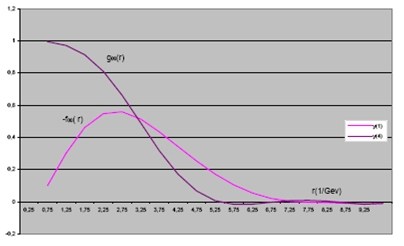
The mean distance between the uu and d quarks is in the hidden relative space of the proton is
\(r_{a} = \frac{\int_{}^{}{d{\underline{x}}^{3}r\left( \left( \chi_{0b}\left( \underline{x} \right) \right)^{*}\chi_{0b}\left( \underline{x} \right) + \left( \psi_{0}^{a}\left( \underline{x} \right) \right)^{}\psi_{0}^{a}\left( \underline{x} \right) \right)}}{\int_{}^{}{d{\underline{x}}^{3}\left( \left( \chi_{0b}\left( \underline{x} \right) \right)^{*}\chi_{0b}\left( \underline{x} \right) + \left( \psi_{0}^{a}\left( \underline{x} \right) \right)^{*}\psi_{0}^{a}\left( \underline{x} \right) \right)}} = \frac{\int_{}^{}{\text{drr}^{3}\left( g_{0}^{2}(r) + f_{0}^{2}(r) \right)}}{\int_{}^{}{\text{drr}^{2}\left( g_{0}^{2}(r) + f_{0}^{2}(r) \right)}} = 3\text{.}\text{05}\text{\ fm}\) (6)
The strong interaction region of the proton has been modeled to be a rod [2] and may possibly be cigar shaped in the invisible space x. These results hold also approximately for the neutron after ud.
The charges of the u and d quarks do not enter (6). Instead, they enter as Coulomb binding between the uu diquark and a neighboring neutrons’s dd diquark [2]. Nuclear force is thus of electrostatic nature, independent of the strong u-d interaction in the hidden space x inside a nucleon given above (5) which cannot be measured via electromagnetic and weak interactions which act in the visible laboratory space X. In addition to the strong force, the quarks can also interact with gravitation. The oval shaped proton in an hydrogen atom can be polarized by ambient gravitational which however is too weak to be measurable on earth but will give rise to dark matter and energy in galaxies [1 Ch 15-16]
The meanq-q distance in a ground state 0 meson corresponding to (6) is 4.7 fm and such meson spectra have been accounted for in [1 Ch3-5].
The above results, apart from the equations, are partly implicit in [1] and [2], made explicit here.
Conflicts of Interest:
The author declares there are no conflicts of interest.
References
Fang Chao Hoh, Scalar Strong Interaction Hadron Theory (2011), Scalar Strong Interaction Hadron Theory III (2022), Nova Science Publishers.
F. C. Hoh, “On u-d Quark Coulomb Origin of Nuclear Force”, Physical Science International Journal 28 (1): 1-15 Article no.PSIJ. 111106 open access at View