
- About the Journal
- Editorial Board
- Review Process
- Author Guidelines
- Article Processing Charges
- Special Issues
- Indexing
- Current Issue
- Past Issue
 Journal of Comprehensive Nursing Research and Care
Journal of Comprehensive Nursing Research and Care Volume 9 (2024), Article ID: JCNRC-196
https://doi.org/10.33790/jcnrc1100196Commentary Article
Introducing Health Support Activities at the University for Local Residents Living in the Mount Haku Foothills
Kuniyo Maitani
Professor, Faculty of Nursing, Kinjo University, Japan.
Corresponding Author Details: Kuniyo Maitani, Professor, Faculty of Nursing, Kinjo University, Japan.
Received date: 07th March, 2024
Accepted date: 19th March, 2024
Published date: 21st March, 2024
Citation: K. Maitani., (2024). Introducing Health Support Activities at the University for Local Residents Living in the Mount Haku Foothills. J Comp Nurs Res Care 9(1):196.
Copyright:©2024, This is an open-access article distributed under the terms of the Creative Commons Attribution License 4.0, which permits unrestricted use, distribution, and reproduction in any medium, provided the original author and source are credited.Creative Commons Attribution License, which permits unrestricted use, distribution, and reproduction in any medium, provided the original author and source are credited
Introduction
According to long-term population projections for Japan by the Ministry of Internal Affairs and Communications [1], the aging rate will rise from the current 29.9% to 40% in 2050. On the other hand, the population continues to decline, and it is said that approximately 20% of areas currently inhabited in the country will become uninhabited. It had been reported that in 2022, the number of municipalities known as “underpopulated areas” exceed half of the nation’s total number of municipalities for the first time. Population decline due to the falling number of young people may weaken communities and social welfare resources such as medical care and nursing care.
Hakusan City [2], where our university is located, has the second largest population in Ishikawa prefecture, and 28.6% of the population is 65 or older, an average percentage for Japan. However, when the city is looked at on an area-by-area basis, there is an under populated region that accounts for only 4.7% of the city’s total population. This is the Mount Haku foothills, which occupy more than 80% of the city's area.
The Mount Haku foothills are a super-aging area where 40.2% of the population is 65 or older, out of whom about half are 75 years or older. According to a city survey [3-4], residents find this area a difficult one to live in due to their concerns about medical care and welfare, as well as transportation being inconvenient there. However, on the other hand, the results also show that many people feel that the region has a rich natural environment and that the people there are kind, and that the people who feel this way tend to have lived in the Mount Haku foothills longer and are more likely to want to remain there than people who live in other areas. These facts reveal the regional character of the many people who wish to continue living for many years in this area that is familiar to them, although they may feel uneasy about its medical and welfare systems.
Mountain Health Care Room, the community contribution activity committee of the Faculty of Nursing of Kinjo University (to which the author belongs), carries out health support activities for residents of the Mount Haku foothills. For residents to continue living in underpopulated areas where the population is aging, it is necessary for those people to become more interested in their health and learn ways to maintain it. Therefore, teachers with nursing qualifications are working to create a place where residents can easily obtain knowledge and information about health, and a place where they can feel free to discuss their physical and mental concerns.
There are two main styles of activity. One is collaborating with the Community Comprehensive Support Center, which is a base for supporting the health and lifestyle of local residents. The center also oversees the annual activities of more than 20 elderly self-help groups in the region.
At the center’s request, we attend self-help group meetings to conduct health classes and provide health consultations (Figure 1).
Another option is for us to participate in events held by community centers in each district. We help conduct health measurements during district cultural festivals and events (Figure 2). All activities involve university student volunteers. Through the participation of young university students, we aim to not only provide health guidance but also provide opportunities for interaction between different generations.
Just when these activities, which had started in 2017, were finally starting to catch on, the COVID-19 pandemic struck. Local events and self-help groups voluntarily suspended their activities, and there was a period in which we could not visit them. What we did during this period was explore methods of supporting people remotely and identify the support that the residents of the foothills required from the Mountain Health Care Room.
We met the challenge of finding a way to provide support remotely by holding health classes online. Online services have become a new tool for connecting people in a society where people continue to limit their activities due to COVID-19 voluntarily. We thought that by utilizing online classes, instructors could connect with local elderly people while staying at the university.
I had two opportunities to take on the challenge of providing online classes. Once, in collaboration with faculty from our Faculty of Rehabilitation, we connected the university with a self-help group online so that its members could perform exercises to prevent them from becoming frail in their old age. On the second occasion, we connected the university with two self-help groups online and held a course on how to avoid oral frailty (Figure 3).
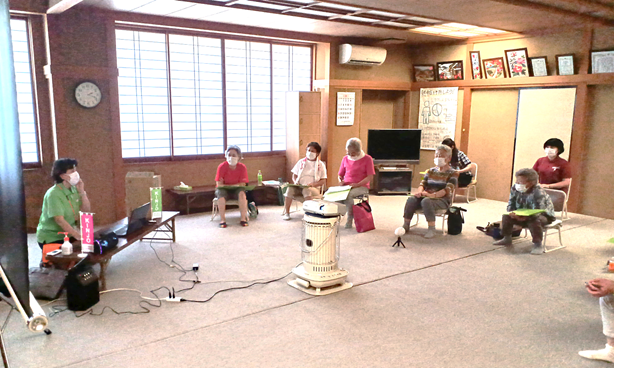
Figure. 1

Figure. 2
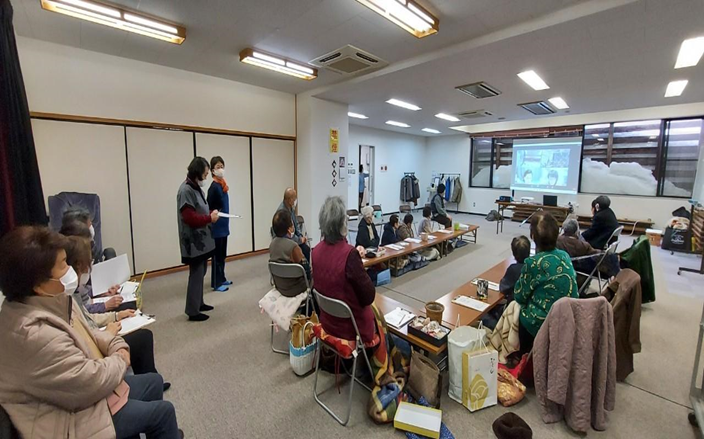
Figure. 3
Although we generally received a positive response from the elderly participants in the online classes that we held, we concluded that it would be difficult to continue implementing the project. The reason for this is that, because it is a mountainous area, there are many places where Wi-Fi cannot reach, and the facilities where self-help groups gather also lack communication equipment. Since the sites had no such equipment, we had to carry and prepare equipment ourselves, and as a result, as many people had to go to the site anyway, there was no point in running the class remotely. Additionally, the Wi-Fi was unstable and sometimes stopped in the middle of a class or sometimes wouldn't connect at all, unnecessarily wasting the participants’ time.
As many of the participants were elderly people who were 75 or older and lived alone, the percentage of them who owned smartphones was low, making it difficult for individuals to utilize online conferencing systems. In many cases, developing an environment for online classes was beyond what we could do ourselves, so many issues remain.
In December 2021, we interviewed three representatives of self help groups to identify the support that residents of the foothills require from the Mountain Health Care Room. They said that the lives of residents of the foothills did not change even during the period when they were asked to refrain from activities voluntarily during the pandemic. They would work in the fields, take a walk to get their bodies moving, and talk with their neighbors.
However, because there were no opportunities for residents to gather with each other together, and there were days when no one came to visit from outside, an increasing number of residents felt that they had no place to check on their health status and were feeling anxious as they felt as if they were just getting older and older.
The representatives also complained of loneliness as they could no longer interact with the young students. The representatives also pointed out that, as elderly people in rural areas are shy among strangers and do not talk about their feelings easily, even if they have concerns or questions about their health, many would not ask their doctors.
The representatives wanted the Mountain Health Care Room to listen to the concerns (even if minor) of the elderly people. The previous health classes primarily aimed to provide the members of the self-help groups with basic health knowledge. We must admit that these classes fell short of offering continuous support as they were one-time classes. We also found that the residents were looking for support that would allow them to build mutual relationships with each other individually, rather than one-way support for the group as a whole. Our interviews with the representatives helped us identify where we should focus our future support.
In 2023, as countermeasures against COVID-19 had been implemented, the activities of the Mountain Health Care Room were returning to normal. We have strengthened our collaboration with the Community Comprehensive Support Center and have had more opportunities to meet with the residents of Mount Haku foothills than ever before. Furthermore, we have started health consultations to listen to what each elderly person has to say.
From now on, I think it is necessary to consider the use of ICT technology in order to continue providing individual support. Providing more individualized health consultations will help us conduct activities unique to the Mountain Health Care Room. Specifically, our aim is to target communities with many health problems among the villages scattered throughout the Mount Haku foothills and provide them with systematic health support.
Seven years have passed since we started our activities. We have overcome difficult periods when we could not work as we wished, and the Mountain Health Care Room has finally become a familiar face to the residents of the communities in the Mount Haku foothills. We would like to continue contributing to realizing healthy lives for the residents there.
Competing interest:
All authors declare that there is no conflict of interest.
References
Ministry of Internal Affairs and Communications (2023): Long-term trends in the total population of Japan ,2023. https://www.soumu.go.jp/main_content/000273900.pdf (Accessed-2023-2-16).View
City of Hakusan: Introduction of Hakusan City, 2021 https:// www.city.hakusan.lg.jp/soumubu/soumu/intro.html (Accessed 2023-07-21)View
City of Hakusan: Hakusan population vision: A vibrant and inviting city — Aiming for Sustainable Development, 2015. https://www.city.hakusan.lg.jp/data/open/cnt/3/9425/1/ fullver2018.pdf (Accessed 2021-07-21)View
City of Hakusan :Questionnaire survey for formulation of the second Hakusan comprehensive plan — Questionnaire on community development for the future: Survey results, 2015.View