
- About the Journal
- Editorial Board
- Review Process
- Author Guidelines
- Article Processing Charges
- Special Issues
- Indexing
- Current Issue
- Past Issue
 Journal of Comprehensive Nursing Research and Care
Journal of Comprehensive Nursing Research and Care Volume 10 (2025), Article ID: JCNRC-217
https://doi.org/10.33790/jcnrc1100217Special Issue
Empowering Bahraini Nurses through Political Competence: A Strategic Framework for Leadership and Policy Influence
Faten Hasani 1*, Post Doctorate, PhD, GRN, PH -SHS, FBIPA, and Sayed Mahmood Alqallaf2
1Training Program in the Institute of Public Administration, Kingdom of Bahrain.
2Associate Professor, Pharmacy Program, Kingdom of Bahrain.
Corresponding Author Details: Faten Hasani, Post Doctorate, PhD, GRN, PH -SHS, FBIPA., Training Program in the Institute of Public Administration, Kingdom of Bahrain.
Received date: 05th July, 2025
Accepted date: 14th November, 2025
Published date: 17th November, 2025
Citation: Hasani, F., & Alqallaf, S. M., (2025). Empowering Bahraini Nurses through Political Competence: A Strategic Framework for Leadership and Policy Influence. J Comp Nurs Res Care 10(2):217.
Copyright: ©2025, This is an open-access article distributed under the terms of the Creative Commons Attribution License, which permits unrestricted use, distribution, and reproduction in any medium, provided the original author and source are credited.
Abstract
The nursing profession in Bahrain faces systemic challenges that limit its potential to influence healthcare policy and leadership. Despite constituting 59.3% of female healthcare workers and numbering 9,914 professionals, Bahraini nurses remain underrepresented in decision-making bodies, with only three nurses serving in Supreme Council of Health committees and no political representation since 2014. This proposal employed a convergent parallel mixed-methods design, combining a Strengths, Weaknesses, Opportunities, and Threats (SWOT) analysis of policy documents with semi-structured interviews of 12 key stakeholders. The research will lead to the development of a multi-dimensional Strategic Framework for Nursing Political Competence, which integrates a comprehensive analysis of the barriers to nursing leadership in Bahrain and proposes a multi- dimensional framework to cultivate political competence. Through a mixed-methods approach combining SWOT analysis and policy review, we identify key challenges including outdated regulations, educational gaps in leadership training, and structural barriers to political participation. The proposed solution integrates curriculum reform, policy advocacy, and leadership development, aligned with Bahrain Vision 2030's goals of healthcare modernization and gender equity. Implementation strategies include mandatory leadership training in nursing education, establishment of nursing policy task forces, and mentorship programs connecting emerging leaders with policymakers. The paper concludes with measurable outcomes and specific recommendations for policymakers, educators, and healthcare administrators to transform nursing from a caregiving profession to a policy-shaping force. This research contributes to global nursing leadership literature while addressing Bahrain's unique healthcare context.
Keywords: Nursing Leadership, Political Competence, Healthcare Policy, Bahrain Vision 2030, Gender Equity in Healthcare
Introduction
The global healthcare landscape increasingly recognizes nurses as crucial stakeholders in health policy formulation and implementation. However, in Bahrain, this potential remains largely untapped due to systemic and structural barriers. This paper examines the current state of nursing leadership in Bahrain and proposes actionable strategies to enhance political competence among nurses.
Globally, nursing leadership has evolved from traditional bedside care to include policy advocacy and health system governance. The World Health Organization's (WHO) Strategic Directions for Nursing and Midwifery 2021-2025 emphasizes developing nurse leaders who can influence policy at all levels. Bahrain's healthcare system, while advanced in many aspects, lags in nursing leadership development, particularly in political engagement.
The significance of empowering nurses with political competence is multifold. Without these skills, nurses are unable to translate their frontline expertise into systemic change, leading to policies that may be inefficient, lack clinical relevance, and contribute to professional dissatisfaction and burnout. Conversely, politically competent nurses can advocate for safer staffing ratios, improved patient care models, and evidence-based health policies, ultimately strengthening the entire healthcare system. While interventions such as policy fellowships in Canada and formal leadership pathways in the UK have shown success, their application within the Gulf Cooperation Council (GCC) context requires careful adaptation. This paper therefore examines the lies in three key areas: First, Bahrain's unique demographic context where 59.3% of nurses are Bahraini women, representing an underutilized resource for healthcare leadership. Second, the alignment with Bahrain Vision 2030's emphasis on preventive healthcare and women's empowerment. Third, the critical timing as Bahrain modernizes its healthcare system post-pandemic. highlighted the misalignment of leadership roles with the necessary scope of practice as a significant barrier, further complicating the landscape of nursing leadership and professional development. This analysis presents a clear picture of the systemic issues that hinder the advancement of nursing in Bahrain, reinforcing the need for policy reform and better alignment of leadership within the profession.
This proposal addresses four research questions:
1. What are the current barriers to political competence among Bahraini nurses?
2. How does the nursing education system prepare (or fail to prepare) nurses for leadership roles?
3. What policy changes are needed to facilitate nurse participation in healthcare decision-making?
4. How can Bahrain implement sustainable strategies to develop politically competent nurse leaders?
Literature Review
The concept of political competence in nursing has gained prominence in recent decades. Bornman and Louw [1] define it as "the ability to effectively navigate and influence healthcare policy systems to improve patient outcomes and working conditions." This builds on earlier work by Cohen et al. (1996) who first articulated the need for nurses to engage in policy advocacy.
In the Gulf region, nursing leadership development faces unique cultural and structural challenges. Alsadaan et al. [2] identified hierarchical structures and gender-based limitations as significant barriers. These limitations, rooted in societal norms that have traditionally restricted women's participation in public leadership [3], are particularly salient in Bahrain, where nursing is a female- dominated profession as the Alsadaan et al. [2] identified three key barriers common across GCC countries: hierarchical healthcare structures, gender-based limitations in leadership opportunities, and educational systems focused on clinical skills rather than leadership development. Bahrain shares these challenges while also dealing with specific local factors.
The Bahraini context presents both opportunities and constraints. On one hand, the country has made significant investments in nursing education, with three universities offering nursing programs. On the other hand, Hassani's [4] research revealed that nursing curricula emphasize technical skills over leadership or policy competencies. This creates a workforce skilled in clinical care but unprepared for policy roles.
Gender dynamics play a significant role. While nursing is a female-dominated profession in Bahrain, traditional gender roles often limit women's participation in public leadership [3]. The case of Dr. Fakhria Shaban Diari, the only nurse to serve in Bahrain's Shura Council (2006-2014), demonstrates both the possibilities and challenges of nursing leadership.
International models offer valuable lessons. The UK's Chief Nursing Officer system and Canada's nursing policy fellowships demonstrate effective approaches to developing political competence. However, as Aboshaiqah et al. [5] caution, such models must be adapted to local cultural and institutional contexts.
Methodology
This proposal utilized a convergent parallel mixed-methods design [6], wherein quantitative and qualitative data were collected concurrently, analyzed separately, and then merged to provide a comprehensive understanding of the research problem. This approach was selected to triangulate findings, ensuring that the insights from document analysis were enriched and explained by the lived experiences of stakeholders. This proposal employs a mixed- methods approach combining document analysis, SWOT framework, and stakeholder interviews. The research design was developed to comprehensively address the complex interplay of educational, policy, and cultural factors affecting nursing leadership in Bahrain.
Data collection occurred in three phases:
The qualitative interview data were transcribed verbatim and analyzed using thematic analysis [7] to identify key themes. The findings from the document review and SWOT analysis were then integrated with the emergent themes from the interviews during the interpretation phase. The ethical Considerations outlined in the Belmont Report. Respect for Persons was ensured through verbal informed consent, guaranteeing voluntary participation and the right to withdraw. Beneficence was upheld by minimizing psychological risk and ensuring the study's potential benefits in improving nursing policy outweighed any risks. Justice was maintained by fairly selecting participants from diverse roles (educators, policymakers, clinicians) to ensure all relevant viewpoints were represented. Anonymity and confidentiality were preserved in the reporting of all data.
1. Policy document review: Analysis of 15 key documents including National Health Regulatory Authority (NHRA) regulations, nursing curricula, and Bahrain Vision 2030 implementation reports.
2. SWOT analysis: Structured evaluation of nursing leadership development using data from NHRA workforce reports and Ministry of Health (MOH) quality metrics [8].
3. Semi-structured interviews: Conducted with 12 key informants including nursing educators, policymakers, and practicing nurses.
The SWOT framework was particularly valuable for organizing findings into:
- Strengths: Existing nursing workforce capabilities
- Weaknesses: Educational and policy gaps
- Opportunities: Alignment with national development goals
- Threats: Cultural and structur
The PDSA (Plan-Do-Study-Act) cycle was selected as the implementation framework due to its proven effectiveness in healthcare quality improvement initiatives. This iterative approach allows for continuous refinement of leadership development programs based on measurable outcomes.
Findings
The research will reveal several critical findings such as participant and document demographics Semi-structured interviews were conducted with 12 key informants (see Table 1). The analyzed documents (n=15) included the Bahrain Vision 2030 implementation plan, the National Health Regulatory Authority (NHRA) [9] 2023 Annual Report, nursing curricula from all three national universities, and Supreme Council of Health committee reports from 2020-2023.
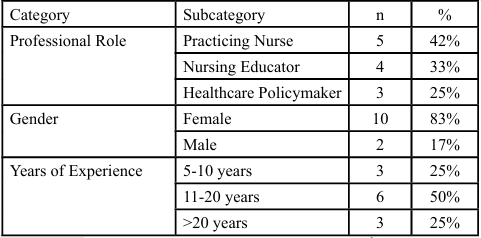
Table 1. Demographics of Interview Participants (N=12)
Educational Gaps
Analysis of nursing curricula at Bahrain's three nursing programs showed less than 5% of coursework dedicated to leadership or policy content. Clinical rotations focused exclusively on technical skills, with no exposure to policy-making processes.
Policy Barriers
The regulatory framework creates structural barriers to nurse leadership. For example, NHRA's licensing requirements emphasize clinical hours over leadership competencies. Only 3 of 87 Supreme Council of Health committee seats are occupied by nurses.
Successful Models
The proposal identified several promising local initiatives, including:
- The Nursing Leadership Forum at Bahrain Royal Medical Services
- Arabian Gulf University's emerging nurse researcher program
- MOH's pilot project for nurse participation in quality improvement committees
Discussion
The proposal will highlight both the urgent need for and feasibility of developing political competence among Bahraini nurses. Our finding of a significant education-policy disconnect corroborates the work of Waring et al. [10], who identified a similar "policy-practice gap" in other Arab healthcare systems. The lack of leadership content in Bahraini curricula creates a self-perpetuating cycle where nurses are not prepared for, and thus not considered for, policy roles.
The intersection of gender and professional identity presents a nuanced challenge. While our data shows high motivation among female nurses, the underrepresentation in leadership aligns with Alsadaan et al. [2] findings on gender-based barriers in the GCC. However, the unique context of Bahrain, with its strong national agenda for women's empowerment [11], provides a countervailing force that can be leveraged, contrasting with more rigid structures reported in neighboring regions. Three key themes emerged from the analysis:
The Education-Policy Disconnect
The near absence of leadership content in nursing education creates a self-perpetuating cycle where nurses aren't prepared for policy roles, and therefore aren't considered for them. This aligns with Waring et al.'s [10] findings in other Arab healthcare systems.
Gender and Professional Identity
The intersection of nursing as a female-dominated profession and traditional gender roles in leadership requires nuanced approaches. Successful strategies must address both professional development and cultural perceptions.
Implementation Challenges
While stakeholders broadly agreed on the need for change, significant differences emerged regarding implementation strategies. Policymakers emphasized top-down approaches, while nurses preferred grassroots leadership development.
Strengths and Limitations
A key strength of this proposal is its convergent mixed-methods design, which allowed for robust triangulation of data from policy documents and stakeholder perspectives. Furthermore, the inclusion of participants from education, policy, and clinical practice ensures a holistic view. However, the study is limited by its relatively small sample size from a single country, which may affect generalizability. The perspectives of physicians and hospital administrators, who are key power-holders, were not included and represent an important area for future inquiry.
Recommendations
Based on the findings, we recommend a multi-pronged approach implemented over a three-year period. First, comprehensive curriculum reform is essential, introducing mandatory leadership courses and policy practicums within all national nursing programs. Second, concomitant policy changes must be enacted, including the establishment of nursing leadership quotas in key health committees and the creation of a Chief Nursing Officer position at the Ministry of Health. Finally, sustained professional development initiatives, such as annual nursing policy fellowships and institutional mentorship programs, are needed to cultivate a sustainable pipeline of politically competent nurse leaders.
Conclusion
In conclusion, developing political competence among Bahraini nurses is a critical strategic investment. As Bahrain works toward Vision 2030, this empowerment will yield measurable dividends, including more clinically-informed health policies, enhanced system resilience, and improved professional retention rates. This study provides a foundational framework for achieving this goal. Future research should focus on implementing and evaluating the proposed framework's impact, exploring the specific barriers faced by nurses in obtaining political roles, and investigating the perspectives of other healthcare leaders on nursing's policy participation.
Competing Interests:
The author declares that they have no competing interests.
References
Bornman, J. & Louw, B. (2023). Leadership Development Strategies in Interprofessional Healthcare Collaboration: A Rapid Review. ncbi.nlm.nih.gov View
Alsadaan, N., K. Jones, L., Kimpton, A., & DaCosta, C. (2021). Challenges Facing the Nursing Profession in Saudi Arabia: An Integrative Review. ncbi.nlm.nih.gov View
Hatem, M. F. (2018). Modernization, the state, and the family in Middle East women’s studies. In A social history of women and gender in the modern Middle East (pp. 63-87). Routledge. View
Hassani, F. (2017). An exploration of the role of school health nurses: A qualitative study. LIFE: International Journal of Health and Life-Sciences, Vol.3, no.1, pp. 12–17 View
Aboshaiqah, A., Alammar, K., Alenezi, A., Majrashi, B., Alshamlani, Y., Alshehari, A., & H. Alanazi, N. (2023). Development of Nursing Research in Saudi Arabia: Implications for Policies and Practice. ncbi.nlm.nih.gov. View
Creswell, J. W., & Plano-Clark, V. L. (2017). Designing and Conducting Mixed Methods (3rd ed). SAGE Publications. View
Braun, V., & Clarke, V. (2006). Using thematic analysis in psychology. Qualitative Research in Psychology, 3(2), 77–101. View
MoH Direction.(2024).
NHRA Annual Report 2023.(2024). file:///C:/Users/My%20 Labtop/Desktop/Project%20Post%20PhD/NHRA%20 Annual%20Report%202023.pdf .online View
Waring, J., Bishop, S., Clarke, J., Exworthy, M., Fulop, N., Hartley, J., … Roe, B.. (2022). Acquiring and developing healthcare leaders’ political skills: an interview study with healthcare leaders. View
Supreme Council of Health report 2021. (2024). https://www. sch.org.bh/en/ (online) View