
- About the Journal
- Editorial Board
- Review Process
- Author Guidelines
- Article Processing Charges
- Special Issues
- Indexing
- Current Issue
- Past Issue
 Journal of Comprehensive Nursing Research and Care
Journal of Comprehensive Nursing Research and Care Volume 11 (2026), Article ID: JCNRC-222
https://doi.org/10.33790/jcnrc1100222Mini Review
Understanding the Physiology Behind Infant Milk Coma
Muneeswari Jeyachandran1, Ph.D.(N)., MBA. CCCE., CBS., IYFC., MIYCAN., and Manimegalai M2, M.Sc.(N)., Ph.D.(N).,
1Senior Registered Nurse, Kuwait Oil Company, Kuwait.
2Principal, VPMM College of Nursing Krishnankoil, Virudhunagar DT, India.
Corresponding Author Details: Muneeswari Jeyachandran., Ph.D.(N)., MBA. CCCE., CBS., IYFC., MIYCAN., Senior Registered Nurse, Kuwait Oil Company, Kuwait.
Received date: 15th November, 2025
Accepted date: 04th February, 2026
Published date: 06th February, 2026
Citation: Muneeswari, J., & Manimegalai, M., (2026). Understanding the Physiology Behind Infant Milk Coma. J Comp Nurs Res Care 11(1):222.
Copyright: ©2026, This is an open-access article distributed under the terms of the Creative Commons Attribution License, which permits unrestricted use, distribution, and reproduction in any medium, provided the original author and source are credited.
Abstract
The “milk coma” is a natural physiological state observed in breastfed infants characterized by post-feeding drowsiness, deep relaxation, and contentment [1,6]. This phenomenon results from the synergistic actions of several hormones and neurotransmitters, including cholecystokinin (CCK), oxytocin, prolactin, melatonin, tryptophan, endorphins, GABA, serotonin, leptin, and endocannabinoids [1,3,4,5,9,13-16]. These substances collectively regulate satiety, calmness, bonding, and circadian rhythms [1,4,9]. Understanding the neuroendocrine mechanisms of the milk coma has significant implications for nursing care and maternal education [6]. Nurses play a vital role in recognizing this state as a positive indicator of effective feeding, supporting mother–infant bonding, and educating families about the normal physiological processes that occur during breastfeeding.
Keywords: Milk Coma, Infant Sleep, CCK, Oxytocin, Prolactin, GABA, Leptin, Melatonin, Tryptophan, Serotonin, β-Endorphins, Endocannabinoids, Breastfeeding.
Introduction
The early postpartum period is marked by complex neuroendocrine changes that facilitate breastfeeding and maternal–infant bonding [6,9,11]. Among these phenomena, the so-called “milk coma” represents a distinct state of post-feeding tranquillity and sleepiness in infants [1]. This is not a pathological condition but a reflection of adequate feeding, hormonal regulation, and emotional connection between mother and child [6,12]. The underlying physiology involves a cascade of hormones and neurotransmitters that modulate appetite, relaxation, and neural inhibition, ensuring that the infant experiences calm alertness followed by restorative sleep [1,3,9,17]. Understanding this process enhances the quality of nursing care, supports maternal confidence, and reinforces the natural rhythm of breastfeeding.
Aim
To explore and describe the physiological and hormonal mechanisms underlying the “milk coma” phenomenon in breastfed infants, and to highlight the nursing implications and educational strategies that support effective breastfeeding practices and infant well-being.
Scope
This paper focuses on the neuroendocrine basis of the milk coma, emphasizing the roles of hormones such as CCK, oxytocin, prolactin, melatonin, endorphins, GABA, serotonin, leptin, and endocannabinoids. The discussion extends to the implications for clinical nursing practice in labor, delivery, and postpartum units, and provides guidelines for educating mothers about the natural physiological processes involved in breastfeeding-induced infant sleepiness.
Milk Coma (Also Known as “Milk Drunk”)
Definition
A milk coma refers to a state of deep relaxation and drowsiness observed in an infant following a satisfying breastfeeding or bottlefeeding session [1,6]. It is characterized by muscle relaxation, decreased motor activity, facial contentment (such as a faint smile), and somnolence, often accompanied by traces of milk around the mouth. This state results from neurohormonal responses including the release of cholecystokinin (CCK), oxytocin, endorphins, and other satiety-related hormones which promote calmness, digestion, and sleep after effective feeding [1,3,9,15].
Neuroendocrine Mechanisms Underlying the “Milk Coma” Phenomenon in infants
The “milk coma” is not the result of a single hormone but a synchronized neuroendocrine symphony involving gastrointestinal peptides, neuropeptides, inhibitory neurotransmitters, and sleep regulators [1,3,17]. These substances collectively regulate satiety, calmness, bonding, and circadian rhythms.
1. Cholecystokinin (CCK)
Cholecystokinin (CCK) is a gastrointestinal peptide hormone released in response to feeding and plays a central role in the satiety– sleep relationship observed in breastfed infants [1,3].
Mechanism
During breastfeeding, stimulation of the infant’s gut through milk intake triggers the release of CCK. This hormone acts via vagal afferent pathways and central hypothalamic circuits to induce postprandial relaxation and decreased arousal [1,3].
Effects
CCK promotes satiety and drowsiness. Plasma CCK levels rise towards the end of a feed and peak again approximately 30–60 minutes later, leading to a characteristic post-feed sleepiness [1,3]. This cyclical elevation helps regulate feeding intervals and supports neurodevelopmental rest phases.
Oxytocin
Oxytocin is a hypothalamic neuropeptide critical for milk ejection and emotional bonding during lactation [9,11].
Mechanism
Suckling activates the hypothalamic-pituitary axis, resulting in pulsatile oxytocin release into the bloodstream and cerebrospinal fluid. Centrally, oxytocin enhances parasympathetic dominance, reduces cortisol, and promotes relaxation in both mother and infant [9,11].
Effects
In infants, oxytocin contributes to calm alertness, reduced stress, and a sedative-like state. Its synchronization with maternal oxytocin release reinforces attachment and facilitates the infant’s transition into postprandial sleep [9,11].
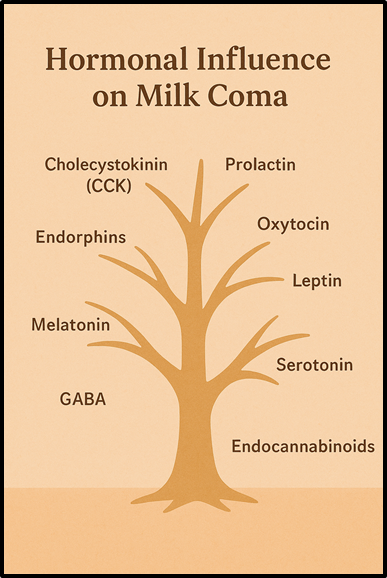
Figure 1
3. Prolactin
Prolactin is the principal lactogenic hormone responsible for milk synthesis and plays a neurobehavioral role in post-feeding restfulness [8,15].
Mechanism
Prolactin secretion from the anterior pituitary increases during suckling due to reduced dopaminergic inhibition [8]. Elevated levels act on the central nervous system to promote maternal nurturing behaviour and regulate infant feeding–sleep patterns.
Effects
In the infant, prolactin indirectly contributes to satiety and comfort through consistent milk flow, supporting energy replenishment and thermoregulation key precursors for sleep initiation.
4. Tryptophan and Melatonin
Tryptophan, an essential amino acid and precursor of serotonin and melatonin, is present in high concentrations in human milk during nighttime feeds [4,10].
Mechanism
After ingestion, tryptophan is metabolized to serotonin and subsequently to melatonin within the pineal pathway. These molecules regulate the circadian rhythm, modulating sleep–wake cycles in the infant [4,10].
Effects
Melatonin promotes sleep onset by lowering body temperature and enhancing GABAergic activity. Its rhythmic secretion in breast milk helps synchronize the infant’s developing circadian system, contributing to the “milk coma” effect.
5. Endorphins (β-Endorphins)
β-Endorphins are endogenous opioid peptides released during breastfeeding that mediate analgesia, calmness, and emotional bonding [9,17].
Mechanism
Suckling stimulates hypothalamic β-endorphin release, which acts on μ-opioid receptors to suppress arousal and induce a state of comfort.
Effects
In infants, endorphins elicit a euphoric and sedative effect, contributing to the relaxed, sleepy post-feed demeanour characteristic of the milk coma.
6. Gamma-Aminobutyric Acid (GABA)
GABA is the primary inhibitory neurotransmitter in the central nervous system and a significant modulator of infant sleep-wake states [17].
Mechanism
Breastfeeding increases GABAergic transmission through hypothalamic–pituitary interactions. Elevated GABA reduces neuronal excitability and enhances sleep spindles, promoting cortical inhibition.
Effects
GABA promotes muscle relaxation and sustained non-REM sleep, reinforcing the tranquil state associated with post-feeding somnolence.
7. Serotonin
Serotonin (5-HT) regulates mood, appetite, and milk secretion, acting as a biochemical bridge between feeding and rest [13].
Mechanism
Derived from tryptophan, serotonin regulates mammary gland tight junction integrity and influences maternal-infant synchrony in feeding behaviour.
Effects
Serotonergic signalling in infants promotes calmness and rhythmic sucking, transitioning smoothly into rest as serotonin converts to melatonin in the evening.
8. Leptin
Leptin, a satiety hormone present in breast milk, regulates infant appetite and energy metabolism [5,16].
Mechanism
Leptin acts on hypothalamic centres to inhibit neuropeptide Y and promote energy balance, sending signals of fullness to the infant brain.
Effects
Post-feeding leptin elevation contributes to satisfaction and reduced arousal, supporting sleep consolidation and growth homeostasis.
9. Endocannabinoids
Endocannabinoids, including anandamide and 2-AG, are bioactive lipids found in human milk that influence feeding motivation and relaxation.
Mechanism
These molecules act on CB1 receptors in the infant brain, promoting suckling reflexes and post-feeding sedation [2,14].
Effects
Endocannabinoid signalling reinforces feeding pleasure and induces calm, aiding in the transition to restful sleep.
Key Clinical Features of Milk Coma
• Altered State of Arousal: A rapid transition from a state of active feeding to a state of deep relaxation, lethargy, and ultimately, unarousable sleep with contented smile.
• Signs of Satiety: The infant typically disengages from the breast or bottle spontaneously, with a relaxed, open mouth and unclenched hands.
• Autonomic Signs: Mild, involuntary buccolingual movements or a transient, faint smile may be observed, which are attributed to primitive neonatal reflexes and subcortical processing, rather than volitional social engagement.
• Residual Oropharyngeal Milk: The presence of small droplets of expressed or regurgitated milk around the commissures of the lips or on the cheeks is a common, though not universal, finding.
These are signs of a well-fed, comfortable baby a good indication that feeding is going well.
Nursing Implications on “Milk Coma”
1. Promoting Rest and Recovery:
Nurses should recognize the “milk coma” as a normal physiological response following effective breastfeeding [6]. This state reflects adequate milk intake, hormonal balance, and infant satisfaction. Encouraging uninterrupted skin-to-skin contact after feeding enhances oxytocin release, deepens bonding, and supports the infant’s transition into a calm, restful state.
2. Monitoring Feeding Effectiveness:
Observation of infant cues such as relaxed limbs, rhythmic sucking, and spontaneous sleep post-feed are clinical indicators of sufficient intake and milk transfer. Nurses should use these signs to reassure mothers that their milk is adequate and the baby is feeding well.
3. Supporting Maternal Well-being:
Understanding the hormonal interplay in lactation (oxytocin, prolactin, endorphins, etc.) allows nurses to provide targeted support for maternal relaxation and stress reduction [7,9]. Encouraging comfortable positioning, hydration, and rest between feeds optimizes hormonal secretion and milk production.
4. Promoting Circadian Rhythm Development:
Nurses can educate mothers on how nighttime feeding rich in melatonin and tryptophan helps synchronize the infant’s sleep-wake cycle. This information reinforces the value of responsive nighttime breastfeeding rather than encouraging formula supplementation during the night.
5. Clinical Application in Breastfeeding Support:
In clinical practice, nurses and lactation consultants should integrate knowledge of milk coma physiology to differentiate normal postfeed sleepiness from pathological lethargy. Continuous education, documentation of feeding patterns, and gentle guidance enhance breastfeeding outcomes and maternal confidence.
Nurses' Roles on Successful “Milk Coma” in Labor Ward
In the labor and delivery (L&D) setting, nurses hold a pivotal role in establishing the foundation for successful breastfeeding and the physiological phenomenon known as the “milk coma.” This role extends beyond immediate postnatal care to encompass hormonal facilitation, emotional support, and early education for mothers.
1. Facilitating Early Skin-to-Skin Contact
Immediately after birth, nurses should promote skin-to-skin contact between the mother and newborn. This practice stimulates the release of oxytocin and endorphins, enhancing both maternal bonding and the infant’s transition into a state of calm alertness [9,11]. Early contact also encourages the first breastfeed, initiating the hormonal cascade that leads to the milk coma.
2. Supporting Early Initiation of Breastfeeding
Encouraging breastfeeding within the first hour of life is crucial. The colostrum not only provides essential nutrients and immune protection but also triggers the infant’s CCK release, leading to early post-feed drowsiness [1,3,6]. Nurses guide mothers on proper positioning and latching techniques to ensure effective milk transfer and hormonal stimulation.
3. Observing and Interpreting Feeding Cues
Nurses must monitor infant cues such as rooting, hand-to-mouth movements, and rhythmic sucking. Recognizing and responding to these signals supports on-demand feeding, allowing the baby to regulate intake naturally. Post-feed relaxation, limp limbs, and deep sleep indicate successful feeding and onset of the milk coma.
4. Promoting Maternal Comfort and Relaxation
Maternal stress can inhibit oxytocin and prolactin release. L&D nurses should create a calm, private, and supportive environment encouraging deep breathing, hydration, and relaxation. This optimizes hormonal flow, ensuring both mother and infant experience the soothing effects of breastfeeding.
5. Educating Mothers About the “Milk Coma”
Education should begin in the L&D unit. Nurses can explain that the baby’s post-feed sleepiness is a healthy, normal response indicating satisfaction and hormonal balance not a sign of illness or overfeeding. Simple, reassuring language helps reduce maternal anxiety and fosters confidence in breastfeeding.
6. Encouraging Rooming-In Practices
By allowing mothers and infants to remain together 24 hours a day, nurses promote frequent feeding opportunities and continuous oxytocin release. This enhances bonding, supports hormonal regulation, and increases the likelihood of observing healthy milk coma patterns.
7. Assessing Infant Well-being
While milk coma reflects satiety and normal physiology, nurses should remain vigilant for pathological lethargy. Continuous assessment of vital signs, feeding duration, and responsiveness ensures early detection of any deviations requiring intervention.
Comparison of Physiological Sleepiness (Milk Coma)Vs Pathological Lethargy in Newborns
Summary
The “milk coma” reflects the intricate harmony of hormonal and neurological processes that follow breastfeeding [1,6]. It is mediated by CCK, oxytocin, prolactin, melatonin, endorphins, GABA, serotonin, leptin, and endocannabinoids each contributing to the infant’s postfeeding calmness, satiety, and sleep. Recognizing this state helps healthcare professionals reassure mothers that their infants are feeding effectively. Proper nursing support during and after breastfeeding reinforces maternal confidence, promotes bonding, and ensures healthy infant growth and rest. L&D nurses are central to initiating and sustaining the physiological processes that lead to the milk coma. Through early breastfeeding support, maternal education, and emotional reassurance, nurses help both mother and infant experience the calm, bonding, and rest that define successful breastfeeding.
Conclusion
The milk coma is a hallmark of effective breastfeeding and maternal-infant harmony. Its foundation lies in the orchestrated release of hormones that facilitate digestion, relaxation, bonding, and sleep. For nurses, understanding this process is essential to guide, support, and educate mothers throughout the breastfeeding journey. Promoting awareness of this natural physiological state empowers mothers, strengthens breastfeeding success, and contributes to holistic neonatal care [6].
Competing interest:
The authors declare that they have no competing interests.
References
Holliday, A., Horner, K., Johnson, K. O., Dagbasi, A., & Crabtree, D. R. (2025). Appetite-related Gut Hormone Responses to Feeding Across the Life Course. Journal of the Endocrine Society, 9(2), bvae223. View
Castro-Navarro, I., Pérez-Beltrán, C., & Cano-Abad, M. F. (2024). Maternal cannabis use during lactation and potential effects on human milk composition and production: A narrative review. Advances in Nutrition, 15(2), 351–365. View
Liang, H., et al. (2024). Role of Cholecystokinin (cck) in feeding regulation. MDPI. View
Figueiredo, J., Pires, A., & Carvalho, M. (2023). Melatonin in human breast milk: A scoping review. Biological Rhythm Research, 54(8), 1395–1408.
Van der Auwera, C., Wittevrongel, T., Vandekerckhove, K., & Verhaeghe, J. (2023). Postnatal leptin levels correlate with breast milk leptin content in preterm infants. Nutrients, 14(24), 5224.
Riordan, J., & Wambach, K. (2022). Breastfeeding and Human Lactation (6th ed.). Jones & Bartlett Learning. View
Nagel, E. M., de Heus, R., Tiemensma, J., & Spek, V. R. (2021). Maternal psychological distress and lactation: A cross-sectional study. International Breastfeeding Journal, 16(1), 21.
McNeilly, A. S. (2021). Prolactin and the control of gonadotrophin secretion in the female. Frontiers in Endocrinology, 12, 781. View
Uvnäs Moberg, K., Ekström-Bergström, A., Buckley, S., Massarotti, C., Pajalic, Z., Luegmair, K., & Kotlowska, A. (2020). Maternal plasma levels of oxytocin during breastfeeding – A systematic review. PLOS ONE, 15(11), e0235806. View
Sánchez, C.-M., Rueda, R., & Pérez-Sánchez, J. (2019). Variations in melatonin levels in preterm and term human breast milk. Scientific Reports, 9, 54530.
Uvnäs-Moberg, K., Ekström-Bergström, A., Buckley, S., Pajalic, Z., Kotlowska, A., & Leng, G. (2019). The oxytocinergic system in relation to human stress and breastfeeding. Breastfeeding Review, 27(2), 29–41.
Geddes, D. T., & Perrella, S. L. (2019). Breastfeeding: How do they do it? Infant sucking, swallowing and breathing. Physiology, 34(5), 327–338. View
Matsuda, M., & Yamaguchi, T. (2018). Serotonin and lactation: Control of milk secretion and maternal behavior. Animal Science Journal, 89(10), 1353–1360.
Gaitán Espinoza, A. V. (2018). Endocannabinoid metabolome of human breast milk (Doctoral dissertation, Louisiana State University). Louisiana State University Digital Commons. View
Neville, M. C., & Morton, J. (2018). Physiology and endocrine changes underlying human lactogenesis II. Journal of Nutrition, 148(10), 1661S–1665S. View
Catlı G., Dündar, N.Ö., Dündar, B.N.,&Özkan, B.(2014). Adipokines in breast milk: An update. Journal of Clinical Research in Pediatric Endocrinology, 6(3), 87–96. View
Van den Pol, A. N. (2012). Neuropeptide transmission in the hypothalamus: Dynamism and integration. Journal of Neuroendocrinology, 24(4), 656–664. View