
- About the Journal
- Editorial Board
- Review Process
- Author Guidelines
- Article Processing Charges
- Special Issues
- Indexing
- Current Issue
- Past Issue
 Journal of Comprehensive Nursing Research and Care
Journal of Comprehensive Nursing Research and Care Volume 11 (2026), Article ID: JCNRC-223
https://doi.org/10.33790/jcnrc1100223Research Article
Building Mental Readiness: A pilot study Evaluating the Effects of stress first aid Training on Prelicensure Nursing Students
Veronica Betts, Courtney Reinisch, and Brenda Marshall*
Montclair State University School of Nursing, 1 Normal Ave, Montclair, NJ, 07043, United States.
Corresponding Author Details: Professor, School of Nursing, Montclair State University School of Nursing, 1 Normal Ave, Montclair, NJ, 07043, United States.
Received date: 27th July, 2025
Accepted date: 13th February, 2026
Published date: 16th February, 2026
Citation: Brenda Marshall, Betts, V., Reinisch, C., & Marshall, B., (2026). Building Mental Readiness: A pilot study Evaluating the Effects of stress first aid Training on Prelicensure Nursing Students. J Comp Nurs Res Care 11(1):223.
Copyright: ©2026, This is an open-access article distributed under the terms of the Creative Commons Attribution License, which permits unrestricted use, distribution, and reproduction in any medium, provided the original author and source are credited.
Abstract
Pre-licensure nursing students frequently experience significant stress and anxiety as they transition from classroom learning to clinical practice, negatively affecting academic performance and contributing to attrition. Limited skills in emotional self-regulation and coping in high-stress environments may further impede readiness for professional roles. Providing structured stress-management training is therefore critical to fostering resilience and mitigating burnout. This non-experimental, descriptive pilot study evaluated the impact of Stress First Aid (SFA) training on nursing students’ beliefs, knowledge, and attitudes related to SFA core elements. Participants completed standardized SFA instruction followed by a post-training survey assessing understanding of the SFA model, perceived relevance of the training, and confidence in applying its principles. Findings indicated increased knowledge of SFA concepts and strong recognition of the model’s value at the individual, team, and organizational levels. Students reported enhanced confidence in accessing support resources, assisting peers, and making appropriate referrals. Results suggest that SFA offers a practical framework for strengthening emotional regulation, peer support capacity, and preparedness for high-stress clinical environments. Integrating SFA into nursing curricula represents a multifaceted strategy to promote student well-being, reduce stress-related attrition, and better prepare future nurses for the psychological demands of professional practice.
Keywords: Stress First Aid, Prelicensure nursing students, Wellbeing, Mental Readiness
Introduction
Nursing students experience significant stress during the course of their education due to the complexity of a nursing curriculum that includes intensive academic workloads and clinical placements. Welch [1] has identified that stress levels in nursing students have increased over the past decade. Anxiety often escalates when the student transitions from didactic to clinical environments. Clinical placements have been identified as the greatest anxiety experiences in nursing education, a time when students are faced with the responsibility of direct patient care [2]. This elevated stress can impact academic performance, and can have a negative impact on the student’s ability to complete their nursing studies [3,4]. Mills et al., [5] identified that this stress can result not only impact their academic performance but their emotional wellbeing as well. Stress can become a vulnerability for negative long-term effects on nursing students’ affecting both the wellbeing of the students and the future nursing workforce. Maqbali et al. [6] recommended infusing stress reduction strategies in the nursing curriculum to reduce the incidence of anxiety and improve the level of perceived support.
When considering the holistic development of nursing students into new nursing professionals it is also important to define the dichotomy between eustress and distress. Where eustress is a positive force that could be a motivator, distress can lead to increased anxiety and impact the student’s well-being [7]. It is this dual nature of stress that underscores the need for supportive measures in nursing education, preparing capable and resilient individuals into the professional nursing workforce [8].
Multiple studies highlight the impact of the coronavirus pandemic on nursing staff turnover, which can be seen in early retirement and attrition [9-11]. Hughes et al. [12] underscores the need for creating a nursing workforce capable of dealing with professional stress as a means to reduce burnout and improve nursing retention, suggesting it begins in the pre-licensure educational setting. Currently, first year nurses’ turnover rates are nearing 30% [13]. The New Jersey Nursing Emotional Well-Being Institute [14] introduced an initiative, training nurses and nursing instructors in Stress First Aid, in order to provide tools for nurses to manage the stress of a nursing career, with the goal of reducing burnout and increasing. Integrating SFA into nursing education is a way to empower future nurses and teach them the strategies that can act as protective factors [15,16].
Stress first aid (SFA), is an evidence-based program created to address the stress experienced by front line servicemen, developed by the American military. This leadership and peer support model promotes mental wellness by the development of specific coping skills accessible in times of stress [14]. Madmoli et al. [17], evaluating 10 studies, identified how stress management training significantly decreased stress in nursing staff by early identification and intervention. The impact of managing stress not only improves the workplace, but can also enhance family life and overall stress management [17,18]. This finding supports the belief that there is an ethical responsibility to provide an education that promotes wellbeing, supporting prelicensure students to transition into their roles as nurses smoothly and with emotional management skills [19]
The goal of infusing SFA into the nursing curriculum is to prepare future nurses to successfully navigate the stressors faced both in nursing education and staff nursing, creating a healthier work force environment [20,21]. Heemskerk et al. [22] identified the creation of learning communities as valuable within the profession of nursing.
The aim of this pilot study was to evaluate the impact of providing SFA training to prelicensure nurses as a community learning experience. The research question was; Does providing SFA training to prelicensure nurses impact their knowledge of SFA skills, beliefs about stress, and attitudes regarding accessing available resources on campus. The students’ understanding and application of the use of the SFA stress continuum, as illustrated by the ‘stress thermometer, [23] was also evaluated.
Materials and Methods
Design: A non-experimental, cross sectional, descriptive design was used for this pilot study.
Setting: A public university school of nursing in the northeast United States.
Participants: Prelicensure nursing students (junior baccalaureate of science in nursing (BSN) students and first year master of science in nursing (MSN) pre-licensure students) attending a community health course at a northeastern public university.
Sampling technique: Purposive convenience sample, all prelicensure students attending the community health program were offered the program as part of their standard curriculum. A unique program at the institution allows students with bachelor’s degrees in order disciplines to enroll in a prelicensure MSN program and sit for their licensing exam upon successful completion. These results represent students from two semesters (fall 2024 and spring 2025) and two programs - one prelicensure BSN students, the other prelicensure MSN students.
Ethical Considerations: Prior to providing this program, exempt status was obtained from the university institutional review board (IRB). The inclusion of SFA is part of the community health curriculum, and participation is part of their educational experience. Students were told of this study’s purpose and their right to voluntarily participate without any reflection on their course grades. All students taking this community health course participated in the SFA training, however responding to the survey via a quick response (QR) code was voluntary and anonymous. All responses were aggregated to protect student confidentiality.
Procedure and Materials: Students were provided with standardized SFA Training from three certified trainers prior to engaging in their community health clinical experiences. After the training, students were asked to complete an anonymous 10 item evaluation survey, which was accessed through a Qualtrics QR code. The survey assessed students’ attitudes, knowledge, and behaviors regarding stress, stress injuries, and accessing resources to address stress. Responses were aggregated to protect confidentiality of student responses.
Stress First Aid (SFA) Training: SFA training was provided in a three hour, in-person classroom session. Three trainers, all nursing educators, conducted the classes. SFA training teaches a common language and focuses on educating participants about the impact of stress injuries and exploring the stress continuum. SFA provides strategies on applying the SFA model using the common language and the stress thermometer; feeling green is ready to help others, feeling yellow is reacting, irritable, feeling orange is injured with a sense of loss of control, and feeling red is ill with persistent symptoms worsening over time and in need of intervention (figure 1). Learning this common language helps participants increase their awareness of stress, and engage in prevention, support, and recovery from possible stress injuries on an individual and team level. At the conclusion of the training, students were asked to fill out exit tickets that identified any remaining questions on the training or how to access resources. They also answered the brief 10 item survey accessed through a QR code, which assessed their knowledge, attitudes, and beliefs about stress and the SFA model.
Questions reflected 1) Belief: perceived individual value of the training, 2) belief: perceived team value of the training, 3)belief: perceived value of SFA as part of an organization, 4) student knowledge about university resources, 5) student knowledge of stress continuum, 6) student knowledge of stress thermometer, 7) student knowledge of stress injury, 8) attitude regarding comfort in accessing resources to manage stress for the individual, 9) attitude regarding referring other students to university based resources for managing stress, and 10) student questions were answered regarding SFA.
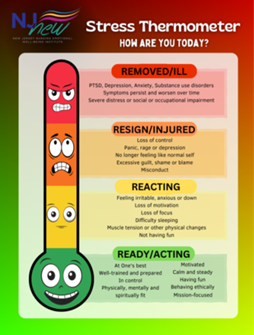
Figure 1: Stress First Aid Thermometer
Results
A total of 58 prelicensure students (BSN and MSN) participated in the SFA training, in two cohort group trainings, during the semesters of the academic year 2024-2025. Thirty-three (33) prelicensure BSN students, and twenty-five (25) prelicensure graduate (MSN) students voluntarily responded to the 10 item survey. No demographic information was collected on the students to protect the confidentiality of their responses.
Individual Question Responses:
Question 1 Belief: Perceived Value as an individual “The content covered by this training was valuable to me as an individual.” BSN responses were in agreement 89% (strongly agree (SA) 85%, agree (A) 4%) and MSN agreed 100% (SA 88%, A 12%). Overall agreement for value to the individual reflected 98% of the participants (Table 1).
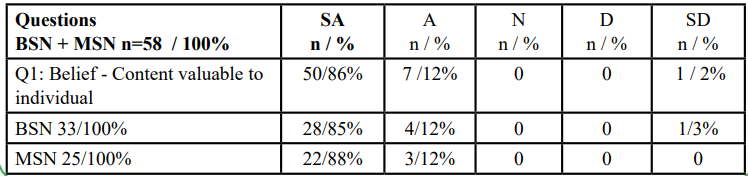
Table 1
Question 1
Question 2: Belief - Perceived value as a team “The content covered by this training was valuable to me as a member of a team.” BSN responses were in agreement 89% (SA 82%, A 15%) and MSN agreed 100% (SA 88%, A 12%). Overall agreement for belief for value to the team reflected 98% of the participants (Table 2).
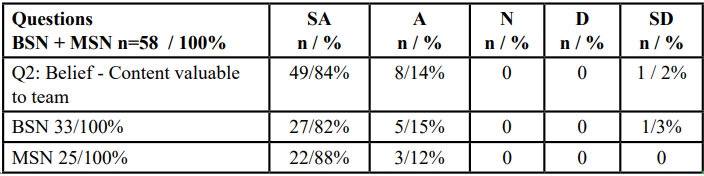
Table 2
Question 2
Question 3: Belief - Perceived value as part of an organization. “The content covered by this training was valuable to me as a member of an organization.” BSN responses were in agreement 94% (strongly agree (SA) 82%, agree (A) 12%) and MSN agreed 100% (SA 84%, A 16%). Overall agreement for belief for the value of an organization reflected 97% of the participants (Table 3).
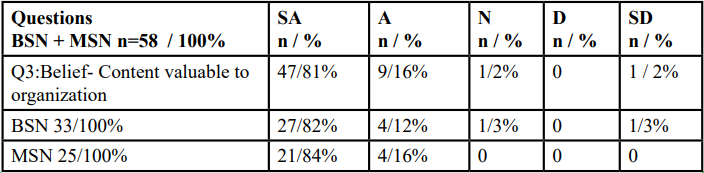
Table 3
Question 3
Question 4: Knowledge about university resources. “I learned about resources available to students.” BSN responses were in agreement 97% (SA 82%, A 15%) and MSN agreed 96% (SA 88%, A 8%). Overall agreement for knowledge of university resources reflected 97% of the participants (Table 4).
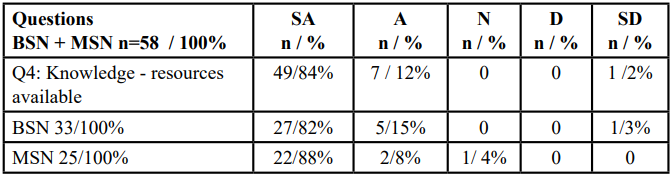
Table 4
Question 4
Question 5: Knowledge about the stress continuum. “I learned about the stress continuum.” BSN responses were in agreement 97% (SA 88%, A 9) and MSN agreed 100% (SA 96%, A 4%). Overall agreement for knowledge of the stress continuum reflected 98% of the participants (Table 5).
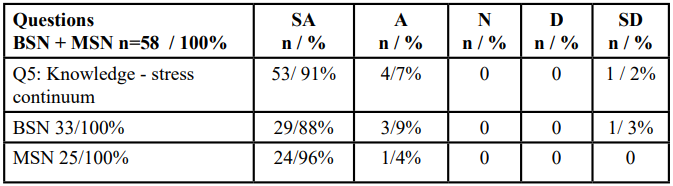
Table 5
Question 5
Question 6: Knowledge about the stress thermometer. “I learned about the stress thermometer." BSN responses were in agreement 97% (SA 85%, A 12%) and MSN agreed 100% (SA 96%, A 4%). Overall agreement for knowledge of the stress thermometer reflected 98% of the participants (Table 6).
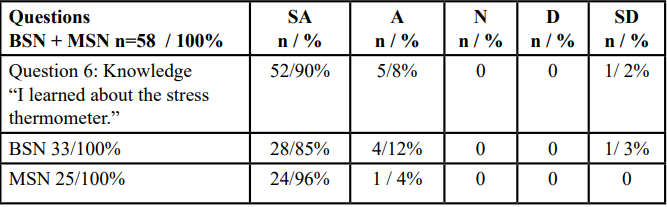
Table 6
Question 6
Question 7: Knowledge about stress injury, “I learned about stress injury." BSN responses were in agreement 97% (SA 79%, A 18%) and MSN agreed 100% (100% SA). Overall agreement for knowledge of stress injury reflected 98% of the participants (Table 7).
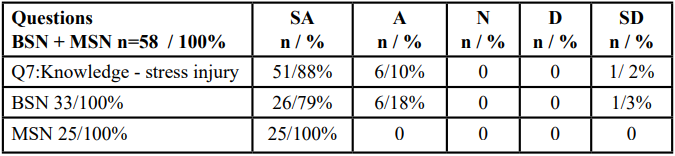
Table 7
Question 7
Question 8: Attitude: increased comfort accessing resources available at the university, “As a result of SFA training I am more comfortable accessing resources available to students.” BSN responses were in agreement 94% (SA 79%, A 15%) and MSN agreed 92% (80% SA, 12% A). Overall agreement for accessing resources reflected 96% of the participants (Table 8).
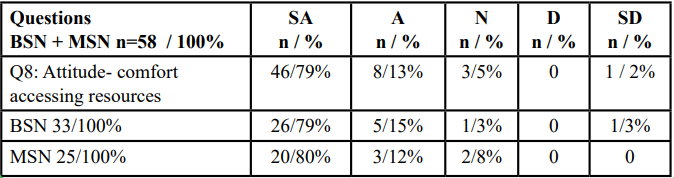
Table 8
Question 8
Question 9: Attitude: increased comfort telling other students about available resources, “As a result of the SFA training, I am comfortable telling other students about available resources.” BSN responses were in agreement 94% (SA 79%, A 15%) and MSN agreed 96% (SA 80%, A 16%). Overall agreement for comfort with sharing resources reflected 97% of the participants (Table 9).
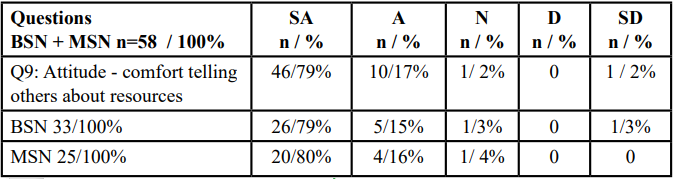
Table 9
Question 9
Question 10: Knowledge: the SFA training answered the student’s questions related to Stress First Aid. “The SFA trainer answered all of my questions related to SFA.” BSN responses were in agreement 97% (SA 85%, A 12%) and MSN agreed 100% (SA 96%, A 4%). Overall agreement for having questions about SFA answered reflected 98% of the participants (Table 10).
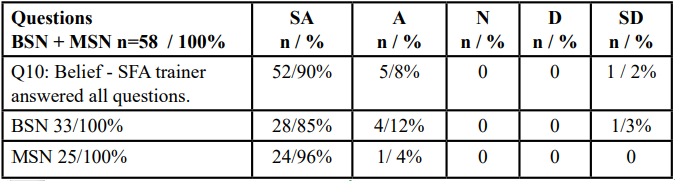
Table 10
Question 10
Summary of results:
Results indicate that an average of 98% of the students believed having the SFA training was valuable for them as individuals, team members and members of an organization (Q 1,2,3). In the area of knowledge, an average of 98% of the students' responses reflected learning the key points taught by the SFA training (resources available, stress continuum, stress thermometer, and stress injury) and were able to have their questions about SFA answered during the training by the SFA trainers. In the category of attitude, being comfortable either accessing resources available to students or telling other students about available resources, an average of 94.5% of students provided a positive response. Students were less certain in their attitude about being comfortable accessing student resources (79% BSN strongly agreed and 80% MSN strongly agreed) with the same percentages related to telling others about available resources. This response correlates to the knowledge question about having learned about available resources (82% BSN strongly agreed and 88% MSN strongly agreed).
Discussion
Providing prelicensure students SFA training in a community health course increased their knowledge about stress injuries, the stress continuum and the stress thermometer. It provided them with a common language to identify their own levels of stress, and to be aware when help is needed. The faculty teaching the clinical rotations in this course were trained in SFA in order to reinforce the knowledge gained in the training, and to utilize the stress thermometer as a gauge for student stress levels in clinical experiences. The lowest “strongly agree” responses reflected less comfort both accessing student resources and referring others for resources (79%, 79%). Stress first aid is not a referral training, however the trainers can use this information to offer suggestions for accessing resources during the training, as well as providing students with information related to resources available at the university. Each student participating in the training received a laminated stress first Aid thermometer identifying university support services on the flip side.
This pilot study reinforces the previous studies that demonstrate an increase in knowledge and resilience through providing stress management courses in nursing curriculum [1,6]. Resilience promoting approaches are presented during the SFA training encouraging students to identify meaningful ways to build resilience though self-care, which are tailored to their personal preferences and lived experiences. SFA training introduces students to multiple methods for increasing emotional self-awareness and engaging in self-care. These include time management skills, scheduling, and reflective practices. Other self-care strategies discussed included journaling, meditation, exercise, and sleep hygiene. These practices increase student protective factors and are supported by the literature [15]. By employing these essential tools students learn to manage their level of stress and support both a personal and community sense of well-being.
Limitations
The small sample size of this descriptive pilot study, and the non experimental nature of the data collection, does not allow for a greater generalizability of the results.
Conclusion
Nursing students encounter substantial stressors in their academic and clinical experiences [3-5]. Clinical rotations for prelicensure students can increase the student’s level of anxiety and stress, impacting their ability to perform required tasks during their rotation. Isea-Arguelles et al. [24] suggests the inclusion of stress management strategies to promote the emotional well being of students and to alleviate stress. Stress first aid (SFA), an evidence-based leadership and peer support model, promotes mental wellness, resilience, and prevention of stress injury. It provides a common language to the students as well as visual indicators allowing them to share their stress level in a safe, non-judgmental manner. SFA has successfully been used to help individuals support each other and engage in stress reduction in multiple areas including the military, after natural disasters, and different healthcare environments. This pilot program offered standardized SFA training to prelicensure nursing students to support their management of the stress. Students learned stress reducing techniques during the SFA training program, and were encouraged to demonstrate their understanding of the newly acquired language and communication techniques through observed teachback, demonstrating that teaching SFA was beneficial for these participants.
A multi-faceted approach is needed to support the emotional well being of nursing students to assist them to manage stress. Programs like SFA provide skills to students that improve their emotional regulation and awareness of working as a team capable of responding in highly stressful environments. Future investigations, using larger samples, can longitudinally evaluate the impact of SFA training, examining impact on retention and academic performance. Studies that follow students into their first few years in the profession can provide data that can reflect the long-term benefits of this training.
This pilot study introduced students to SFA, providing them with specific skills to manage the stress they encountered during their semester experience in community health. Bringing SFA to students has been demonstrated to have a long lasting positive impact on students [25]. Including evidence-based stress reducing education in prelicensure nursing curriculum can support the wellbeing of nursing students and prepare them with the necessary skills to thrive in a highly stressful, ever changing healthcare environment.
Competing interest:
The authors declare that they have no competing interests.
References
Welch, S. (2023). Clinical stress and clinical performance in prelicensure nursing students: A systematic review. Journal of Nursing Education, 62(1), 36–41. View
Hart, J., & Swenty, C. F. (2015). Understanding transitions to promote student success: A concept analysis. Nursing Forum, 51(3), 180–185. View
Mthimunye, K., & Daniels, F. (2019). Predictors of academic performance, success, and retention amongst undergraduate nursing students: A systematic review. South African Journal of Higher Education, 33(1). View
Mohamed, N. A., Ali, S. O., Ehrahim, E. E. E., Ahmed, A. L., & Wahba, A. M. (2024). Predictors of academic and clinical stress among nursing students. SAGE Open Nursing, 10. View
Mills, S. C., Krouse, A. M., Rossi-Schwartz, R., & Klein, J. M. (2017). Curriculum revision: Student stress and lessons learned. Journal of Nursing Education, 56(6), 337–342. View
Maqbali, M. A., Madkhali, N., Gleason, A. M., & Dickens, G. L. (2023). Fear, stress, anxiety, depression and insomnia related to COVID-19 among undergraduate nursing students: An international survey. PLOS ONE, 18(10), e0292470. View
Salvarani, V., Ardenghi, S., Rampoldi, G., Bani, M., Cannata, P., Ausili, D., … & Strepparava, M. (2020). Predictors of psychological distress amongst nursing students: A multicenter cross-sectional study. Nurse Education in Practice, 44, 102758. View
Anwar, K., Maruf, N., Arifani, Y., & Mansour, M. (2023). Affective factors and eustress-distress of nursing English students: A comparison analysis. JEES (Journal of English Educators Society), 8(1). View
Falatah, R. (2021). The impact of the coronavirus disease (COVID-19) pandemic on nurses’ turnover intention: An integrative review. Nursing Reports, 11(4), 787–810. View
Poon, Y. S. R., Lin, Y. P., Griffiths, P., Yong, K. K., Seah, B., & Liaw, S. Y. (2022). A global overview of healthcare workers’ turnover intention amid the COVID-19 pandemic: A systematic review with future directions. Human Resources for Health, 20(1), 70.View
Farahani, M. A., Nargesi, S., Saniee, N., Dolatshahi, Z., Heidari Beni, F., & Shariatpanahi, S. (2024). Factors affecting nurses’ retention during the COVID-19 pandemic: A systematic review. Human Resources for Health, 22(1), 78. View
Hughes, V., Cologer, S., Swoboda, S., & Rushton, C. (2021). Strengthening internal resources to promote resilience among prelicensure nursing students. Journal of Professional Nursing, 37(4), 777–783. View
Nursing Solutions Inc. (2025). 2025 NSI National Health Care Retention & RN Staffing Report. View
New Jersey Nursing Emotional Well-Being Institute. (2025). View
Barde, S., Upendra, S., Scholar, P., & Jagdishprasad, S. (2020). Effectiveness of structured teaching programme on the level of knowledge about psychological first aid among psychiatric nurses working in selected psychiatric nursing homes in Pune City. Indian Journal of Forensic Medicine & Toxicology. View
Gapp, D. (2019). Implementing mental health first aid and certification in the nursing program. Journal of Nursing Education, 58(6), 373. View
Madmoli, M., Madmoli, M., Izadi, M., Khodadadi, M., & Ahmadi, F. (2019). A systematic review study on educational interventions to reduce nurses’ job stress. International Journal of Drug Research and Dental Science, 21–26. View
Heavey, E. (2021). Psychological first aid for nurses during the pandemic response. Nursing, 51(8), 17–20. View
Sinmileoluwa, M., Onibokun, A., & Abiodun, O. L. (2020). Implications of stress and study habits on academic outcome of undergraduate nursing students in selected universities in South West, Nigeria. Journal of Education, Society and Behavioural Science, 1–14. View
Balcuk, J. R. (2024). The impact of Stress First Aid on perceived stress levels of new graduate nurses. Nursing Economic$, 42(4), 191–201. View
Bellehsen, M. H., Cook, H. M., Shaam, P., Burns, D., D’Amico, P., Goldberg, A., … & Schwartz, R. M. (2024). Adapting the Stress First Aid model for frontline healthcare workers during COVID-19. International Journal of Environmental Research and Public Health, 21(2), 171. View
Heemskerk, Q. M., Dauphin, S. L. M., van Dorst, M. A., Bussemaker, M., & Wallner, C. (2021). A learning community within nursing practice: The value created by the activities and interactions during the early stage of community development. Nurse Education in Practice, 57, 103242. View
U.S. Department of Veterans Affairs, National Center for PTSD. (2018). Stress First Aid self-care/organizational support model. View
Isea-Arguelles, J. J., Gutierrez, T. d. J. M., Alvarez-Gomez, G. A., & Romero-Fernandez, A. J. (2025). Impact of academic stress on the well-being of postgraduate students: Coping strategies. Salud, Ciencia y Tecnología – Serie de Conferencias, 4, 628. View
Kunkle, J. L., Stanley, M. A., & Nelson, C. R. (2025). Critical incident stress in healthcare education: An integrative review. Western Journal of Nursing Research, 47(2), 142–155. View