
- About the Journal
- Editorial Board
- Review Process
- Author Guidelines
- Article Processing Charges
- Special Issues
- Indexing
- Current Issue
- Past Issue
 Journal of Public Health Issues and Practices
Journal of Public Health Issues and Practices Volume 10 (2026), Article ID: JPHIP-262
https://doi.org/10.33790/jphip1100262Research Article
Assessing Interprofessional Education Through TeamSTEPPS: A Cross- Sectional Study Evaluation
Amy K. Chesser1*, Nikki Keene Woods2, Whitney Crager3, and Amy Drassen Ham4
1Professor, Department of Public Health Sciences, College of Health Professions, Wichita State University, 1845 Fairmount, Campus Box 43, Wichita, KS 67260, United States.
2Chair and Professor, Department of Public Health Sciences, Wichita State University, 1845 Fairmount St. Wichita, Kansas 67260, United States.
3Research Analyst, Wichita State University, Wichita, Kansas, United States.
4Clinical Professor, Department of Public Health Sciences, Wichita State University, 1845 Fairmount St. Wichita, Kansas 67260, United States.
Corresponding Author Details: Amy K. Chesser, PhD, Professor, Department of Public Health Sciences, College of Health Professions, Wichita State University, 1845 Fairmount, Campus Box 43, Wichita, KS 67260, United States.
Received date: 05th June, 2026
Accepted date: 11th June, 2026
Published date: 13th June, 2026
Citation: Chesser, A. K., Keene Woods, N., Crager, W., & Drassen Ham, A., (2026). Assessing Interprofessionl Education Through TeamSTEPPS: A Cross-Sectional Study Evaluation. J Pub Health Issue Pract 10(1): 262.
Copyright: ©2026, This is an open-access article distributed under the terms of the Creative Commons Attribution License, which permits unrestricted use, distribution, and reproduction in any medium, provided the original author and source are credited.
Abstract
Interprofessional education (IPE) is essential for preparing healthcare students to work collaboratively, improving team communication, and enhancing patient safety. This project aims to address these gaps by evaluating our currently implemented IPE activity at a midwestern university called Team Strategies and Tools to Enhance Performance and Patient Safety (TeamSTEPPS). Students learn about IPE competencies through several learning activities that demonstrate teamwork and communication. TeamSTEPPS II expands students’ knowledge through video education, showing students how to choose effective communication tools to improve patient care. The IPE evaluation team created an evaluation survey (Human Subject approval #5880) and issued the survey to a convenience sample of participants of TeamSTEPPS I and II trainings. The educational evaluation was administered using the Qualtrics™ survey tool. This was a cross-sectional study of a convenience sample of students at a midwestern university. This study surveyed methods to 1) learn attitudes toward IPE, 2) better understand participant learning outcomes, and 3) evaluate the quality of IPE activities. Participants (N=151/300; 50%) were asked to rate each statement on a scale of 1 (Strongly Disagree) to 5 (Strongly Agree). Most respondents were from WSU (84.1%), Graduate students (61.6%), and participated in TeamSTEPPS I (98.0%). The facilitators described the IPE activity environment and expectations (85.3%) and were knowledgeable and supportive (85.3%). (Questions N=25). Differences in participant responses across educational level highlight the need to tailor IPE and TeamSTEPPS training to diverse student backgrounds, reaffirming the value of analyzing Wichita specific outcomes to inform future program refinement. These findings show a foundation for IPE for some opportunities for communication skill evaluation and continued curriculum development.
Keywords: Interprofessional Education, Survey, TeamSTEPPS, Evaluation, Quantitative Methods
Background
Interprofessional education (IPE) is essential for preparing healthcare students to work collaboratively, improving team communication, and enhancing patient safety. The World Health Organization [1] identifies IPE as a foundational strategy for building a “collaborative practice-ready” workforce capable of delivering safe, high quality care. Research consistently demonstrates that IPE enhances learners’ understanding of professional roles, strengthens teamwork behaviors, and improves clinical decision making in complex healthcare environments [2,3]. Effective interprofessional collaboration has also been linked to reductions in medical errors, improved patient outcomes, and greater care coordination [4,5].
Team Strategies and Tools to Enhance Performance and Patient Safety (TeamSTEPPS) is an evidence based framework designed to improve teamwork, communication, and safety culture in healthcare settings [6]. TeamSTEPPS has been widely adopted in academic and clinical environments and is supported by research demonstrating its effectiveness in strengthening team competencies, enhancing communication clarity, and reducing adverse events [7,8]. As a structured approach to IPE, TeamSTEPPS provides students with shared language, tools, and strategies that promote collaborative practice across professional boundaries.
This study evaluated the TeamSTEPPS I and II IPE training activities conducted collaboratively by two Midwestern universities. TeamSTEPPS I is designed to expose students to the foundations of interprofessional practice. Students learn about the four core IPE competencies including values/ethics, roles/responsibilities, interprofessional communication, and teams/teamwork, through a variety of learning activities that demonstrate optimal teamwork and communication [9]. The institutions conduct TeamSTEPPS I as an in person, large capacity, four hour event occurring once each year.
TeamSTEPPS II expands students’ knowledge using a modular video format that demonstrates how to select and apply effective communication tools to improve patient care. These modules are followed by case based scenario activities and facilitated discussion, allowing students to apply communication strategies such as SBAR, check backs, and huddles in realistic clinical contexts. Prior research supports the use of simulation and case based IPE activities as effective methods for reinforcing teamwork behaviors and improving learner confidence in interprofessional communication [10,11].
The specific aim of this study is to evaluate the effectiveness of collaborative IPE activity delivery in enhancing students’ knowledge, attitudes, and performance necessary for collaborative practice among health professionals.
Methods
Using a cross-sectional survey design, the authors created an evaluation instrument (University Human Subject approval #5880) and administered it to a convenience sample of participants who completed either TeamSTEPPS I and/or II trainings. The response rate was 50% (151/300). The educational evaluation was delivered electronically using the Qualtrics™ survey platform via a QR code upon completion of training The number of survey questions varied based on the type of training (TeamSTEPPS I or II) completed over an 18-month training timeframe. Training formats included facilitated interprofessional workshops (typically 4 hours in length with modular delivery) that included short didactic segments on teamwork principles and behaviors (communication, leadership, monitoring, mutual support), introduction to specific tools (i.e., “Show-me”, teach-back, using entrenched conflict skills models), hands-on role-playing, table-top exercises (e.g., mock briefs), and communication drills (rapid SBAR practice). Sessions were followed by debriefing sessions focused on using teamwork tools and mutual support behaviors with facilitator coaching and real-time feedback.
Sample
The sample included student participants from two Midwestern universities who completed TeamSTEPPS I and/or II activities in the 2025-2026 academic year. Students participants represented interprofessional programs that included physicians, physical therapy, dental hygiene, physician associate, nursing, health science, audiology, pharmacy, communication sciences and disorders, medical laboratory sciences, speech language pathology, health administration and public health.
Measurement
This study surveyed methods to 1) learn attitudes toward IPE, 2) better understand participant learning outcomes, and 3) evaluate the quality of IPE activities. Specifically, participants were assessed on their general perception of IPE experiences, attitudes towards IPE, perceived learning and relevance of IPE activities to patient safety, evaluations of the IPE activity design, and what teamwork and communication behaviors were impacted through student participation. The survey included 25 questions measured on a 5-point Likert scale of (1=Strongly Disagree to 5 Strongly Agree). Given the positive skew in response distributions, nonparametric analyses were conducted. The Kruskal–Wallis test was used to assess differences in mean ranks across educational levels, with statistically significant differences observed among select groups.
Data analysis
Data were described using descriptive and inferential statistics. Analyses were performed using Qualtrics™.
Results
A total of 151 participants completed the TeamSTEPPS trainings. Most respondents were Graduate students (61.6%) and participated in TeamSTEPPS I (98.0%). Overall, students reported highly positive perceptions across domains related to facilitation, teamwork behaviors, interprofessional attitudes, and perceived learning outcomes and median scores of 5.0 across nearly all measures (see Table 1 below).
Overall perceptions of IPE experiences
Students rated the quality of facilitation particularly highly. A large proportion of participants agreed that facilitators clearly described the IPE activity environment and expectations (98.0%) and were knowledgeable and supportive (96.6%). Similarly, students reported that facilitators established a safe place to practice and challenge skills (95.3%), with mean scores across facilitation items ranging from M = 4.7 to 4.8.
Participants also reported strong perceptions of peer support and collaborative team dynamics, including feeling supported by peers (96.0%), considering input from others (97.4%), and engaging in positive feedback exchanges (96.7%).
Teamwork behaviors and communication
Students indicated strong engagement in key teamwork behaviors emphasized in TeamSTEPPS training. High levels of agreement were observed for role clarity (96.0%), conflict management (93.8%), and verbal verification of information (94.7%). Participants also reported sharing information about potential complications or patient safety concerns (94.6%).
Comparatively lower ratings were observed for help seeking behaviors (83.4%) and use of standardized handoff communication (86.7%), suggesting areas for continued instructional emphasis.
Attitudes toward IPE
Participants reported favorable attitudes toward interprofessional learning. Most respondents agreed that learning with other students improves their effectiveness as healthcare team members (94.0%) and enhances appreciation for other professions (95.3%). A majority also reported enjoying interprofessional learning activities (90.7%) (See Table 2 below).
Perceived learning and relevance to patient safety
Students demonstrated strong recognition of the relationship between teamwork and patient safety. Nearly all participants agreed that ineffective communication increases the risk of errors (96.6%) and that maintaining information exchange with patients and families may reduce adverse events (97.3%). Additionally, most respondents indicated that IPE experiences improved their understanding of how to enhance the quality and safety of patient care (89.9%).
Evaluation of activity design
Difference across educational levels
Descriptive analyses demonstrate that responses were positively skewed across degree levels. Accordingly, nonparametric analyses were conducted. The Kruskal Wallis test revealed statistically significant differences across educational levels for multiple items, including facilitator effectiveness, psychological safety, teamwork behaviors, and activity design.
For example, for the statement “The facilitators were knowledgeable and supportive,” significant differences were observed (H(2) = 9.15, p = .01). Master’s students reported lower mean ratings (M = 4.58) compared to bachelor’s students (M = 4.86, p = .03) and doctoral students (M = 4.90, p = .02).
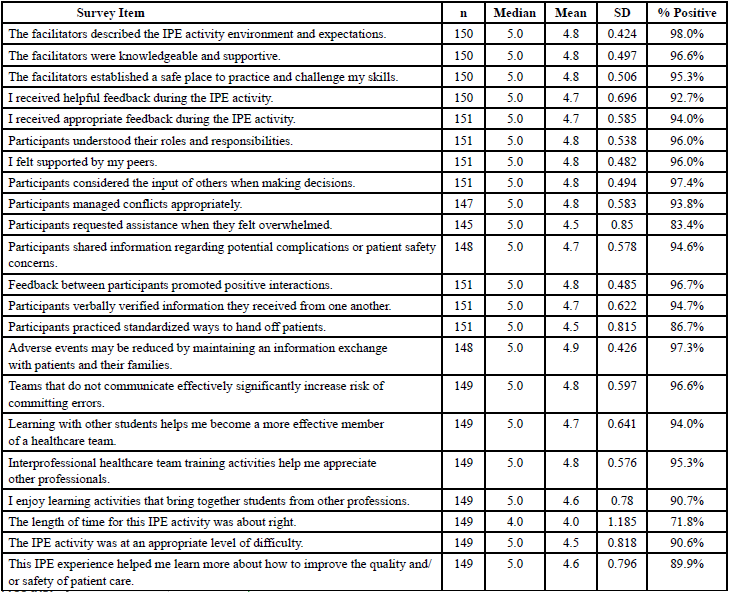
Table 1. Student Perceptions of TeamSTEPPS Training.
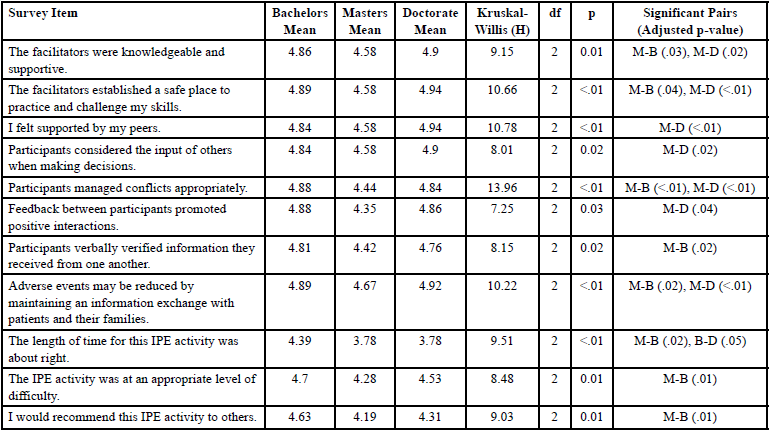
Table 2. Student opinions of TeamSTEPPS
Similar patterns were observed across several measures, with master’s students consistently reporting lower ratings than bachelor’s and doctoral students, including perceptions of psychological safety (H(2) = 10.66, p < .01), conflict management (H(2) = 13.96, p < .01), and appropriateness of activity difficulty (H(2) = 8.48, p = .01). These findings suggest that perceptions of TeamSTEPPS based IPE vary by level of training.
While overall perceptions were positive, ratings related to activity design were more variable. The perceived appropriateness of activity difficulty was rated favorably (90.6%). However, only 71.8% agreed that the length of the activity was appropriate, representing the lowest rated item. Most students indicated they would recommend the activity to others (84.6%).
Limitations
A limitation to IPE studies is the ability to control for confounding factors due to the inherently group nature of interprofessionalism and differing stages of student development. As noted by Gonçlaves et al., [12] simply bringing participants together from different disciplines challenges students because they spend too much time explaining themselves to others, or worse, some don’t have a deep enough knowledge about their own field to correctly explain it to a peer. Further, the logistical, program timetable, and student degree progression create barriers to ensuring participants complete TeamSTEPPS I before completing TeamSTEPPS II. As such, some students receive higher-level training without having completed introductory and foundational IPE exposure as they self-select into activities. While our sample reported overall favorable experiences, an added constraint to effective evaluation of our TeamSTEPPS I and II activities is that they are facilitated by faculty with varying degrees of experience with IPE and may change from one session to the next.
Although Likert‐scale data are ordinal and therefore typically analyzed using medians rather than means, in this the median values across groups showed little to no variance. Reporting mean values provided a more interpretable summary of group tendencies without meaningfully distorting the data [13]. This approach is used here for practical clarity, with the acknowledgment that Likert responses do not strictly meet the assumptions of interval-level measurement. the median values across groups showed little to no variance. Reporting mean values provided a more interpretable summary of group tendencies without meaningfully distorting the data. This approach is used here for practical clarity, with the acknowledgment that Likert responses do not strictly meet the assumptions of interval-level measurement.
Discussion
This study contributes to the existing literature on TeamSTEPPSbased IPE by providing additional cross-sectional evidence of highly positive student perceptions across facilitation quality, teamwork behaviors, and attitudes toward interprofessional collaboration. The findings reinforce prior research demonstrating strong learner receptivity to TeamSTEPPS while offering more granular insight into specific teamwork competencies, highlighting areas of relative strength (e.g., psychological safety, shared decision-making) and opportunity (e.g., help-seeking, handoff communication). These patterns are consistent with earlier studies showing that TeamSTEPPSbased training improves student attitudes, communication skills, and teamwork confidence, particularly in simulation-based IPE contexts [14,15].
Notably, the analysis identified significant differences by educational level, with master’s-level students reporting lower ratings across several domains, suggesting that learner experience may vary by training stage an area that remains underexplored in the literature. While prior IPE researchers [2] have documented variability in outcomes based on discipline and experience level, few studies have directly examined differences across academic training levels within TeamSTEPPS interventions. Collectively, these results extend prior work by linking perceived IPE quality, teamwork processes, and patient safety understanding within a single evaluation framework, while also identifying opportunities for targeted instructional refinement. These findings further align with broader IPE literature emphasizing that well-designed, facilitated IPE activities can enhance learners’ understanding of team-based care and patient safety, while also highlighting the importance of tailoring experiences to learner readiness and developmental stage [2,3].
Conclusions
Findings from this study demonstrate that TeamSTEPPS-based IPE is associated with consistently positive student perceptions across facilitation quality, teamwork behaviors, and interprofessional attitudes, reinforcing its value as an effective approach for preparing learners for team-based care. At the same time, significant differences observed across educational levels suggest that student experience may vary by training stage, highlighting the importance of tailoring IPE design and delivery to meet the needs of diverse learners.
These results provide institution-specific evidence to inform ongoing program refinement, particularly in strengthening competencies such as help-seeking and handoff communication. While the findings support a strong foundation for IPE implementation, they also underscore the need for continued investigation into longerterm outcomes, including retention of teamwork skills, objective assessment of communication behaviors, and sustained impact on practice.
Conflicts of Interest:
The author(s) declare that they have no competing interests.
Acknowledgements include:
Jennifer Celso, Brandy Jackson and Trisha Self.
References
World Health Organization. (2010). Framework for action on interprofessional education and collaborative practice. View
Reeves, S., Fletcher, S., Barr, H., Birch, I., Boet, S., Davies, N., McFadyen, A., Rivera, J., & Kitto, S. (2016). A BEME systematic review of the effects of interprofessional education: BEME Guide No. 39. Medical Teacher, 38(7), 656–668. View
Thistlethwaite, J. (2012). Interprofessional education: A review of context, learning and the research agenda. Medical Education, 46(1), 58–70. View
Institute of Medicine. (2015). Measuring the impact of interprofessional education on collaborative practice and patient outcomes. National Academies Press. View
Zwarenstein, M., Goldman, J., & Reeves, S. (2009). Interprofessional collaboration: Effects of practice based interventions on professional practice and healthcare outcomes. Cochrane Database of Systematic Reviews, 2009(3). View
Agency for Healthcare Research and Quality. (2019). TeamSTEPPS® 2.0: Strategies and tools to enhance performance and patient safety. AHRQ. View
King, H. B., Battles, J., Baker, D. P., Alonso, A., Salas, E., Webster, J., Toomey, L., & Salisbury, M. (2008). TeamSTEPPS™: Team strategies and tools to enhance performance and patient safety. In Advances in patient safety: New directions and alternative approaches (Vol. 3). AHRQ. View
Clapper, T. C., & Kong, M. (2012). TeamSTEPPS®: An evidence based teamwork system to improve communication and teamwork skills. Medical Science Educator, 22(1), 5–9. View
Interprofessional Education Collaborative. (2016). Core competencies for interprofessional collaborative practice: 2016 update. View
Palaganas, J. C., Epps, C., & Raemer, D. B. (2014). A history of simulation enhanced interprofessional education. Journal of Interprofessional Care, 28(2), 110–115. View
Robertson, J., Bandali, K., & Doyle Waters, M. (2016). Interprofessional education in health care: An integrative review. Journal of Allied Health, 45(2), 113–122.
Rodrigues da Silva Noll Gonçalves J, Noll Gonçalves R, da Rosa SV, Schaia Rocha Orsi J, Santos de Paula KM, Moysés SJ, Werneck RI. (2023). Potentialities and limitations of Interprofessional Education during graduation: a systematic review and thematic synthesis of qualitative studies. BMC Med Educ. Apr 12;23(1):236. View
de Winter, J. C. F., & Dodou, D. (2010). Five point Likert items: t test versus Mann–Whitney–Wilcoxon. Practical Assessment, Research & Evaluation, 15(11), 1–16. View
Brock, D., Abu-Rish, E., Chiu, C. R., Hammer, D., Wilson, S., Vorvick, L., Blondon, K., Schaad, D., Liner, D., & Zierler, B. (2013). Interprofessional education in team communication: Working together to improve patient safety. BMJ Quality & Safety, 22(5), 414–423. View
Weaver, S. J., Dy, S. M., & Rosen, M. A. (2014). Team-training in healthcare: A narrative synthesis of the literature. BMJ Quality & Safety, 23(5), 359–372. View