
- About the Journal
- Editorial Board
- Review Process
- Author Guidelines
- Article Processing Charges
- Special Issues
- Current Issue
- Past Issue
 Journal of Social Work and Welfare Policy
Journal of Social Work and Welfare Policy Volume 3 (2025), Article ID: JSWWP-172
https://doi.org/10.33790/jswwp1100172Research Article
The Impact of Anti-DEI Legislation on LGBTQ+ College Students: A Survey of Trends
Erin Stevenson1*, PhD, MSW, and Stephanie Saulnier2, MSW,
1,2Associate Professor, Department of Social Work, Eastern Kentucky University, 521 Lancaster Avenue, Keith Building 223, Richmond KY 40475, United States.
Corresponding Author Details: Erin Stevenson, PhD, MSW, Associate Professor, Department of Social Work, Eastern Kentucky University, 521 Lancaster Avenue, Keith Building 223, Richmond KY 40475, United States.
Received date: 25th October, 2025
Accepted date: 02nd December, 2025
Published date: 04th December, 2025
Citation: Stevenson, E., & Saulnier, S., (2025). The Impact of Anti-DEI Legislation on LGBTQ+ College Students: A Survey of Trends. J Soci Work Welf Policy, 3(2): 172.
Copyright: ©2025, This is an open-access article distributed under the terms of the Creative Commons Attribution License, which permits unrestricted use, distribution, and reproduction in any medium, provided the original author and source are credited.
Abstract
This report examines the detrimental impact of recent anti-Diversity, Equity, and Inclusion (DEI) legislation on LGBTQ+ high school and college students across the United States. Following the termination of DEI programs under an executive order in 2025, states continued to pass anti-DEI bills, significantly affecting access to gender-affirming care, inclusive education, and campus resources. National surveys of LGBTQ+ youth indicate increased mental health challenges, suicidal ideation, and enacted stigma as this wave of exclusionary policies moves forward. Additionally, educational environments have become restrictive, leading to diminished support services and increased feelings of isolation among students. The researchers explored how experiences of social stigma have changed over time, particularly before and after the implementation of anti-DEI and antitrans policies. Comparisons were made between results of surveys conducted in 2023 and 2025 with convenience samples of LGBTQ+ students at a southeastern university. The 2023 survey gave insight into their experiences with stigma in secondary school; the 2025 survey focused on stigma experiences in college. Results show stigma experience changing with increased positive connections in college compared to high school. Overall, the study highlights the importance of advocacy and inclusive policies in safeguarding the well-being of marginalized populations in higher education.
Keywords: Diversity, Equity, Inclusion, Policy, Stigma, Mental Health
Introduction
Recent legislative efforts to dismantle Diversity, Equity, and Inclusion (DEI) programs have had profound and harmful effects on youth in the lesbian, gay, bisexual, transgender, questioning/ queer plus (LGBTQ+) community across the United States. These laws, which often restrict access to gender-affirming care, inclusive education, and campus resources, are contributing to a public health crisis marked by increased psychological distress, educational disruption, and social isolation. They perpetuate negative stigmatizing social perceptions.
In January 2025, the U.S. government, under an executive order from President Donald J. Trump, ended all DEI programs and offices, stating they were radical and wasteful spending. Another executive order focused on the Department of Labor, aiming to end the promotion of diversity through DEI mandates, programs, or activities. The order forced any agency receiving federal funds to comply with this order, including universities or colleges. By mid- 2025, over 28 anti-DEI bills have passed into law across the U.S. [1]. The Chronicle of Higher Education has been tracking changes across universities, including impact on jobs, offices, training, diversity statements, and other DEI activities or programs [2].
Mental Health Impacts
The impact of anti-DEI legislation can be found in national youth mental health data from The Trevor Project’s longitudinal study. The Trevor Project and Kinsey Institute completed a groundbreaking study between Sept. 2023 and March 2025, covering a period that saw a noticeable increase in legislation targeted at eliminating DEI programs and policies as well as anti-LGBTQ+ legislation and rhetoric [3]. The number of youth between the ages of 13 and 24 reporting anxiety significantly increased (from 57 to 68%) with a similarly marked increase in depressive symptoms (48 to 54%).
Rates of suicidal ideation also rose among LGBTQ+ youth from 41 to 47%, with transgender and non-binary youth reporting the highest levels of distress. Despite a slight decline in suicide attempts (from 11 to 7%), rates remain significantly higher than among cisgender peers. In one survey, 86% of trans and non-binary youth said anti-trans debates harmed their mental health. Nearly 1 in 3 avoided medical care due to fear. A causal relationship exists between anti-trans laws and increased suicide attempts among trans and non-binary youth. Suicide attempts rose by 7 to 72% in states that enacted such laws between 2018 and 2022 [4].
Similarly, the American Psychological Association (APA) [5] reports that 90% of LGBTQ+ youth say politics negatively affect their well-being [6]. APA reports heightened levels of anxiety, depression, and suicidal ideation among LGBTQ+ youth, especially in states with bans on gender-affirming care, sports participation, and inclusive school policies. About 45% of trans and non-binary youth considered relocating due to hostile laws [6].
Educational and Social Impacts
College is often the first environment where students can explore their identities with relatively lower risk, as many experience their initial separation from family and greater independence. For LGBTQ students, this period is particularly significant because they encounter and negotiate oppressive cisheteronormative systems that shape their self-perceptions and experiences [7].
Research shows that disclosing one’s sexual or gender identity (being "out") in supportive contexts yields significant benefits, including higher self-esteem, improved psychological well-being, and empowerment. Disclosure itself, regardless of others’ reactions, often brings a profound sense of relief and authenticity, allowing individuals to integrate their identities more fully and reduce the mental burden of concealment [8]. For instance, LGBTQ+ college students who are “out” tend to experience less psychological distress, lower rates of depression, stress, and suicidal ideation compared to those who conceal their identities [9].
Colleges play a critical role in destigmatizing LGBTQ+ identities through providing supportive environments and relationships, which foster resilience and a renewed sense of strength and courage for students navigating identity challenges [10]. This underscores the important developmental, psychological, and social benefits for LGBTQ+ students engaging openly with their identities in collegiate settings.
Since 2023, more than 29 anti-DEI bills have become law [2]. A study by the Williams Institute found that anti-DEI laws led LGBTQ+ faculty to omit certain topics, reduce research on LGBTQ+ issues, and experience increased mental health strain [11]. Additionally, many of the laws prohibit specific offices for diversity, equity or inclusion services, programs, and training. In many states, such as Alabama, this includes prohibiting colleges from sponsoring or requiring attendance at programming based on race/ethnicity, nationality, sexuality, or gender. This restrictive learning environment can directly affect student learning and mentorship.
These anti-DEI laws have also led to the closure of campus resources and student support programs. This results in a loss of community, mentorship, and access to gender-affirming services, directly affecting student retention and academic performance [12]. Kentucky signed a bill into law starting June 30, 2025, that forbids DEI initiatives or programs in public colleges. In response, state universities were required to develop policies that forbid requiring students, faculty, or staff to "endorse or condemn a specific ideology, political viewpoint, or social viewpoint" to be eligible for admission, graduation, promotion, or hiring [13]. Students are aware of these changes as they trickle down to their program admission guidelines and graduation requirements. Faculty are affected as they are pressured to change lessons or assignments that highlight living in a diverse world [2].
Faculty and students report feeling unsafe, silenced, and surveilled. LGBTQ+ faculty are less likely to be “out,” and many have altered their teaching or research to avoid backlash [11]. Students report feeling isolated and unsupported, which undermines their sense of belonging and academic success.
Shim [14] highlights how structural discrimination embedded in anti-DEI policies contributes to long-term mental health harm for marginalized populations, including transgender and non-binary youth. Cole et al. [10] noted that LGBTQ+ students entering college are concerned about access to appropriate and affordable health and mental health care. They are aware of the political discourse around not only LGBTQ+ issues but also increasing open prejudice coming from K-12 experiences during the slew of anti-DEI laws.
Examining Current Trends with Secondary Data
The implementation of anti-DEI laws is occurring in real time affecting college and university policy. The authors felt it was important to share insights found through reexamining two current datasets that capture LBGTQ+ college student trends in experiencing social stigma on campus. The research studies used an adapted stigma scale [15] and the researchers identified the comparison of stigma at different time periods as an important way to contribute to our knowledge of the impact of the anti-DEI laws.
Research Question
The primary research question asked: How have experiences of stigma among LGBTQ+ youth changed over time considering increased anti-DEI and anti-trans legislation and policies?
Materials & Methods
The researchers combined secondary data from two convenience samples of anonymous LGBTQ+ college students enrolled at a fouryear liberal arts university in the Southeastern United States. The first dataset, collected in Fall 2023, asked students to reflect on their recent high school experiences when responding to stigma scales. The second dataset, collected in Spring 2025 at the beginning of university implementation of state level anti-DEI legislation, focused on students’ current college experiences. Both datasets used adapted stigma scales [15,16]. By running descriptive statistics we compared responses from Fall 2023 and Spring 2025—after the implementation of numerous anti-DEI laws—the researchers examined trends in stigma experiences among LGBTQ+ college students.
Participants
All respondents met the following inclusion criteria: they were at least 18 years old, enrolled as full-time students at the university, and self-identified as members of the LGBTQ+ community. It is unknown how many LGBTQ+ students are at this university; therefore, a response rate is not included. In Fall 2023, 94 students participated in the anonymous electronic survey, while the Spring 2025 survey received 277 unique responses. The university administration emailed all students during both semesters—Fall 2023 and Spring 2025 – sharing an electronic link to the survey. The survey was open for about 6 weeks each time. Participation was voluntary and anonymous, approved under expedited review by the university IRB.
Results from Secondary Datasets
For this article, a secondary dataset was compiled focused on comparing responses to the same stigma scales in surveys from Fall 2023 and Spring 2025. All respondents met the same inclusion criteria.
The Spring 2025 survey included a question on the level of perceived connectedness both online and in person with the campus community and with the wider LGBTQ+ community. About 37.2% of respondents felt connected to the campus community, while 62.8% felt only a little or not at all connected to campus. Connection to the LGBTQ+ community in general was higher, with 66.5% feeling very or somewhat connected, while only 33.6% felt only a little or not at all connected.
In Figure 1, respondent ratings from the Spring 2025 survey are displayed on the impact of being LGBTQ+ on substance use and mental health. The majority of respondents (83.5%) believed LGBTQ+ stigma affects mental health. Similarly, 69.2% (combined "very much" and "somewhat") see stigma as a moderate to strong contributor to substance use. While stigma is more widely recognized as affecting mental health, a substantial portion of students also link it to substance use as a coping mechanism.
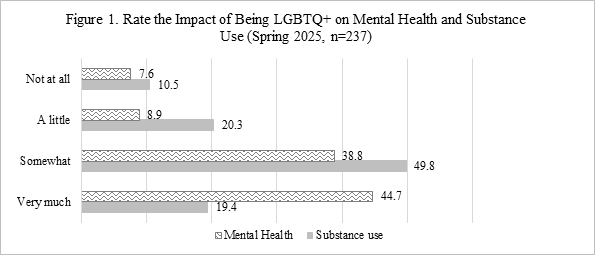
Figure 1: Rate the Impact of Being LGBTQ+ on Mental Health and Substance Use (Spring 2025, n=237)
Stigma Scale Comparisons
The secondary dataset compared Fall 2023 and Spring 2025 survey questions from the same stigma scales. Scales for internalized negative social messages and perceived beliefs about negative stigma in society were adapted from Puckett et al. [16]. The scale for enacted stigma was adapted from Gower et al.’s [15] study of youth perceptions of lived experience with oppression and discrimination. Respondents rated their level of agreement in the stigma scales with statements using Strongly Agree, Agree, Disagree, or Strongly Disagree. The analyzed dataset is from anonymous college students, ages 18 or older, who identified as LGBTQ+. Fall 2023 questions reflected on recent high school experiences, while Spring 2025 questions asked students to focus on the present time in college.
Enacted Stigma
Figure 2 illustrates significant differences in LGBTQ+ students' experiences between high school and college across key indicators of enacted stigma and support. The data point to positive changes as individuals attend college.
There appears to be a substantial increase in perceived safety in college environments (H.S. 34.5% vs. College 66.7%). Individuals report nearly double the rate of openness with being LGBTQ+ in college compared to high school (H.S. 24.5% vs. College 49.5%). We also see a sharp decrease in reported physical or verbal attacks (H.S. 53.8% vs. College 16.2%) and experiences of discrimination due to being LGBTQ+ from high school (53.8%) to college (13.3%).
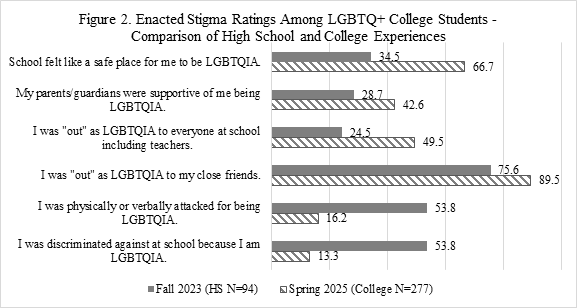
Figure 2: Enacted Stigma Ratings Among LGBTQ+ College Student Comparison of High School and College Experiences
Perceived Stigma
Figure 3 displays a comparison of perceived stigma. Across all five statements, students consistently reported higher levels of perceived stigma in high school than college. This suggests that perceptions of societal stigma may decrease with age, education level, or exposure to more inclusive environments like those typically found in college.
Public displays of affection are still seen as stigmatized, though less so in college (H.S. 90.5 vs. College 75.0%). A strong stigma remains around LGBTQ+ individuals raising children, but students perceived more acceptance in college (H.S. 89.3 vs. College 71.9%). Students reported more optimism about family acceptance in college (H.S. 80.6 vs. College 61.0%).
The stereotype that LGBTQ+ people have mental health issues persists strongly in both groups, though slightly less once students were in college (H.S. 88.2 vs. College 80.3%).
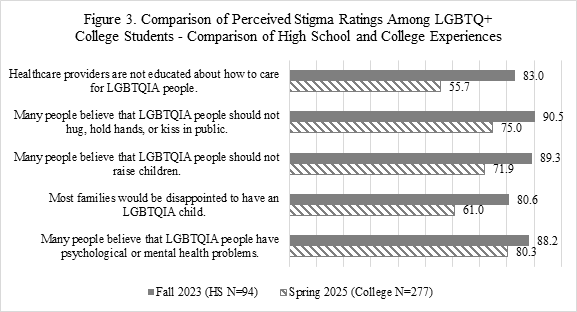
Figure 3: Comparison of Perceived Stigma Ratings Among LGBTQ+ College Students - Comparison of High School and College Experiences
Internalized Stigma
Internalized stigma ratings are displayed in Figure 4. Viewpoints appear to shift in complex ways between high school and college. There is a small increase in internalized negative feelings about being LGBTQ+ in college, suggesting that stigma may persist or intensify in some ways (H.S. 18.7 vs. College 21.8%).
Greater acceptance is evident in fewer attempts to change sexual orientation (H.S. 64.9 vs. College 41.2%). However, slightly more students reported feeling that being LGBTQ+ is a shortcoming when in college (H.S. 18.7 vs. College 21.8%), and fewer expressed pride in being LGBTQ+ (H.S. 86.2 vs. College 78.2%).
Slightly more students believed sexual orientation (H.S. 27.8 vs. College 35.1%) and gender identity (H.S. 29.7 vs. College 34.4%) are choices once they were in college, which may reflect evolving understandings of human behavior and personal beliefs.
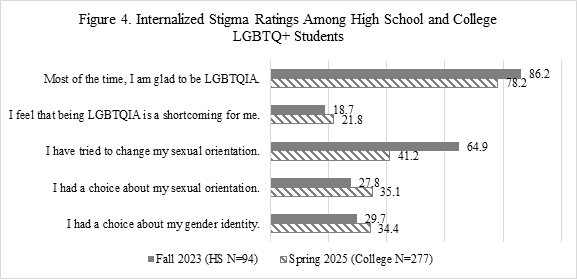
Figure 4: Internalized Stigma Ratings Among High School and College LGBTQ+ Students
Discussion
Consistent with findings from the Trevor Project (2025), our examination of secondary data found that LGBTQ+ youth experience college environments as significantly more affirming than high school, with this effect particularly pronounced among transgender and gender-nonbinary students. Participants reported that their college was a “safe place” at nearly twice the rate they had reported for high school safety. Additionally, a larger proportion of students indicated being open about their identity, especially with close friends, reflecting an encouraging shift toward greater acceptance and inclusion in higher education settings. The increase in perceived choice about identity may reflect broader exposure to diverse perspectives in college, though it can also signal internal conflict or societal influence.
College appears to offer greater safety, support, and openness for LGBTQ+ students. It is a place where student reports lower levels of enacted stigma, particularly in terms of attacks and discrimination. This suggests the increased visibility and openness in college is a positive shift for students as institutional and peer support improves. As anti-DEI policies are implemented in colleges and universities this may change and continued research is encouraged.
Perceived stigma is high in both groups, but college students report lower levels across all categories, indicating a possible shift in societal attitudes or greater resilience and support in college environments. Despite improvements, stigmatizing beliefs remain prevalent, especially around public affection, parenting, and mental health stereotypes. Anti-DEI legislation and polices may be helping continue to perpetuate these stereotypical views.
Correlating with internalized stigma ratings, our study found that students were significantly less likely to have attempted to change their sexual orientation since high school, indicating measurable progress in self-acceptance and supportive environments. Nevertheless, this improvement exists alongside troubling policy developments. In states such as Kentucky, Texas, and Ohio, where conversion therapy remains legally permissible, the proportion of students nationally reporting threats or coercion to undergo such practices has doubled [3]. These patterns emphasize the pressing need for comprehensive policy reform to safeguard LGBTQ youth and eliminate exposure to harmful and discredited interventions.
In our survey, one in five students reported daily substance use. Moreover, more than 70% of participants agreed, at least somewhat, that LGBTQ+ students often use substances as a means of coping with stigma. These findings align with national data from The Trevor Project (2022), which indicate that 14% of LGBTQ+ youth under age 21 report daily substance use, and with broader research demonstrating that this population experiences higher rates of substance use disorder than their cisgender or heterosexual peers [17]. Of particular concern, substance use is strongly associated with increased suicide risk—youth who misuse prescription drugs face nearly triple the rate of suicide attempts and completions, while alcohol misuse is linked to a 50% increase in risk.
We acknowledge the limitation of these comparisons. This article is an initial exploration of the idea that recent anti-DEI legislation which stigmatizes LGBTQ+ student may be negatively impacting secondary and higher education. Using the available secondary data, we see indicators of positive protective factors against the impact of stigma in college that are not as apparent in high school. A follow up survey will be necessary to determine whether the positive protective factors continue to exist when institutions have fully implemented federal and state policy changes.
Recommendations
Based on these findings, we recommend that colleges and universities continue to prioritize inclusive policies and practices that foster safety and openness for LGBTQ+ students. Institutions should actively monitor the impact of anti-DEI legislation and advocate for protections that prevent regression in student connectedness and campus climate.
Expanding peer support networks, affirming counseling services, and faculty training on intersectionality of LGBTQ+ issues with community identity can help sustain the positive trends observed in higher education. Targeted interventions addressing substance use and mental health stigma are critical, given their strong association with suicide risk. College students with risk factors, including stigmatized racial, ethnic, sexual, and gender identities, are more likely to retain and graduate with affirming and accessible medical and mental health care [7]. Colleges and universities must ensure access as part of retention efforts.
Conclusion
Future research should explore longitudinal outcomes to determine whether college-based protective factors persist beyond graduation and how policy shifts influence these dynamics over time. Supporting intersectional approaches that address the compounded effects of racism, transphobia, and economic insecurity. Anti-DEI legislation is not merely a political issue—it is a public health concern. Action is needed to reverse these trends and ensure that all young people can thrive in safe, affirming environments from high school to college and beyond.
Competing Interests:
The authors declare that they have no competing interests.
Acknowledgments
We are grateful to Gregory Sandman, PhD, Assistant Professor at Eastern Kentucky University, and research assistant Mack Rutherford, who assisted with the surveys and data collection.
References
Council on Social Work Education (CSWE). (2025). DEI bans and restrictions tracker: July 2025 update (CSWE). View
Gretzinger, E., Hicks, M., Dutton, C., Smith, J., Cutler, S., & Baiocchi, A. (2025, October 17). Tracking higher ed’s dismantling of DEI. The Chronicle of Higher Education. View
Nath, R., Matthews, D.D., Hobaica, S., Eden, T., DeChants, J.P., Clifford, A., Taylor, A.B., & Suffredini, K. (2025). Project SPARK interim report: A longitudinal study of risk and protective factors in LGBTQ+ youth mental health (2023-2025). The Trevor Project. View
Trevor News. (2024, September 26). Anti-transgender laws cause up to 72% increase in suicide attempts among transgender and nonbinary youth, study shows. The Trevor Project.
American Psychological Association (APA). (2025, October 7). The evidence against “conversion therapy”: Insights from psychological research. APA. apa.org/topics/lgbtq/conversiontherapy- research View
Novotney, A. (2024). ‘The young people feel it’: A look at the mental health impact of transgender legislation. View
Thacker Darrow, N. E., Duran, A., Weise, J. A., & Guffin, J. P. (2022). LGBTQ+ college students’ mental health: A content analysis of research published 2009–2019. Journal of Gay & Lesbian Social Services, 35(3), 330–359. View
Legate, N., Ryan, R. M., & Rogge, R. D. (2017). Daily autonomy support and sexual identity disclosure predicts daily mental and physical health outcomes. Personality and Social Psychology Bulletin, 43(6), 860-873. View
Pachankis, J. E., Mahon, C. P., Jackson, S. D., Fetzner, B. K., & Bränström, R. (2020). Sexual orientation concealment and mental health: A conceptual and meta-analytic review. Psychological Bulletin, 146(10), 831–871. View
Cole, J., Burkhart, J., & BrckaLorenz, A. (2025). Experiences and expectations of LGBTQ+ students before entering college. New Directions for Higher Education. View
Goldberg, A.E. (2024, May). The impact of anti-DEI laws on LGBTQ+ faculty in higher education. UCLA School of Law, Williams Institute. View
Alonso, J. (2025, March 31) Report: 6 in 10 LGBTQ Texas students said they were negatively impacted by DEI Ban. Inside Higher Ed. View
Acquisto, A., & Kast, M. (2025, May 16). EKU adopts ‘institutional viewpoint neutrality’ policy under KY’s new anti- DEI law. Lexington-Herald Leader Newspaper. View
Shim, R. S. (2025, May 1). How anti-DEI policies adversely affect mental health. JAMA Health Forum, 6(5), e252163. View
Gower, A.L., Valdez, C.A.B., Watson, R.J., Eisenberg, M.E., Mehus, C.J., Saewyc, E.M., Corliss, H.L., Sullivan, R., & Porta, C.M. (2021). First- and second-hand experiences of enacted stigma among LGBTQ youth. The Journal of School Nursing, 37, 185–194. View
Puckett, J.A., Newcomb, M.E., Ryan, D.T., Swann, G.; Garofalo, R., & Mustanski, B. (2017). Internalized homophobia and perceived stigma: A validation study of stigma measures in a sample of young men who have sex with men. Sexuality Research & Social Policy, 14, 1–16. View
Paschen-Wolff, M.M., DeSousa, A., Paine, E.A., Hughes, T.L., & Campbell, A.N.C. (2024). Experiences of and recommendations for LGBTQ+-affirming substance use services: an exploratory qualitative descriptive study with LGBTQ+ people who use opioids and other drugs. Substance Abuse Treatment Prevention Policy 19, 2. View