
- About the Journal
- Editorial Board
- Review Process
- Author Guidelines
- Article Processing Charges
- Special Issues
- Current Issue
- Past Issue
 Journal of Social Work and Welfare Policy
Journal of Social Work and Welfare Policy Volume 4 (2026), Article ID: JSWWP-182
https://doi.org/10.33790/jswwp1100182Review Article
Humanity and Spirituality in Social Work Practice: A Qualitative Study on Mental Health and Healing
Mohit Prodhan, DSW, MSW
Assistant Professor of Social Work, College of Nursing, Health and Human Services, Texas A&M University–Texarkana, Texas 75503, United States.
Corresponding Author Details: Mohit Prodhan, DSW, MSW, Assistant Professor of Social Work, College of Nursing, Health and Human Services, Texas A&M University–Texarkana, Texas 75503, United States.
Received date: 06th November, 2025
Accepted date: 20th January, 2026
Published date: 22nd January, 2026
Citation: Prodhan, M., (2026). Humanity and Spirituality in Social Work Practice: A Qualitative Study on Mental Health and Healing. J Soci Work Welf Policy, 4(1): 182.
Copyright: ©2026, This is an open-access article distributed under the terms of the Creative Commons Attribution License, which permits unrestricted use, distribution, and reproduction in any medium, provided the original author and source are credited.
Abstract
This qualitative study explores how humanity and spirituality function as interconnected dimensions of mental health and healing in social work practice. Using a phenomenological approach, two focus groups were conducted: one with clients of The Village Nac, a community-based nonprofit in Texas, and another with licensed social workers (LSW) from diverse practice settings across the United States. Thematic analysis identified four themes: compassion as relational healing, spirituality as resilience and meaning, belonging as recovery, and ethical responsibility as transformation. Together, these themes illustrate how dignity, connection, moral presence, and meaning-making shape participants’ lived experiences of healing. The findings suggest that integrating humanity and spirituality into social work education, practice, and policy can strengthen ethical engagement and support holistic well-being across diverse contexts. Future research may broaden this work across additional communities and practice contexts and may incorporate mixed-methods designs to deepen understanding of these relational and spiritual dimensions.
Keywords: Humanity, Spirituality, Mental Health, Social Work Practice, Phenomenology
Background
Social work is grounded in advancing human dignity, compassion, and equitable care values that form the ethical core of the profession [1]. As mental health needs become increasingly complex, practitioners are encouraged to move beyond technical interventions and consider the emotional, moral, and spiritual dimensions that shape individual and community well-being. These deeper layers of practice reflect social work’s longstanding commitment to relational care, ethical responsibility, and holistic engagement.
Humanity is defined as the embodiment of compassion, kindness, empathy, sacrifice, selflessness, and moral responsibility toward others, regardless of social identifiers such as race, class, gender, or religion. It reflects a universal recognition of human dignity and the moral obligation to uphold care and justice in interpersonal, community, and systemic contexts [2]. Within this study, humanity is understood not merely as a philosophical ideal but as an actionable principle that shapes relational presence, ethical engagement, and compassionate practice in social work.
Spirituality refers to the human search for meaning, purpose, and connection to something greater than the self, whether or not it involves affiliation with formal religious traditions [3]. It encompasses beliefs, values, and practices that nurture inner peace, moral reflection, self-transcendence, and compassion toward others. In social work practice, spirituality functions as both a grounding resource for practitioners and a source of resilience, hope, and healing for clients [4].
Recent scholarship affirms that spirituality enhances meaningmaking, reduces distress, and strengthens recovery for individuals navigating emotional or psychological hardship [5]. Similarly, compassion-driven engagement the core of humanity builds trust, empowerment, and therapeutic bonds, especially in marginalized and underserved communities, where social and emotional support is scarce [6]. Despite this, many practitioners report limited preparation for integrating spiritual or existential concerns into practice in culturally sensitive ways [7]. This gap highlights the need for more intentional attention to the moral, relational, and spiritual dimensions of social work.
Integrating humanity and spirituality requires recognizing that effective mental health support depends not only on skill, but on presence showing up with humility, ethical awareness, and an authentic commitment to shared humanity. When practitioners engage clients through moral sensitivity, reflective practice, and mindful presence, they foster spaces where healing, resilience, and connection can take root [6,8]. These intertwined dimensions help bridge the professional, cultural, and spiritual experiences that shape individuals’ lives.
Social work practice is widely recognized as fundamentally relational, with helping processes grounded in empathy, trust, and the intentional development of supportive practitioner–client relationships [9,10]. Building on this foundation, the present study extends the literature by examining how clients and practitioners describe relational presence when it is explicitly experienced and enacted through humanity and spirituality, particularly within a rural, community-based nonprofit context.
This study explores clients’ lived experiences of humanity and spirituality in relation to mental health and healing, alongside licensed social workers’ (LSWs’) perspectives on integrating humanity- and spiritually sensitive practice within the helping relationship. Through a qualitative, phenomenological approach, this study examines how humanity and spirituality function as guiding forces in practice and how they support resilience, belonging, ethical awareness, and holistic well-being. By centering participants’ experiences, the study contributes to the growing body of scholarship advocating for spiritually informed, humanity-centered approaches that reconnect the profession with its moral essence and relational foundations.
Literature Review
Humanity as an Ethical Foundation in Social Work
Humanity expressed through compassion, empathy, and moral responsibility has long shaped the ethical commitments of the social work profession [1]. Contemporary scholarship increasingly frames humanity not only as an ethical aspiration but as a core professional skill essential for relational practice. Recent studies highlight that compassion-centered engagement strengthens trust, deepens therapeutic connections, and supports the well-being of both clients and practitioners [6,8]. Acts such as listening without judgment, demonstrating unconditional respect, and honoring each person’s dignity contribute to healing, particularly among individuals experiencing poverty, trauma, or mental health challenges.
Humanity also operates as a counterbalance to the growing technocratic and managerial pressures within social services. Scholars argue that administrative demands and rigid evidencebased mandates can overshadow relational care, especially in rural and marginalized communities where connection is often central to survival [11]. Integrating humanity shifts practice toward moral presence, humility, and justice. Within mental health settings, this humanistic orientation enables practitioners to engage clients who may feel alienated or stigmatized by traditional clinical approaches.
Spirituality and Mental Health
Spirituality has gained renewed attention in social work as a vital dimension of holistic well-being. Current research links spiritual engagement with increased meaning-making, reduced emotional distress, and strengthened recovery processes [5]. Social work scholars increasingly recognize spirituality as a cultural, relational, and existential resource that fosters resilience and belonging [8]. Despite this growing recognition, many practitioners report uncertainty or limited training in addressing spiritual needs ethically and respectfully [7].
Emerging practice frameworks emphasize spiritual sensitivity as a skill rooted in cultural humility and reflexive awareness. These approaches encourage practitioners to support clients in exploring hope, gratitude, purpose, and connectedness without imposing beliefs. Spiritually informed practice aligns with mindfulness-based and trauma-responsive models that promote inner awareness, moral attunement, and compassionate engagement [6]. Such approaches help practitioners honor the interconnected emotional, cultural, and spiritual dimensions that influence mental health.
Intersections of Humanity, Spirituality, and Mental Health
Increasingly, integrative studies highlight the complementary roles of humanity and spirituality in supporting mental health recovery. Compassionate relational practices such as reflective listening, presence, and gratitude help nurture emotional regulation and empathic connection [8]. Spiritual reflection similarly contributes to resilience by offering meaning-making pathways that reduce despair, strengthen hope, and counter self-stigma [5]. Together, these dimensions form a relational and moral foundation for healing that extends beyond symptom management and fosters growth, dignity, and connection.
Within social work practice, integrating humanity and spirituality requires ethical awareness, relational sensitivity, and adaptive approaches. Practitioners are encouraged to maintain professional boundaries while fostering genuine, culturally respectful engagement [7]. Research suggests that community programs blending faithinformed support with secular mental health services may promote stronger client satisfaction, deeper trust, and longer-term healing, particularly in rural and community-oriented contexts [11].
Gaps in the Literature
Despite growing scholarly interest in spirituality and ethics within social work, several gaps remain within the existing literature.
Conceptual clarity. Humanity and spirituality are frequently discussed as related yet separate constructs, with limited attention to how they function together as interconnected dimensions of relational and ethical practice. While compassion, dignity, and moral responsibility are often cited as professional values, fewer studies explicitly conceptualize humanity as an actionable practice intertwined with spiritual meaning-making.
Empirical grounding. Although a small number of qualitative studies have examined spiritually sensitive or compassion-centered practice, most focus primarily on practitioners’ perspectives or clinical processes. For example, qualitative work by Stewart et al. [4] and Vieten et al. [7] explores how social workers navigate spirituality and ethical sensitivity in practice, while Hodge et al. [8] synthesizes qualitative insights related to spiritually informed engagement.
However, few qualitative studies capture the lived experiences of both clients and practitioners within the same inquiry, and even fewer examine humanity expressed through compassion, dignity, and moral responsibility as an integrated relational practice alongside spirituality.
Contextual application. Existing research on spirituality and mental health in social work is predominantly situated within urban, clinical, or hospital-based settings [5,7]. As a result, communitybased, rural, and nonprofit contexts where healing often occurs through informal support, relational presence, and shared meaning remain underrepresented in qualitative scholarship [11]. These settings may differ substantially from formal clinical environments in how humanity and spirituality are expressed and experienced.
Addressing these gaps is essential for developing integrative frameworks that honor the moral, relational, and spiritual foundations of social work. This phenomenological study responds to these limitations by exploring the lived experiences of both clients and licensed social workers within a rural, community-based nonprofit context, offering empirically grounded insights into how humanity and spirituality function together in mental health and healing.
Method
Research Design
This study used a qualitative phenomenological design to illuminate how clients and LSWs experience humanity and spirituality within mental health contexts. Phenomenology was chosen because it centers lived experience and meaning-making [12]. This approach aligns with the study’s focus on understanding compassion, dignity, and spiritual connection as they are experienced in practice.
Research Context
The study was conducted in collaboration with The Village Nac, a community-based nonprofit organization located in Texas that serves individuals experiencing homelessness, poverty, and mental health challenges. The organization operates through a relational, dignitycentered model that emphasizes compassion, belonging, and practical support. Services include access to shelter, meals, basic resources, peer support, and opportunities for community connection, alongside faith-informed and spiritually sensitive engagement that is client-led and non-coercive.
The Village Nac was an appropriate research setting for this study because its programming intentionally centers humanity expressed through relational presence, respect, and ethical care and provides space for individuals to draw upon spiritual beliefs or sources of meaning as part of healing. Clients who participated in the study had engaged with the organization’s services and community activities, allowing them to reflect on lived experiences of compassion, belonging, and spiritual support. This context offered a meaningful environment for examining how humanity and spirituality function together within a community-based, nonclinical mental health setting.
Participants and Sampling
Purposive sampling was used to select individuals with direct experience of the phenomena under study [12]. Two focus groups were conducted:
Focus Group 1. Eight clients of The Village Nac (four men and four women) who had experienced homelessness, poverty, trauma, or emotional distress and had engaged with the organization’s support services.
Focus Group 2. Eight LSWs from across the United States, two of whom explicitly integrate spirituality into their practice while others engage with relational and ethical approaches in diverse settings.
Participants were selected based on their ability to reflect meaningfully on compassion, humanity, spirituality, and moral responsibility. Consistent with qualitative inquiry, the goal was depth of insight rather than numerical representation.
Data Collection
Data were collected through two semi-structured focus groups conducted in person and via Zoom. The first focus group included clients of The Village Nac, and the second included LSWs from across the United States. Open-ended questions invited participants to reflect on their experiences of humanity, spirituality, belonging, and ethical engagement in personal and professional contexts. Sample prompts included:
“Can you describe a time when you experienced humanity such as compassion, dignity, or kindness from others?”
“In what ways has your connection with The Village Nac influenced your healing, sense of belonging, or well-being?”
“How do you integrate humanity through compassion, dignity, or respect into your work with clients?”
“What role do spiritual beliefs or practices play in how you support clients during moments of stress, trauma, or healing?”
These questions encouraged storytelling and meaning-making consistent with phenomenological inquiry. Participants were invited to share examples from their lived experience, discuss sources of resilience, and reflect on the moral, relational, and spiritual dimensions of healing. Each session lasted approximately 60–75 minutes and was audio-recorded with informed consent.
Data Analysis
Data were analyzed using open coding and thematic content analysis [12,13]. The analytic process included three iterative stages:
1. Initial Coding. Identifying meaningful expressions related to compassion, spirituality, belonging, and ethical responsibility.
2. Categorization. Grouping codes into broader conceptual categories such as relational healing, spiritual resilience, community connection, and moral action.
3. Theme Development. Synthesizing categories into overarching themes that captured the essence of participants’ lived experiences.
Throughout the analysis, the researcher practiced reflexivity by documenting analytic decisions, acknowledging their positionality as a practitioner-scholar, and maintaining transparency through an audit trail.
Trustworthiness
Trustworthiness was supported using Lincoln and Guba’s [14] criteria.
Credibility was enhanced through member reflections, peer debriefing, and triangulation of perspectives across client and practitioner groups.
Dependability was strengthened by systematic documentation of analytic procedures.
Confirmability was ensured by maintaining reflexive memos and an audit trail.
Transferability was supported by describing the research context, participants, and setting to allow readers to assess relevance to other environments.
Ethical Considerations
This study received Institutional Review Board approval from a public university in the United States and followed the ethical standards outlined in the NASW Code of Ethics [1]. Participants were informed about the purpose of the study, the voluntary nature of their involvement, and their right to withdraw at any time without consequence. Confidentiality was maintained through the use of pseudonyms and secure data storage practices. Conversations involving spirituality and personal beliefs were approached with cultural humility and sensitivity to honor the diverse backgrounds and experiences of participants.
This methodology offered an in-depth, ethically based exploration of how humanity and spirituality manifest within mental health practice. The phenomenological approach highlighted the shared meaning of compassion and moral responsibility, creating a foundation for understanding the intersection of faith, ethics, and mental well-being in social work.
Findings
The analysis revealed four interrelated themes that illustrate how humanity and spirituality shape healing, resilience, and ethical connection within clients’ and practitioners’ lived experiences. These themes Compassion as Relational Healing, Spirituality as Resilience and Meaning, Belonging as Recovery, and Ethical Responsibility as Transformation reflect the shared ways participants understand dignity, connection, and moral presence in mental health contexts.
Table 1 presents the demographic characteristics of participants, and Table 2 outlines the themes, associated categories, and representative quotes drawn from focus group discussions.
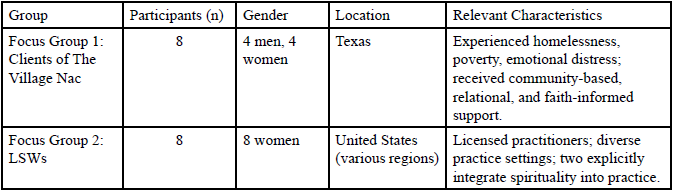
Table 1. Participant Demographics
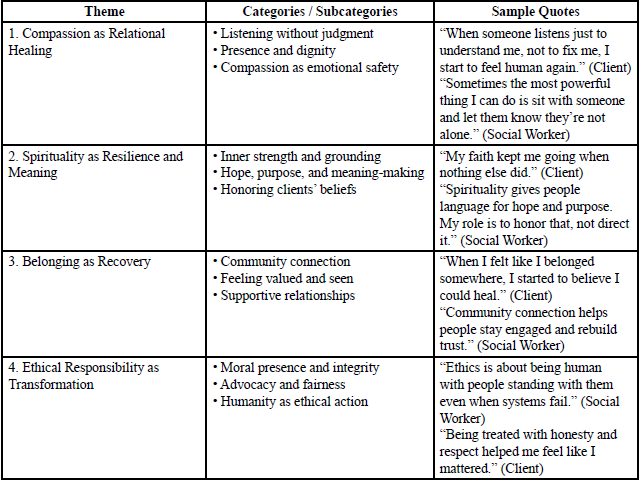
Table 2. Themes, Categories/Subcategories, and Sample Quotes
Theme 1. Compassion as Relational Healing
Participants consistently described compassion as the core expression of humanity. Clients spoke of moments when being treated with dignity through listening, presence, or simple kindness helped restore hope and emotional safety. One client shared, “When someone listens just to understand me, not to fix me, I start to feel human again.” Practitioners echoed this sentiment, highlighting that relational presence often fosters deeper healing than structured interventions. As one social worker reflected, “Sometimes the most powerful thing I can do is sit with someone and let them know they’re not alone.”
Compassion emerged as a lived practice that bridged isolation and connection, particularly for clients who had experienced stigma, trauma, or homelessness. These insights are reflected in Table 2, which outlines key categories such as nonjudgmental listening, dignity, and emotional safety.
Theme 2. Spirituality as Resilience and Meaning
Spirituality surfaced as a grounding force that supported both clients and social workers during moments of hardship. Clients described prayer, faith, and personal reflection as sources of inner strength. One participant noted, “My faith kept me going when nothing else did.” Practitioners described spirituality as a relational resource that supports meaning-making and ethical presence without imposing beliefs. One practitioner explained, “Spirituality gives people language for hope and purpose. My role is to honor that, not direct it.”
This theme highlights how spirituality nurtures resilience, purpose, and meaning consistent with subcategories presented in Table 2.
Theme 3. Belonging as Recovery
Belonging emerged as a vital component of healing and identity restoration. Clients shared how feeling valued at The Village Nac, in faith communities, or among peers helped them reconnect with themselves and others. One client reflected, “When I felt like I belonged somewhere, I started to believe I could heal.”
Social workers observed that belonging fosters sustained engagement, trust, and emotional safety. Community-based environments were described as spaces where individuals rebuild confidence and reduce isolation. Subcategories in Table 2 such as community connection, acceptance, and supportive relationships further illustrate this theme.
Theme 4. Ethical Responsibility as Transformation
Participants described humanity as moral action rooted in fairness, dignity, and compassion. Social workers emphasized that ethics are enacted through relational integrity, advocacy, and care. As one practitioner shared, “Ethics is about being human with people standing with them even when systems fail.” Clients also described ethical behavior as relational, noting that being treated with honesty and respect helped transform their sense of worth.
This theme emphasizes how ethical responsibility becomes transformative through compassionate action, reinforcing the moral dimensions outlined in Table 2.
Summary of Findings
Together, the four themes reveal that humanity and spirituality are deeply interconnected dimensions of mental health and healing. Compassion fosters emotional safety; spirituality nurtures resilience and purpose; belonging restores identity and connection; and ethical responsibility transforms relationships through dignity and moral presence. These findings highlight the relational and existential foundations of healing described by participants and provide insight into how humanity and spirituality shape both client experiences and social work practice.
Discussion
This study explored how humanity and spirituality shape the lived experiences of clients and LSWs within mental health practice. The findings illuminate four interconnected dimensions compassion, spirituality, belonging, and ethical responsibility that together form a relational and moral foundation for healing. These insights align with and extend existing literature, affirming that humanity and spirituality are not peripheral elements of social work but essential components that guide practice, ethical engagement, and well-being.
Humanity as a Relational and Ethical Practice
The theme of Compassion as Relational Healing reinforces scholarship describing compassion and dignity as core expressions of humanity in social work [6,8]. Participants emphasized the power of being listened to, acknowledged, and received with nonjudgmental presence echoing your definition of humanity as compassion, empathy, and moral responsibility.
These findings highlight that humanity is enacted through everyday relational practices rather than through formal techniques alone. For clients who experienced homelessness, trauma, or social marginalization, compassion restored a sense of visibility and worth. For practitioners, compassion served as an ethical anchor that shaped their approach to care. This relational foundation aligns with the NASW [1] commitment to dignity and respect, underscoring the importance of human connection as a healing force.
Spirituality as a Source of Resilience, Meaning, and Ethical Awareness
The theme Spirituality as Resilience and Meaning demonstrates how spiritual beliefs and practices support both clients and practitioners as they navigate trauma, uncertainty, and emotional hardship. Participants’ reflections affirm research suggesting that spirituality can function as a protective factor, offering grounding, purpose, and existential meaning [5].
This study extends the literature by showing how spirituality also strengthens practitioners’ ethical presence. Social workers described spirituality as informing humility, moral reflection, and a deeper sense of shared humanity. Rather than imposing spiritual views, practitioners emphasized honoring clients’ own beliefs an approach consistent with cultural humility and spiritually sensitive practice [7]. These insights reveal spirituality as intertwined with ethics, belonging, and resilience, forming a significant dimension of holistic healing.
Belonging as a Context for Recovery and Connection
The theme Belonging as Recovery illustrates the transformative role of community connection. Participants described belonging as a process through which individuals rebuild identity, reestablish trust, and develop a sense of safety. This finding aligns with research on the relational and community-driven dimensions of mental well-being [11].
In the context of The Village Nac, belonging was experienced through shared meals, relational presence, peer interactions, and spiritual community. For many clients, belonging countered isolation and offered a pathway toward emotional stability and hope. For practitioners, fostering belonging was perceived as an ethical and relational responsibility an extension of humanity in practice. This suggests that community-based social work settings can play a vital role in restoring dignity and strengthening recovery.
Ethical Responsibility as Transformative Practice
The theme Ethical Responsibility as Transformation highlights the moral dimension of social work as lived experience rather than procedural compliance. Participants described ethics as compassion in action showing fairness, honesty, integrity, and advocacy even in challenging systems.
These reflections align with Reamer’s [15] argument that ethical practice requires courage, moral sensitivity, and a commitment to justice. Clients described how being treated ethically transformed their sense of worth, illustrating how everyday moral actions can reshape healing relationships. For practitioners, ethical responsibility involved standing with clients, recognizing shared humanity, and responding with dignity. This perspective strengthens the idea that ethical practice is both relational and transformative.
Integration of Themes: Humanity and Spirituality as Interconnected Forces
Taken together, the four themes show that humanity and spirituality operate as intertwined dimensions that support healing, resilience, and belonging. Compassion fosters safety; spirituality cultivates meaning; belonging supports recovery; and ethical responsibility sustains dignity and moral presence. These interconnected dimensions reflect holistic models of care that integrate emotional, spiritual, relational, and ethical aspects of human life.
The findings also illustrate how community-based spaces like The Village Nac embody these dimensions organically, creating environments where healing unfolds through shared meals, conversations, relational presence, and spiritual grounding. This integrative, humanity-centered approach strengthens practice in ways that go beyond traditional mental health frameworks.
Contribution to Social Work Practice and Knowledge
This study contributes new insights to social work scholarship by:
1. Framing humanity as an actionable practice rather than a philosophical value.
2. Clarifying spirituality as a relational and ethical resource, not merely a belief system.
3. Highlighting belonging as a community-based pathway to healing, particularly in rural settings.
4. Reconceptualizing ethics as compassionate moral presence that transforms both clients and practitioners.
These contributions deepen the profession’s understanding of holistic well-being and reinforce the value of integrating humanity and spirituality into education, practice, and policy.
Implications
The findings of this study offer meaningful guidance for integrating humanity and spirituality into social work practice, education, and research. These implications draw from participants’ lived experiences and highlight approaches that support compassion, relational connection, ethical engagement, and holistic healing across diverse settings.
Implications for Social Work Practice
The themes identified in this study point to several ways practitioners can deepen humanity-centered and spiritually sensitive engagement:
1. Prioritize Relational Presence
Compassionate presence listening without judgment, demonstrating dignity, and showing kindness should be recognized as a central component of therapeutic work. Practitioners can integrate relational presence alongside clinical tools to create safe, emotionally grounded environments.
2. Honor Spiritual Diversity and Meaning-Making
Practitioners should create space for clients to explore their own spiritual beliefs, sources of meaning, and spiritual coping practices. This requires humility, cultural sensitivity, and an awareness that spirituality may function as a vital source of resilience.
3. Cultivate Community and Belonging
Practice models can intentionally incorporate communitybased supports, peer engagement, and relational activities that foster belonging. In rural or resource-limited settings, community connection may be a primary pathway to healing.
4. Embed Ethical Responsibility into Daily Interactions
Ethical practice involves more than adhering to codes it requires compassionate moral action, advocacy, and integrity. Practitioners can model ethics through fairness, honesty, and relational respect, reinforcing clients’ sense of dignity and worth.
5. Use Humanity as a Guide Across Micro, Mezzo, and Macro Levels
Humanity-centered practice can shape one-on-one engagement, organizational culture, community partnerships, and policy advocacy. Approaching clients as whole persons reinforces social work’s moral foundation.
Implications for Social Work Education
Findings suggest that schools of social work can strengthen training by integrating humanity and spirituality into curricula:
1. Teach Humanity as a Professional Skill
Coursework can include reflection on compassion, empathy, moral presence, and relational ethics, emphasizing these as competencies essential to effective practice.
2. Include Spiritual Sensitivity Training
Educators can prepare students to navigate spiritual conversations ethically and respectfully, using client-led approaches that honor cultural and faith diversity.
3. Promote Reflective and Experiential Learning
Reflection journals, mindfulness practices, community engagement, and structured dialogue can help students develop moral awareness, emotional intelligence, and cultural humility.
4. Model Humanity-Centered Pedagogy
Faculty can demonstrate humanity through listening, respect, accessibility, and supportive relationships, reflecting the very values students are expected to practice in the field.
5. Integrate Rural and Community-Based Perspectives
Including case examples and field experiences from rural, faithinformed, and nonprofit contexts broadens students’ understanding of belonging, spirituality, and community healing.
Implications for Social Work Research
Future research can continue strengthening the evidence base around humanity and spirituality in practice:
1. Explore Humanity and Spirituality in Diverse Contexts
Studies can explore how these dimensions appear in different regions, cultures, and practice environments, especially in underserved rural areas.
2. Develop and Refine Humanity-Centered Frameworks
This study contributes to the emerging Humanity Practice Model (HPM); future research may further refine its components through qualitative, participatory, or mixed-method designs.
3. Study Community-Based Models of Belonging
Community-driven programs such as The Village Nac can be further explored to understand how belonging shapes recovery and resilience.
4. Investigate Practitioner Well-Being
Research may examine how spiritual grounding, moral reflection, and relational presence support practitioner resilience, ethical awareness, and reduced burnout.
5. Strengthen Interdisciplinary Inquiry
Collaboration across social work, psychology, religion, and public health can deepen understanding of how humanity and spirituality intersect with mental well-being.
Implications for Policy and Community Systems
1. Support Community-Based, Humanity-Centered Initiatives
Policies can prioritize funding for relational, compassion-driven programs that meet emotional, spiritual, and practical needs, particularly in rural areas.
2. Promote Ethical and Dignity-Centered Standards
Agencies can embed ethical principles dignity, fairness, and respect into organizational culture, staff development, and service delivery.
3. Recognize Spiritual and Relational Needs in Mental Health Policy
Policies can acknowledge that healing often occurs through connection, meaning-making, and belonging, expanding the definition of mental health support beyond clinical frameworks.
Summary
Overall, the findings indicate that humanity and spirituality are essential dimensions of mental health and healing. Integrating these values across practice, education, research, and policy can strengthen social work’s moral grounding and enhance its capacity to support holistic well-being. The themes identified in this study highlight a path forward for intentionally incorporating compassion, belonging, meaning, and ethical responsibility into the profession’s core approaches.
Limitations
This study has several limitations that should be considered when interpreting the findings. The study was conducted with participants from The Village Nac in Texas, whose cultural traditions, faith backgrounds, and lived experiences shaped their reflections. While these insights offer depth, they represent a specific rural and community-based context. In addition, all licensed social worker participants were female, which may limit the diversity of practitioner perspectives included in the analysis. These factors narrow the transferability of the findings. Future research may expand to more diverse regions and practitioner backgrounds and can incorporate mixed-methods designs to strengthen understanding of humanity and spirituality in varied settings.
Conclusion and Future Directions
This study highlights that humanity and spirituality are essential dimensions of healing within social work practice. Through the lived experiences of clients and LSWs, the findings demonstrate that compassion, belonging, ethical responsibility, and spiritual meaning function as interconnected forces that support well-being, resilience, and relational connection. These insights reaffirm social work’s moral foundation and emphasize that healing emerges not only through techniques but through presence, dignity, and shared humanity.
The study contributes to the field by framing humanity as an actionable principle and spirituality as a grounding source of meaning and resilience. Community-based environments such as The Village Nac illustrate how relational and spiritual support can foster recovery, identity, and trust. Practitioners and educators can draw upon these insights to strengthen relational practice, cultivate spiritual sensitivity, and promote environments that honor clients as whole persons.
Future research may explore humanity and spirituality across more diverse cultural and geographic contexts, including urban, suburban, and global settings. Mixed-methods approaches can enrich this work by pairing qualitative depth with broader perspectives, offering a more complete understanding of how compassion, belonging, and spiritual meaning shape healing and ethical engagement in social work.
Competing Interest:
The authors declare that they have no competing interests.
References
National Association of Social Workers. (2021). Code of ethics of the National Association of Social Workers. View
The Pluralism Project. Humanism as a belief system. View
Canda, E. R., & Furman, L. D. (2010). Spiritual diversity in social work practice: The heart of helping (2nd ed.). Oxford University Press. View
Stewart, C., Whitworth, J. A., & Lawrence, S. A. (2022). The relationship of spirituality and empathy to attitudes towards addiction. Journal of Social Work Practice in the Addictions, 22(1), 1–20. View
López-Tarrida, Á. C., Suárez-Reina, P., & de Diego-Cordero, R. (2024). The confluence between spiritual and mental health: A phenomenological approach to the study of healthcare professionals’ experiences. Healthcare (Basel), 13(1), 35. View
Ramanathan, C. S., Juvva, S., Stephens, N., Scheyett, A. M., & Dutta, S. (2025). Spirituality, social work practice, and sustainable development. Journal of Religion & Spirituality in Social Work: Social Thought, 1–21. View
Vieten, C., Astin, J., Bussema, R., & Hooker, S. (2023). Mental health professionals’ perspectives on the relevance of spiritual and religious backgrounds and practices in clinical care. BMC Psychology, 11(1), 146. View
Hodge, D. R., Boynton, H. M., Vis, J. A., Graham, J. R., Coholic, D., & Canda, E. R. (2025). Spirituality in social work practice: Myth or essential component of ethical and effective service provision? Journal of Social Work, 25(2), 250–270. View
Cleece, K., Cheneler, B., Harrison, J., & Hill, J. E. (2025). Relational practice, a critical component for successful social work. Cogent Social Sciences, 11(1). View
Lamph, G., Lamph, J., Maguire, N., & Davies, L. (2023). Relational practice in health, education, criminal justice, and social care: A scoping review. Systematic Reviews, 12, 194. View
Smith, S. J., & Read, J. (2025). Work with people in mental distress who access spirituality/religion. The British Journal of Social Work, 55(1), 401–418. View
Creswell, J. W., & Poth, C. N. (2024). Qualitative inquiry and research design: Choosing among five approaches (5th ed.). SAGE. View
Nowell, L. S., Norris, J. M., White, D. E., & Moules, N. J. (2017). Thematic analysis: Striving to meet the trustworthiness criteria. International Journal of Qualitative Methods, 16(1), 1–13. View
Lincoln, Y. S., & Guba, E. G. (1985). Naturalistic inquiry. SAGE. View
Reamer, F. G. (2023). Ethics and values in social work (6th ed.). Columbia University Press. View