
- About the Journal
- Editorial Board
- Review Process
- Author Guidelines
- Article Processing Charges
- Special Issues
- Current Issue
- Past Issue
 Journal of Social Work and Welfare Policy
Journal of Social Work and Welfare Policy Volume 4 (2026), Article ID: JSWWP-189
https://doi.org/10.33790/jswwp1100189Research Article
Re-envisioning Social Work Education Policy: Social Work Students’ Perspectives on Anti-Racist Curriculum and Training
Laneshia R. Conner1*, Becky Anthony2, April L. Murphy-Morgan3, Austin Weiler4, Jennifer R. Jewell4, and Victoria Venable-Edwards2
1College of Social Work, University of Kentucky, Kentucky, United States.
2School of Social Work, Salisbury University, Maryland, United States.
3Department of Social Work, Human Services, & Criminal Justice, Columbia College, Missouri, United States.
4School of Arts & Sciences, Columbia College, Missouri, United States.
Corresponding Author Details: Laneshia R. Conner, Ph.D., MSW, CSW, Assistant Professor, College of Social Work, University of Kentucky, Kentucky, 631 Patterson Office Tower, Lexington, KY 40506, United States.
Received date: 06th February, 2026
Accepted date: 23rd March, 2026
Published date: 25th March, 2026
Citation: Conner, L. R., Anthony, B., Murphy-Morgan, A. L., Weiler, A., Jewell, J. R., & Venable-Edwards, V., (2026). Re envisioning Social Work Education Policy: Social Work Students’ Perspectives on Anti-Racist Curriculum and Training. J Soci Work Welf Policy, 4(1): 189.
Copyright: ©2026, This is an open-access article distributed under the terms of the Creative Commons Attribution License, which permits unrestricted use, distribution, and reproduction in any medium, provided the original author and source are credited.
Introduction
Professional social workers are charged with the ethical mandate to address inequities and advance social justice initiatives within myriad arenas that reflect micro, mezzo, and macro intervention levels [1]. Social work education has typically operationalized this mandate through cultural competency training readings, classroom discussion, and field placement often treating competence as an individual skill that can be achieved. The usage of cultural competence frameworks as an approach to address systemic and structural racism has been critiqued and is often compared to cultural humility [2]. Cultural competence baseline trainings inherently focus on learning about the “other” and promotes that one can know about another culture and its contexts. Cultural competence elevates the ability of the individual to practice from a place of expertise that is exempt from bias or stereotyping. This way of thinking reduces the need for critical self-reflection as it focuses learning on the “other” [3]. Scholars and practitioners argue that cultural competency frameworks can depoliticize racism, minimize power and structural conditions, and provide limited accountability for anti-racist practice. This critique raises a policy-relevant question: How do social work students think social work education should change through curriculum governance, field education requirements, and evaluation practices to prepare them for anti-racist practice?
From Cultural Competence to Anti-Racist Practice
Cultural humility is a way of being that requires one to honor the experiences of others and critically self-reflect [4]. When practiced, it can create a space of respectful curiosity [5,6] and encourage anti-oppressive pedagogies. Too often, cultural competence baseline training has limited culture to race and ethnicity, giving little attention to other important components of culture. This significantly diminishes the role of culture and eliminates the need for self- reflection, limiting opportunities to develop a deeper understanding and improve interactions and treatment of affected populations. Therefore, relying solely on a cultural competence framework to address systemic change is less effective than adopting a continuous, context-driven approach that emphasizes respect, remains flexible, and recognizes individual uniqueness that ultimately fosters ongoing development of critical consciousness [3,7].
Anti-racist practice is the intentional and ongoing commitment to seek out and understand systemic racism and actively work towards rejecting and dismantling the manifestations of systemic racism by naming racism, rejecting complicity, identifying how racism is operating within a given system or institution (e.g., examining policies, filling gaps, seeking representation at all tables) and committing to action [8]. Jones further outlines eight collective action teams that “harnessed the wisdom and energy of anti-racist activists” [8]. These eight collective action teams focused on the following: communication and dissemination; education and development; global matters; history; liaison and partnership; organizational excellence; policy and legislation; and science and publication [8].
The overarching outline and guiding questions of the collective action teams can serve as an interdisciplinary anti-racist framework within numerous fields, including social work and social work education. A key strategy for increasing cultural awareness is ongoing self-evaluation, as culture shapes our sense of self and influences how we interpret the world. This reflection must also extend to the field of social work, including an examination of how it has contributed to and sustained racist and oppressive policies and practices [9].
However, many social work educators struggle to teach cultural competence through self- and cultural awareness because social work curricula often fail to address the profession’s dual role as both an oppressor and an advocate. Additionally, many social work educators are also unable to teach cultural humility, a process of continuous self-evaluation and critique that challenges power imbalances and serves as a powerful tool for advancing anti-racism efforts in the classroom [10]. This difficulty stems, in part, from the reality that no single course or curriculum can adequately address the complex, multilevel issues involved in such work. The lack of discussion in social work classrooms about both the historical and ongoing presence of racism, including within the social work profession, may be attributed to instructors’ unconscious and internalized racism, as well as the tendency to frame marginalized groups as the “other,” as identified in participatory research on teaching anti-racism [10].
Structural Racism and Implications for Social Work Education
Structural racism within the United States creates a majority narrative that identifies white individuals as the perceptual baseline that illustrates the lived experience of white people. An example of this was the mention of the over identification of Black, Indigenous, and People of Color (BIPOC) characters within young adult fiction novels and a disproportionate lack of white character identifiers in White Fragility: Why It’s So Hard for White People to Talk About Race [11]. This can lead the reader to assume that all characters are white unless otherwise specified, which can create an “otherness.” The dominant culture that was enacted through the continued mandate of this perception forces all BIPOC individuals to be categorized as “other” and subsequently assumes that social workers who are part of the dominant culture are white [12]. In addition to the prevalence of the “other,” the co-occurring perception of “good white people” who bolster efforts to be more culturally competent and the separation of “bad white people” who support systemic racism can create further division [11,13]. Similarly, concepts akin to “not seeing color,” focusing on shame/guilt instead of cultivating more anti-racist approaches, and furthering division among “bad white people” instead of providing education and taking accountability to be anti-racist. It is also discussed that the mindset of “good white people” through cultural competency alone gives permission to blame systemic racism on the past or on “bad white people” instead of taking ownership and accountability to challenge systemic oppression with immediacy [13]. Cultural competence is a constantly evolving concept, and it can be difficult to define or measure because it emphasizes potential understanding rather than concrete, observable actions. Negative connotations of “otherness” are sometimes linked to cultural competence, which can lead white students and those close to whiteness to dismiss the need to be culturally competent or, even more so, anti-racist [12].
There are three tasks outlined to prioritize anti-racist practice: naming racism; asking how racism is operating here; and organizing and strategizing to act. Naming Racism is the act of allocating time and resources to the acknowledgement of racism, weakening the strength of society as a whole rather than spending time trying to create a divide of “who is racist and who is not.” Asking How Racism is Operating Here? focuses on being accountable for filling the gaps of representation within institutions to ensure racism is not implicitly or explicitly being presented within decision making. Organizing and Strategizing to Act is the purposeful and intentional commitment to establishing a plan of action and committing to act to combat racism [8].
Classroom and Institutional Challenges
Current classroom obstacles with the cultural competency baseline training that has been historically utilized include the innate ability to separate from the discussion. This training allows social workers to distance themselves from the profession’s role in perpetuating institutional and structural racism. By framing the problem as belonging to other helping professions, it “others” them and creates the false impression that social work is somehow exempt from participating in these harmful systems. Abdicating the social work profession from being racist leads to a lack of involvement in dismantling these systems within our own field. The Council on Social Work Education (CSWE) revealed statistics in 2019 that highlighted the demographics of social work students within U.S. programs. According to their data, 50.2% of Master of Social Work (MSW) students in 2019 were white, 20.1% were Black, and 16.3% of students were Latinx [14]. Given that over half of MSW students whose programs participated in the survey identified as white, this illustrates the importance of program and profession- level accountability measures to address students of privilege (e.g., students from a high social economic status; white students who are the racial majority) who are given an “out” when discussing race related topics through a cultural competency instructional lens. As such, their lived experiences as the “non-other” often enables them to “check-out” of cultural competency related discussions and lectures. This presents an obstacle because it fosters the barrier of separation between white social work students and their BIPOC colleagues, clients, and community members. Conversely, placing greater emphasis on white social work students’ roles within oppressive and racist systems that confer privilege would be more impactful and help develop anti-racist practice skills. This approach would provide more practical tools for navigating difficult conversations and actively interrupting injustice.
Shifting the mindsets of students and educational institutions to a more anti-racist ideology can be accomplished through establishing anti-racism into action within educational systems, which necessitates an ongoing commitment to deconstructing and reconstructing the complex layers that result from the individual educational system’s policies, procedures, and institutional culture [15]. Identifying racism as the root issue within disproportionate oppressive systems is vital to combat the widespread denial of the aforementioned in the United States.
Shifting mindsets of lecturers within higher education is another essential component to foster anti-racism within the classroom because they shape students’ experiences. White lecturers may be more likely to overlook their own racial identity and the privilege associated with it, which can lead to a failure to recognize their responsibility to teach anti-racist frameworks and to challenge racist institutions [16]. This lack of racial awareness and teaching responsibility leaves curricular gaps that are often left to be filled by BIPOC lecturers [5], which further misallocates the responsibility of teaching anti-racism to BIPOC individuals. White lecturers must hold themselves accountable by demonstrating anti-racist practice in tangible ways. This includes ongoing self-interrogation, examining how whiteness and power shape their teaching, revising course content and classroom practices, and equipping students with tools to identify and challenge structural and institutional inequities in agencies and communities. This work requires institutional support, such as protected time within teaching workloads for reflexivity, critical self-assessment, and pedagogical development without it, expectations for anti-racist teaching risk remaining aspirational rather than pragmatic.
Emerging Anti-Racist Frameworks in Social Work Education
There have been recent developments in social work education that illustrate how anti-racism is increasingly being formalized at both accreditation and programmatic levels. The 2022 Council on Social Work Education’s (CSWE) Educational Policy and Accreditation Standards (EPAS) explicitly position anti-racism, diversity, equity, and inclusion (ADEI) as foundational to social work education. This commitment is reflected in both the explicit and implicit curriculum, requiring programs to integrate ADEI across all aspects of the educational environment rather than treating it as a stand-alone topic. Within the explicit curriculum, CSWE embeds ADEI through revised competencies, including the integration of racial justice within Competency 2 and the addition of Competency 3, which focuses on engaging anti-racist and anti-oppressive practice. These competencies require programs to provide intentional instruction, learning activities, and measurable outcomes that prepare students to recognize and challenge systemic inequities in practice. ADEI must also be demonstrated through the implicit curriculum, which encompasses the program’s culture, policies, faculty composition, practicum education experiences, and institutional climate. This means that programs must not only teach anti-racism in coursework but also model it through equitable practices, inclusive environments, and meaningful representation. ADEI is assessed not only by what is taught, but by how programs operate, ensuring students experience anti-racist and anti-oppressive principles in practice throughout their education [17]. In response, several schools have integrated anti- racist pedagogy into their curricula. For example, Columbia School of Social Work uses a Power, Race, Oppression, and Privilege framework and supports anti-racist initiatives [18]. Silberman School of Social Work embeds racial equity and just practice across its curriculum. Smith College School for Social Work mandates a community-based anti-racism experience in its MSW program [19]. These efforts indicate a shift from general diversity rhetoric to explicit anti-racist design. However, they represent institutional experiments rather than established best practices, owing to limited evidence on effectiveness, consistency, and student outcomes.
Developing actionable anti-racist practice skills provides educators and practitioners with practical tools to combat oppressive practices and biased learning in the classroom. One way this can be achieved is through the employment of Danso’s [20] Critical-Cultural- Anti-Oppressive-Practice (CCAOP). CCAOP is a framework that emphasizes anti-oppressive practice while promoting a deeper understanding and appreciation of human diversity. This framework emphasizes a commitment to social justice and social change, guiding social work educators, practitioners, and researchers to engage with clients and communities mindfully and collaboratively, using a shared, agreed upon approach to address identified problems as the foundation of practice [20]. This subsequently recognizes the importance of self-determination in critically anti-oppressive practice [20]. One of the leading principal tasks of anti-racist social workers and social work educators is the need to “unpack” or “deconstruct” white privilege for efficacious professional practice. Anti-racist social workers assert that professional social workers must explore their own identities and how they are contributing to systems of oppression and subsequently maintain inequity. Though implicit bias training utilized within social work programs initiates this process, the efficacy of these practices alone without the commitment to anti- racist practice that is both active and intentional lead to significant educational gaps [21]. However, ongoing commitments towards challenging bias and being anti-racist will foster continued learning and self-accountability outside of the classroom. Social work educators and leaders are encouraged to confront their own privilege and complicities as part of active social work curriculum and instruction to ensure they are leading by example in the classroom and in the field [22].
The authors contend that social work programs face considerable challenges in sustaining essential anti-racism efforts amid current federal mandates. Without dedicated institutional support, including protected time for faculty reflexivity and pedagogical development, these initiatives risk devolving from mandated aspirations into superficial compliance, undermining the profession's mission, NASW Code of Ethics, and commitment to ADEI. At this point in our history, teaching from this perspective is both a privilege and a challenge, especially for faculty who are tenure-track or not yet tenured. Acknowledging this reality is essential. These challenges are exacerbated by the dominant white racial frame within the United States, which often complicates critical interrogation of systemic whiteness and its influence on social work education [23,24].
Unlearning oppression and confronting complex histories require sustained, difficult dialogue between students and educators. Amid concerns that anti-racism content in social work education remains insufficiently actionable, this study examines social work students’ perceptions of how curricula should change to better prepare them for anti-racist practice shaped by the intersecting pandemics that exposed racial inequities. Using qualitative analysis of survey responses, we address the question: How do students think social work education can improve to include anti-racist practice training? This inquiry followed an earlier quantitative study that developed and validated a measure of anti-racism for social work students, educators, and practitioners.
Methods
The design for this study was exploratory in nature and utilized descriptive, qualitative methodology. This approach was used to gain an understanding of the perceptions of social work students on the presence, or lack thereof, of anti-racism practices in social work education. This design allowed for rich descriptions of the students’ perceptions.
Sampling Strategy and Design
Data were collected from students enrolled in accredited social work programs in 2020, using purposive sampling [25]. Participants were recruited via email, through the assistance of Deans and/or Program Directors, and social media (i.e., Facebook; Twitter). Each potential participant was provided with a brief overview of the study, including approval documents from the Institutional Review Board (IRB) at Author 2’s University, and a link to a Qualtrics survey. The first item in the survey was the approved informed consent document, along with the following statement: “Please indicate that you consent to participate in this study.” If participants answered “yes” to this item, their responses were included. If the response was “no,” then they were taken to the end of the survey.
Analytical Approach
Descriptive analyses were conducted using version 27 of the Statistical Package for the Social Sciences (SPSS). Descriptive statistics were used to summarize participants’ demographic characteristics. Participant responses to the item, “How do you think social work education can improve to include anti-racist practices?” were saved in a separate file. Any respondent who did not respond to this item was excluded from analysis. Responses were analyzed utilizing a step-by-step guide for the analysis and interpretation of qualitative data. The steps to data analysis included: organization, perusal, classification and synthesis [26]. First, the data were downloaded into a Word document. During the perusal stage, the first author carefully read through the data and then classified the data using word and phrase reparation. After the data were coded, this researcher utilized the identified codes to create initial themes, which summarized the data. The analysis focused on the perceptions of the social work students and anti-racist practices. The first author reached data saturation when there was enough data collected to replicate the study and when further coding was no longer feasible [27]. To ensure rigor, an audit trail was created to establish confirmability. Random selection of several responses was selected for the development of the coding scheme and later compared codes with author 3 [28]. Intercoder reliability was established with authors 1 and 3 who carefully read the data for recurrent themes. The first author brought the created themes to the larger research team to discuss results for peer debriefing. Four researchers from the study (authors 1-4) adapted the initial themes and created the final themes based on group consensus, triangulation of the data to check perceptions, understand the data, and to discuss discrepancies of the data. Transferability, authenticity, and credibility were established by collecting data from social work students, drawing from the Social Work Education Anti- Racism (SWEAR) scale, a standardized from, and the year-long engagement with the data [29].
Results
There were 363 student participants who responded to the item, “How do you think social work education can improve to include anti-racist practices?” Participants ranged in age from 18 to 65, with the average age being 31.1 years (SD = 11.0 years). While a majority of participants reported residing in the United States (n = 358, 98.6%), 1.4% reported living outside of the United States at the time of participation (n = 5). It is important to note that 38 states were represented in this study. Regarding race/ethnicity, most participants identified as white (61.2%), followed by African American/Black (15.4%), Hispanic/Latino (10.2%), multiracial (8.5%), other race/ ethnicity (2.5%), Asian (1.7%), and Native American/First Nations (0.6%). A majority of participants reported they spoke English as their primary language at home (n = 340, 93.7%) while 6.3% reported speaking another language primarily in their home. In terms of gender, 79.1% of participants identified as cisgender female, 15.4% as cisgender male, 3.3% as gender non-conforming, 1.4% as transgender, and 0.8% selected another gender category. Table 1 presents more details related to participant demographics.
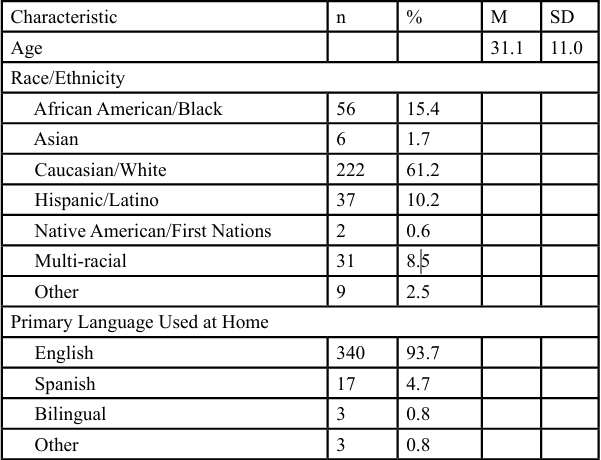
Table 1: Sample Characteristics
Table 1 displays school/program-level characteristics. A majority of participants reported being a MSW student (n = 187, 51.7%), while 45.3% reported being a BASW/BSW student (n = 164, 45.3%) and 3.0% reported being a doctoral (i.e., Ph.D., Ed.D., DSW) student (n = 11). While a majority of doctoral students did report having a graduate degree (i.e., MSW) in social work (n = 9, 81.8%), a majority of MSW students did not have an undergraduate degree in social work before beginning their MSW program (n = 147, 75.4%). When asked about what format they typically take courses, 44.6% reported taking face-to-face courses (n = 162), 39.4% reported taking online courses (n = 143), and 16.0% reported taking hybrid courses (n = 58). Participants were also asked how many courses they had taken on cultural diversity at the time of this study. They reported a wide range (0 – 23), with the average being 2.6 courses (SD = 2.5).
Findings
The researchers created five overall themes including: (1) Re- envisioning the curriculum; (2) Embracing courageous conversations; (3) Fostering Representation; (4) Engaging in advocacy; and (5) Acknowledging resistance and ambivalence. While not coded as a theme, less than one percent, or 12 participants stated they did not know. At first glance, this could have been coded as ambivalence, indicating they do not think social work education can improve anti- racist practices. However, the responses do not explicitly state this; therefore, it was inferred that the student participants did not know strategies or suggestions to include. One participant said, “no input,” while others noted, “I don’t know” or “unknown.” One participant provided a longer explanation, “to be honest, I have just recently been accepted into the MSW program, and my undergraduate education was in social work. I am involved in social work professionally, but I can’t speak on any experiences in social work education.” There was either not enough information provided to code these statements (i.e., the first quotes noted above) or the participant was unsure of how to improve anti-racist social work education (i.e., the second quote).
Re-envisioning the Curriculum
This theme generated the highest number of responses. Approximately 68% of participants highlighted specific social work educational strategies that could be utilized (n = 246). The majority of responses accounted for the creation of new diversity-related content, specifically the call for a stand-alone required course. Participants asked for a specific anti-racism course, while others utilized terminology, such as cultural competency, diversity, privilege and oppression, and/or cultural humility, but still asked for a stand-alone course that focused on these topics.
Some participants listed specific content they would like to see directly addressed in the explicit curriculum. Participants noted that they would like additional education about biases. For instance, one participant noted, “Provide more resources and materials for students to review that can help them recognize their own biases and prejudice attitudes” and another reported the need for “action-based education.”
A small minority of participants mentioned specific resources by name. These included books, assignments, and specific classroom activities. While these comments did not make up a majority of the responses, they suggest that some social work educators and students have already identified resources that can be utilized to teach this content.
Embracing Courageous Conversations and Strategies
Fifty-six items (15%) were coded within this theme, Embracing Courageous Conversations and Strategies. The majority of the responses for this theme focused on the need to increase discussions around anti-racism specifically within the classroom, among other students in various settings, and with community members. Examples of discussion-based comments included: “direct practice with engaging in difficult conversations;” “foster more conversations about the topic;” and “student led discussion groups and media sharing so multiple voices can be heard.” A handful of participants noted concrete examples of specific courageous conversations they would like to have, such as “monthly or every other month meetings with students, professors, and staff to address any concerns for inequity (open forum, not just class reps)” and “Holding space for open dialog about ‘what’s going on’.” Another participant suggested, “white accountability groups where white students can come together to discuss issues of racism without further traumatizing students of color or making them the token educators on the issue.” Student participants asked for additional conversations that included how to address racism when they are presented with it: “real life scenarios shown in the classroom of how to shut down racist talk/behaviors. Ways to shut down family members, friends, professional coworkers, and future clients. How to remain calm and professional but be firm with what will be tolerated.”
Fostering Representation
This theme, Fostering Representation, highlights the need for racially diverse social work educators and students. Fourteen percent (n = 51) of the responses fit into this theme. The majority of the responses coded in this theme discussed the need for more racially diverse faculty in the field of social work education. Examples of the comments coded in this sub-theme include: “diversify instructors and have BIPOC in leadership positions” and “have more BIPOC professors.” One student participant noted: “I have had solely white professors throughout my social work career. That is fundamentally backwards.”
About one third of responses in this theme suggested including the contributions of BIPOC social workers throughout the curriculum to increase representation. Specifically, a student participant noted, “I hope to learn more about the contributions of POC to the social work field.” Other participants suggested that the field “use educational materials not written and developed by white folks” and “include more theories and practices written and introduced by BIPOC.”
Fewer participants (n = 5) spoke directly about diversifying the student population. Some example comments include the following: “We need a much, much greater representation of students from the BIPOC community in our MSW program” and “financial assistance or incentives to increase the representation of people of color in the Social Work profession.”
Engaging in Advocacy
Forty-seven (13%) responses were coded with this theme, Engaging in Advocacy. The majority of these responses called for general advocacy and did not include specific advocacy strategies. An example of this is the following participants’ quotes: “Policy development” and “Social workers must act in a legal and political role.” More specific responses were coded into two sub-themes: Community engagement and legislative advocacy. One participant noted that social work education should “Require students to engage with activist seeking social/racial justice and require volunteering in a least two ongoing anti-racist initiatives to deepen the students’ education with real world experiences.” Legislative advocacy suggestions included: “write to your state legislators about racial justice-minded legislation” and “changing policies within the school that are racist or uphold racist ideology.”
Acknowledging Resistance and Ambivalence
Twenty-four (7%) responses were coded in this theme, Acknowledging Resistance and Ambivalence, and responses were broken into resistance and ambivalence. These researchers’ impression is that both terms reflect a resistance, with ambivalence suggesting a passive resistance and the term resistance being used here to describe the more active or direct resistance to anti-racist social work education. Quotes in the direct resistant theme include: “Stop the focus on race and re-focus to teaching skills, knowledge, technique and how to help all people” and “We need to stop sub grouping humans. It [is] like if we are sports team. We have allowed people to divide us into different teams and levels. In reality we all play on the human race team. Yes, we have different roles on the team but if every part doesn’t work right we can’t function.” Additional examples include statements such as: “Promote ‘ALL LIVES MATTER’” and this statement suggesting that anti-racism is not based in science - “It shouldn’t. we should be focused on legit science. There is a reason we are made fun of and not taken seriously. This ‘study’ is one of them.” Ambivalence was suggested by participants who noted that no change was needed. Four participants specifically mentioned that their specific department or school of social work was already doing a good job at this and did not provide any suggestions for how to improve. This was coded as ambivalence because anti-racist work is lifelong and this suggests that there is nothing else to do surrounding the goal of anti-racism social work education.
Discussion
Jones [8] highlighted the need for Naming Racism as the first strategy to engage in anti-racist practice. For social work educators, stand-alone classes that focused on anti-racism, privilege, power, oppression, and other connected topics would be a start to addressing this. CSWE [30] proposed 2022 EPAS that utilize the terms anti- racism and cultural humility. This shift in language suggests that this terminology should be adopted within social work programs and social work education should be actively anti-racist and address these topics directly by dedicating curriculum content. The authors acknowledge that just teaching a class about a topic is not enough to address this, but for many, it would be a starting point and an opportunity for social work to specifically name and focus on anti racist social work practice. We see this as one potential starting place, but not the end.
Critical multi-culturalism and anti-racism that places emphasis on active engagement and cultivating strong skills oriented in research and subsequently illustrated through practice demonstration will necessitate pedagogical shifts in the educational structure within higher education. The importance and need of this addition to curriculum will provide a platform that fosters transformative thinking among all students. This addition will help create a space for students who are privy from experiencing the consequences of systemic racism to acknowledge their privilege and learn how they can be more actively anti-racist. This is vital to assist in radically addressing the systems that threaten the very lives of BIPOC individuals.
Instructors need to look inward at their own personal role and explore how racism is operating within our own systems (Jones, 2018), including social work education. Participants noted that we need to engage in courageous conversations with students, faculty, staff, and community members. These conversations will take many different forms based on the needs of the educational community but should first focus on listening. Then we need to utilize the information learned from the conversations to intentionally commit to a plan of action and commit to enacting that plan within social work education [8]. Participants suggested advocacy and engaging in action; however, many did not list specific strategies. This suggests that social work education has developed strategies to help us “name racism” but perhaps we are still struggling to determine how to engage in anti-racist action-based practice. One respondent suggested that we “be clear in what steps someone can take to check the boxes of anti-racism.” The authors strongly suggest against a checklist or a one-size fits all approach to addressing systematic racism and anti- racist social work practice. Instead, we recommend that social work education programs critically examine their own practices by listening to students and engaging in reflective evaluation, then commit to intentional actions that address the specific needs and concerns of their school communities. Some suggestions include the following: a standalone anti-racism course that includes specific action project assignments; town halls hosted by the social work department that ask for feedback around specific topics (e.g., curriculum, student opportunities for engagement, etc.); developing an intentional anti- racist action plan and developing an intentional accountability structure to ensure that the plan is being completed; acknowledging the field’s historical and current role in systematic oppression; and being intentional about diversifying faculty and student populations by implementing strategies to help diversify faculty.
Meaningful implementation requires institutional support, including workload recognition, protected time for faculty preparation, administrative backing, and academic freedom protections for politically contested topics [31,32]. A key policy implication is that institutions cannot advocate for anti-racist education while leaving its implementation to overextended individual faculty members. Social work educators and academic leaders also need to acknowledge resistance to anti-racist practice and adopt policies that limit its influence. As Kendi [33] argues, it is not enough to change people’s hearts regarding racism but that we need to adopt policies that are anti-racist if we want to enact long-term change that challenges current systems. One way to achieve this is for programs to embed anti-racist content across required coursework, field education, and competency assessments. This can be done by following models such as Cornell's programmatic infusion of anti-racist pedagogy throughout the MSW curriculum, ensuring it is not treated as elective, episodic, or dependent on individual instructors [34]. Currently, there is resistance, including ambivalence, within the field to adopt anti-racism social work practice, especially anti-Black racism. We should continue to provide narratives about systematic racism and the ways that white supremacy has shaped our society and our field. We also need to enact policies that uphold social work’s values of social justice and human rights within social work education that do not allow this type of resistance to flourish. An example of this are schools providing structured faculty development programs focused on critical self-interrogation. This will also include the need for workload policies to explicitly recognize and credit this as intensive labor that falls on underrepresented and historically excluded faculty and staff. Such policies could include a requirement that faculty provide at least a certain percentage of BIPOC authors on their syllabus and require faculty to create professional goals that specific address anti-racist social work practice. Social work academic leaders should establish support within the larger institution in order to implement some of these policies as well as to serve as a buttress in the event that there is blowback from others. In addition, social work education programs must consider how to effectively address both active and passive resistance among students.
Conclusion
More research, dialogue, and program-level policy change are needed to strengthen how social work education confronts white supremacy and prepares students for anti-racist practice. This study centered student perspectives to identify actionable strategies that educators and academic leaders can translate into curriculum, field, and assessment reforms. Findings underscore the importance of explicitly naming racism and moving beyond awareness-oriented approaches toward measurable, practice-based anti-racism training. This study has important limitations. Thematic interpretation is inherently influenced by researchers’ lens and the self-selected sample limits generalizability. Even so, the results provide a practical starting point for programs seeking to clarify expectations, reduce variability across courses, and implement accountable anti-racist educational practices and social work educational policies.
Statements of Declaration
Acknowledgements: none to declare
Funding: None to declare
Competing interests: The authors declare that they have no competing interests.
We have no known conflict of interests to disclose.
References
Bussey, A., Thompson, M., & Poliandro, E. (2021). Leading the charge in addressing racism and bias: Implications for social work training and practice. Social Work Education, 41(5), 907- 925. View
Cambron, S., & Conner, L. (2020). Using a lens of cultural humility to dissolve racialized inequities for families. Reflections: Narratives of Professional Helping, 26(2), 13-19. View
Yeager, K. & Bauer-Wu, S. (2013). Cultural humility: Essential foundation for clinical researchers. Applied Nursing Research, 26(4), 251-256. View
McGee-Avila, J. (2018, June 23). Practicing cultural humility to transform healthcare (Blog post). View
Hook, J. N., Davis, D. E., Owen, J., Worthington, E. L., Jr., & Utsey, S. O. (2013). Cultural humility: Measuring openness to culturally diverse clients. Journal of Counseling Psychology, 60(3), 353–366. View
Tervalon, M., & Murray-Garcia, J. (1998). Cultural humility versus cultural competence: A critical distinction in defining physician training outcomes in multicultural education. Journal of Health Care for the Poor and Underserved, 9(2), 117-125. View
Danso, R. (2018). Cultural competence and cultural humility: A critical reflection on key cultural diversity concepts. Journal of Social Work, 18(4), 410-430. View
Jones, C. P. (2018). Toward the science and practice of anti- racism: Launching a national campaign against racism. Ethnicity & Disease, 28, 231-234. View
Edmonds-Cady, C. & Wingfield, T.T. (2017). Social workers: Agents of change or agents of oppression? Social Work Education, 36(4), 420-442. View
Feize, L., & Gonzalez, J. (2018). A model of cultural competency in social work as seen through the lens of self-awareness. Social Work Education, 37(4), 472-489. View
Diangelo, R. (2018). White fragility: Why it’s so hard for white people to talk about racism. Boston, MA: Beacon Press. View
Harrison, G., & Turner, R. (2011). Being a 'culturally competent' social worker: Making sense of a murky concept in practice. British Journal of Social Work, 41(2), 333-350. View
Bailey, A. (2016). Good white people: The problem with middle-class white anti-racism. Philosophia-a Journal of Continental Feminism, 6(1), 142-145. View
Council on Social Work Education [CSWE]. (2020). 2019 statistics on social work education in the United States. View
Welton, A. D., Owens, D. R., & Zamani-Gallaher, E. M. (2018). Anti-racist change: A conceptual framework for educational institutions to take systemic action. Teachers College Record, 120(14), Article 140314. View
Ahmed, B. (2008). Teaching critical psychology of “race” issues: Problems in promoting anti-racist practice. Journal of Community & Applied Social Psychology, 18(1), 54–67. View
Council on Social Work Education. (2022). Educational policy and accreditation standards (EPAS). View
Columbia School of Social Work. (n.d.). Anti-racism. View
Hunter College Silberman School of Social Work. (n.d.). Facing what needs to be changed. View
Danso, R. (2015). An integrated framework of critical cultural competence and anti-oppressive practice for social justice social work research. Qualitative Social Work, 14(4), 572-588. View
FitzGerald, C., Martin, A., Berner, D., & Hurst, S. (2019). Interventions designed to reduce implicit prejudices and implicit stereotypes in real world contexts: A systematic review. BMC Psychology, 7(29). View
de Montigny, G. A. J. (2013). The essentialism of whiteness: Abandoning empirical engagement. Journal of Social Work, 13(6), 633-651. View
Ortega-Williams, A., & McLane-Davison, D. (2021). Wringing out the “whitewash”: Confronting the hegemonic epistemologies of social work canons (Disrupting the reproduction of white normative). Advances in Social Work, 21(2/3), 566-587. View
Todić, J., & Christensen, M. C. (2022). Integrating critical, engaged, and abolitionist pedagogies to advance antiracist social work education. Advances in Social Work, 22(2), 389. View
Murphy, A., Conner, L., Weiler, A., Anthony, B., Jewell, J., & Venable, V. (2023). Social Work Education Anti-Racism (SWEAR) Scale. Journal of Social Work Education, 60(1), 4-13. View
Creswell, J. W. (1998). Qualitative inquiry and research design: Choosing among five traditions. Sage Publications, Inc. View
Lincoln, Y. S., & Guba, E. G. (1985). Naturalistic inquiry. Newbury Park, CA: Sage Publications. View
Morse, M. and Field, A. (1995). Qualitative Research Methods for Health Professionals. Sage Publications, Thousand Oaks. View
Angen, M. J. (2000). Evaluating interpretive inquiry: Reviewing the validity debate and opening the dialogue. Qualitative Health Research, 10(3), 378–395. View
Council on Social Work Education [CSWE]. (2021). 2022 Education policy and accreditation standards for baccalaureate and master’s social work programs: Draft #1. View
Giroux, H. A. (2006). Academic freedom under fire: The case for critical pedagogy. College Literature, 33(4), 1–42. View
Westover, J. H. (2025). Navigating academic freedom and political constraints: The challenges of DEI program development in higher education. Preprints. View
Kendi, I.X. (2019). How to be an antiracist. New York, NY: One World. View
Hostetter, C., & Decker, V. D. (2024). Fall/spring 2023 editorial. Advances in Social Work, 23(2). View