
- About the Journal
- Editorial Board
- Review Process
- Author Guidelines
- Article Processing Charges
- Special Issues
- Current Issue
- Past Issue
 Journal of Social Work and Welfare Policy
Journal of Social Work and Welfare Policy Volume 4 (2026), Article ID: JSWWP-198
https://doi.org/10.33790/jswwp1100198Review Article
Empowering Student Voice for Social Justice in Social Work Education: Experiential Assignments that Build Critical Consciousness
Marshelia D. Harris, DSW, LCSW, CYC-P
Assistant Professor, School of Social Work, Indiana University Northwest (IUN), 3400 Broadway, Gary, IN 46408, United States.
Corresponding Author Details: Marshelia D. Harris, DSW, LCSW, CYC-P, Assistant Professor, School of Social Work, Indiana University Northwest (IUN), 3400 Broadway, Gary, IN 46408, United States.
Received date: 28th October, 2025
Accepted date: 01st June, 2026
Published date: 03rd June, 2026
Citation: Harris, M. D., (2026). Empowering Student Voice for Social Justice in Social Work Education: Experiential Assignments that Build Critical Consciousness. J Soci Work Welf Policy, 4(1): 198.
Copyright: ©2026, This is an open-access article distributed under the terms of the Creative Commons Attribution License, which permits unrestricted use, distribution, and reproduction in any medium, provided the original author and source are credited.
Abstract
This article advances a pedagogical model for integrating social justice and advocacy within social work education by linking the National Association of Social Workers (NASW) Code of Ethics, the Council on Social Work Education (CSWE) Educational Policy Accreditation Standards (EPAS), critical pedagogy, and constructivist learning theory (CLT). The model addresses the persistent challenge among social work students in connecting micro and macro levels of practice while recognizing structural conditions shaping client well- being. Social work students often struggle with connecting social justice and advocacy to direct practice, frequently viewing these concepts as separate from micro-level interventions. This disconnect prevents students from conceptualizing how systemic issues, which are larger in scope than individual or family challenges, impact client well-being and require a broader, macro-level approach. The intersection for social justice occurs when critical pedagogy and constructive learning theory combine. Both create a classroom that acts as a microcosm of democracy by dismantling the hierarchy between teacher and student, the classroom itself becomes a place where students practice challenging authority and participating in democratic processes. Pursuing social justice empowers the student voice and creates a pathway for advocacy and social change through pragmatic learning. This article presents five primary assessments to anchor the curriculum strategically designed as a scaffolded learning sequence for creating experiential assignments that build critical consciousness, advocacy skills, and policy practice competencies that are engaging, and interactive for students.
Keywords: Social Justice, Advocacy, Social Change, Social Welfare, Policy Competencies, Social Work Education, Critical Pedagogy
Introduction
Social work lacks a singular, operational definition of social justice, which is a complex and contested term. Social justice has been part of social work since the early beginnings of social work during the Progressive Era [1]. The definition of social welfare is the well-being of individuals, families, and communities [2]. Social welfare is at the center of social justice because it acknowledges social problems faced by oppressed or marginalized groups [3]. Reisch [1], defines social justice as the fair and equitable distribution of resources, opportunities, and benefits within a society, and connects to the environment and political landscape surrounding those who should receive social justice.
Literature Review
The Relationship Between the National Association of Social Workers Code of Ethics and the Council of Social Work Education
The primary mission of the social work profession is to enhance human well-being and help meet the basic human needs of all people, with particular attention to the needs and empowerment of people who are vulnerable, oppressed, and living in poverty. A historic and defining feature of social work is the profession’s dual focus on individual well-being in a social context and the well-being of society. Fundamental to social work is attention to the environmental forces that create, contribute to, and address problems in living. The National Association of Social Work [4] is a professional organization that supports social workers through advocacy, professional development, and the establishment of ethical standards, such as the NASW Code of Ethics.
The mission of the social work profession is rooted in a set of core values, principles, purposes, and standards to guide decision making and conduct when ethical decisions arise. These core values are service, social justice, integrity, dignity and worth of the person, the importance of human relationships, and competence. Each core value aligns with an ethical principle and standard to address the social worker’s professional conduct [4]. These NASW core values are embraced by social workers throughout the profession’s history and are the foundation of social work’s unique purpose and perspective.
The NASW principle associated with social justice stresses the importance for social workers to challenge social injustices. It suggests that social workers pursue social change, particularly with and on behalf of vulnerable and oppressed individuals and groups of people. Social change efforts are focused primarily on issues of poverty, unemployment, discrimination, and other forms of social injustice. These activities seek to promote sensitivity to and knowledge about oppression and cultural and ethnic diversity. Social workers strive to ensure access to needed information, services, and resources; equality of opportunity; and meaningful participation in decision making for all people [4].
Social work students commonly face difficulties in integrating the values of social justice and advocacy into their practice, a challenge rooted in the perceived separation between micro and macro-level interventions. This limited perspective hinders students' ability to analyze how broader societal contexts and systemic issues influence individual and family well-being, suggesting a need for pedagogical approaches that bridge this theoretical gap and promote a holistic understanding of client and community needs [4].
Since different worldviews and perspectives make it difficult to agree on what constitutes an injustice, effective prevention must concentrate on reducing barriers that could lead to harm, rather than on trying to enforce a single, universal definition.
It is hard to know how to prevent injustices because everyone has a different idea of what is fair and what is not. Therefore, the task is to focus on removing obstacles that can cause problems in the first place. It is important to identify the actions and activities that focus on reducing barriers to prevent injustices, supporting equality for all, and locating resources to meet the needs of client systems.
The Council on Social Work Education Educational Policy and Accreditation Standards
The Council on Social Work Education [5], is the national association representing social work education in the United States. The core purpose is to ensure a well-educated social work profession equipped to advocate for and promote education, health, well-being, universal rights, and justice in a diverse world. CSWE is focused on accrediting social work education programs and establishing educational standards for baccalaureate and master’s social work programs. It ensures that social work programs prepare students to meet professional competencies.
The mission of CSWE is to advance excellence and innovation in social work education, by providing leadership and scholarship, to ensure quality in teaching and learning, supporting critical thinking, empathy, and advocacy to strengthen the capacity of our membership. CSWE [5] has adopted a competency-based education framework for its Educational Policy and Accreditation Standards (EPAS). A competency-based approach identifies and assesses what students should demonstrate in practice. In social work, this approach involves assessing students’ ability to demonstrate the nine competencies identified in the educational policy.
Nine CSWE Competencies
1. Demonstrate ethical and professional behavior.
2. Advance human rights and social, racial, economic, and environmental justice.
3. Engage anti-racism, diversity, equity, and inclusion (ADEI) in practice.
4. Engage in practice-informed research and research-informed practice.
5. Engage in policy practice.
6. Engage with individuals, families, groups, organizations, and communities.
7. Assess individuals, families, groups, organizations, and communities.
8. Intervene with individuals, families, groups, organizations, and communities.
9. Evaluate practice with individuals, families, groups, organizations, and communities.
Critical Pedagogy
An approach based on the seminal work of Paulo Freire and other critical theorists that encourages students to move from understanding to action. This involves fostering "critical consciousness," where students challenge oppressive systems rather than simply helping clients cope with oppressive systems [6]. Critical pedagogy requires an understanding of the role of social welfare policy in a social justice framework and the goal is social transformation. To decrease oppression and domination, critical pedagogy seeks to empower students through enabling them to recognize the ways in which "dominant power operates in numerous and often hidden ways" [7]. This awareness aligns closely with the principles of critical pedagogy, which emphasizes uncovering and challenging the hidden power structures that shape educational institutions and broader societal systems [8]. By recognizing the often-invisible political forces that reproduce oppression and domination, students and instructors become better equipped to question those granted assumptions, disrupt inequitable practices, and engage in transformative learning. In this way, understanding these underlying dynamics not only empowers individuals but also advances the broader critical pedagogical goal of fostering consciousness, agency, and collective action toward social justice.
Critical pedagogy is an important framework and tool for teaching and learning because it recognizes systems and patterns of oppression within society at-large and education more specifically, and in doing so, decreases oppression and increases freedom. It empowers students through enabling them to recognize the ways in which "dominant power operates” in various and often hidden ways. Critical pedagogy offers a critique of education that acknowledges its political nature while spotlighting the fact that it is not neutral. It encourages students and instructors to challenge commonly accepted assumptions that reveal hidden power structures, inequities, and injustices [9].
In this system, teachers become students and students become teachers. Paulo Freire introduced the concept of the "banking model of education" as a criticism of passive learning [8]. Critical pedagogy pushes against passive learning, which places the instructor in a position of higher power than the student. Active learning is one method in which the instructor can become less powerful [10] and allows the student to collaborate in the learning process while gaining knowledge about their critical consciousness of transformative action and breaking down barriers.
Paulo Freire’s Transformative Action
Paulo Freire's educational philosophy tightly links the concepts of conscientization, resistance, and transformative action. For Freire, education is a political act that must empower oppressed individuals and communities to understand and change their social reality. Conscientization is the cornerstone of Freire's theory. It is the process by which oppressed people move from a "naive consciousness" to a "critical consciousness" by engaging in an examination of their lives [8].
Under a "culture of silence," oppressed individuals internalize myths created by the dominant ideology and view their circumstances as inevitable or divinely ordained. Conscientization helps them shed this passive fatalism and become critically aware that their oppression is a changeable, human-made condition [6].
Resistance, in Freire's framework, is the natural and necessary outcome of conscientization. It is not merely rebellion but a thoughtful, critically informed rejection of the status quo and the dehumanizing conditions of oppression. Freire argues that oppressors have little incentive to change the existing power structure that benefits them. Therefore, organized resistance from the oppressed is necessary to challenge the system and initiate change.
Transformative action, or praxis, is the cyclical process of informed reflection and deliberate action that is essential for social change. It is the goal of conscientization and the practical expression of resistance. As individuals engage in praxis, they not only challenge existing power structures but also actively create alternatives and build a more just world. Transformative action moves beyond dissent to a constructive process of building a new, more humane reality. Transformative action is not an individual endeavor. It occurs collectively, as communities develop a shared critical understanding and work together to implement social change [6].
The NASW Code of Ethics and CSWE EPAS standards connect to Freire’s framework through the pursuit of social change for oppressed and marginalized individuals and communities.
Training future social workers to understand oppressive structures and champion social and economic justice is a key objective of social work education. Social work education teaches students to recognize and dismantle oppressive structural barriers, while also empowering them to promote social and economic justice. Social welfare policy requires an understanding of how to change barriers using a social justice framework.
Constructivist Learning Theory
Critical pedagogy and constructivist learning connect to social justice by repositioning the student as an active creator of knowledge rather than a passive recipient, with the goal of challenging oppressive social structures. Critical pedagogy incorporates constructivist principles and applies them to power dynamics. Constructivist learning theory (CLT) is a student-centered teaching model that suggests that students construct knowledge through active participation and experiences, rather than passively receiving information. In this theory, prior knowledge acts as a foundation for building new concepts. CLT encourages exploration, experimentation, collaboration, critical thinking, and reflection.
Jean Piaget Constructivist View of Learning
Jean Piaget (1896–1980) is recognized as the foundational figure behind the constructivist view of learning. Trained as a biologist, Piaget was concerned with how organisms adapt to their environments and how prior cognitive structures shape behavioral responses. He argued that knowledge is not a fixed or literal representation of reality; individuals do not come to understand the world by merely observing it and creating mental copies. Rather, genuine understanding requires active engagement with objects and ideas. As Piaget (1964) asserted, learning involves modeling, transforming, and comprehending the processes through which phenomena develop. Through ongoing interactions with the environment, individuals revise their internalized understandings of the world, and these revisions can occur in separate ways depending on the nature of the experiences encountered.
Departing from traditional stimulus–response models, Piaget (1964) proposed a reciprocal and dynamic relationship between environmental stimuli and behavioral responses. The initial stimulus may elicit a response, but that response subsequently informs and reshapes how future stimuli are perceived.
This process reflects the vital role of cognitive schemas mental structures that organize knowledge and guide perception. Schemas evolve through two adaptive processes: assimilation, in which added information is incorporated into existing cognitive structures, and accommodation, in which schemas are modified to integrate novel experiences. These processes occur continuously and interchangeably across the lifespan.
Constructivist Learning Theory (CLT) builds directly on Piaget’s contributions by emphasizing that knowledge is actively built through experience and social interaction. Piaget’s concepts of assimilation, accommodation, and developmental stages form the theoretical basis for CLT’s learner-centered orientation, which encourages educators to design instruction that reflects students’ developmental readiness. Contemporary studies further affirm the practical relevance of these principles. Almulla [11] demonstrates that constructivist instructional strategies can promote critical thinking and creativity in higher education, whereas Çibukçiu [12] highlights the capacity of constructivist approaches to support inclusion and socio-emotional development in primary school settings. Together, these findings underscore that CLT is not merely a theoretical model but also an applied framework for designing meaningful, equitable, and developmentally aligned learning environments.
More broadly, constructivism posits that knowledge is not innate but is developed by learners through their unique experiences and social interactions. This framework rests on three key assumptions: (1) knowledge is personal, meaning students’ lived experiences and perspectives are valuable sources of expertise; (2) the teacher’s role shifts from disseminator of information to facilitator of inquiry, guiding students as they construct their own understandings; and (3) student agency is central, granting learners ownership over their educational processes and outcomes. Together, these principles position constructivist learning as a dynamic, learner centered approach that supports deeper engagement and more authentic understanding.
The Intersection for Social Justice
The intersection for social justice occurs when critical pedagogy and constructive learning theory combine. Both create a classroom that acts as a microcosm of democracy by dismantling the hierarchy between teacher and student, the classroom itself becomes a place where students practice challenging authority and participating in democratic processes. Validating marginalized voices and allowing the lived experiences of students as legitimate sources of learning rather than being ignored by a standardized curriculum and creating agents of change with the primary goal of equipping students with the critical thinking and problem- solving skills needed to resist injustice in the real world [10].
From a critical pedagogical point of view, knowledge is subjective and experience-based, and most of the materials used in classrooms present a very limited range of perspectives. Multiple sources of knowledge, including oral histories, blogs, graffiti art, and rap, can express viewpoints and voices that do not appear in textbooks and canonical literature, and they are hence central to constructing the critical classroom.
Activities that seek to correct, amend, or change an existing policy, practice, or action are at the core of social justice. To assist students in gaining knowledge and experiential learning, classroom assignments and activities should highlight advocacy skills for coordinating and organizing change. Incorporating assignments and activities that are engaging, innovative, and interactive can empower student voices for social justice [13].
Developmental Level of Learner
The instructional design for this course aligns with the developmental needs of undergraduate learners in social welfare policy, with adaptability for early-stage graduate students. Learning tasks are in a developmental sequence that strengthens students’ core policy knowledge while supporting their mastery of discipline specific language through a scaffolded set of activities.
Low-stakes Formative Assessments
This approach reflects evidence that structured supports facilitate students’ uptake of disciplinary discourse and complex concepts [14]. To cultivate confident engagement with policy analysis and theory, the course incorporates low stakes (minimal risk) formative assessments short, iterative tasks that emphasize practice, feedback, and conceptual clarity. Recent scholarship indicates that well designed, low stakes assessments can enhance student engagement and facilitate deeper learning; however, their effectiveness is contingent upon how they are executed, for example, their frequency and whether participation is mandatory [15]. Such formative assessments serve to lower performance pressure, strengthen students’ use of retrieval practice and reflection, and prepare them for more advanced, high stakes policy analysis tasks [16,17].
In parallel, experiential learning strategies such as structured policy events, debates, and community engaged tasks are employed to move students through cycles of concrete experience, reflection, and abstract conceptualization, thereby developing policy literacy and analytical competence in large and small class settings [18].
To facilitate students’ mastery of policy analysis and related conceptual frameworks, the course incorporates low stakes assignments that prioritize exploration, practice, and conceptual clarity. Such minimal risk learning opportunities are pedagogically effective for promoting skill development while reducing performance anxiety, thereby enabling deeper engagement with unfamiliar material [16]. These assignments also serve as an entry point into the process of abstract conceptualization, consistent with experiential learning theory, which emphasizes the iterative movement from concrete experiences to reflective and conceptual understanding [18]. Overall, the course design supports the gradual development of policy literacy, critical thinking, and analytical competence, preparing students for more advanced work in social welfare policy.
These assignments move into active experimentation in practical application activities such as policy language exercises that link to social work terminology to assist students with articulating definitions with examples. Another active experimentation assignment requires students to roleplay different scenarios by calling their local legislative office to discuss a particular social issue. Students learn to build critical thinking skills by asking questions and exploring solutions with local leaders. The purpose of these assignments is to help students build and apply practical policy skills, to empower students with knowledge of the legislative process, and to understand the client systems served [13]. These formative practices help reduce the student’s anxiety, increase performance, and build students’ readiness for more complex, higher stakes policy analysis [15].
Methods
Five primary assessments anchor the curriculum strategically designed as a scaffolded learning sequence that transitions from foundational conceptualization to autonomous student advocacy.
The Scaffold Learning Sequence
The scaffolded learning sequence moves from concept building to student-led action to assist students in gaining their voice and confidence as a change maker. The sequence consists of a) a critical analysis of a state policy; (b) an investigation of policy discourse within contemporary media; (c) a comparative evaluation of the NASW Code of Ethics and core values and the CSWE Educational Policy and Accreditation Standards Competencies; (d) experiential engagement through attendance at a community town hall and field-based observation; and (e) a summative capstone project. Comprehensive descriptions and corresponding learning objectives for all assessments appear below.
Suggested Experimental Classroom Activities and Assignments
Assignment Descriptions:
Analyzing State Policy connects to competency five and the specific behavior and learning outcomes for the students include: a) developing policy practice skills by learning how to work toward social change congruent with social work ethics and the profession’s commitment to social and economic justice; b) integrating and applying social work knowledge and values in a policy arena; and c) engaging in community activities by interviewing practice professionals and residents.
Investigation of policy discourse within contemporary media connects to competency two and the specific behavior and learning outcomes for the students include: a) participating in policy discussions and exposure to basic terminology; b) identifying a social welfare issue within a local or larger community; and c) applying an understanding of social, economic, and environmental justice to advocate for human rights and engage in practices that advance social, economic, and environmental justice [5].
A comparative evaluation of the NASW Code of Ethics and core values and the CSWE educational policy and accreditation standards (EPAS) connect to competency one and the specific behavior and learning outcome for the students include: a) working in small groups of three or four depending on class size to gain a better understanding of the NASW core values and how the values support the CSWE competencies; b) recognizing and discussing social justice using policy language; c) learning how to apply the core values and competencies in a professional and community setting; and d) examining different perspectives and ideologies.
Experiential engagement through attendance at a community town hall and field-based observation connects to competency six and the specific behavior and learning outcome for the students include: a) attending a town hall meeting to present a community issue to problem-solve with residents; b) role playing of the town hall event in class; c) learning how to move beyond the classroom into the community; and d) researching social welfare issues to resolve community issues.
Summative Capstone Project connects to competency three and the specific behavior and learning outcomes for the students include: a) developing critical thinking skills by dissecting social issues and identifying the steps for creating change, and b) identifying needed resources to invoke change.
Mapping NASW Core Values to CSWE Competencies
These NASW core values are service, social justice, dignity and worth of the person, the importance of human relationships, integrity, and competence. An illustration of this mapping is referenced in table1, and the assignments are mapped to the competencies in table 2.
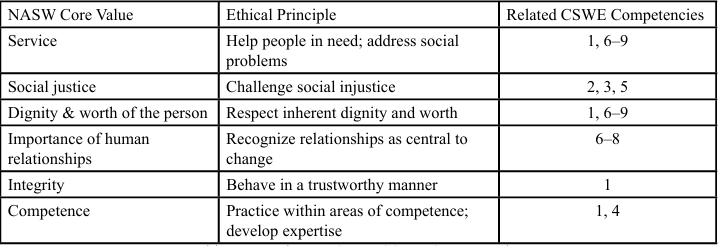
Table 1: Mapping NASW to CSWE Competencies
Mapping NASW Core Values and CSWE Competencies – these core values and the corresponding principles are mapped to illustrate instructional alignment with the 2022 EPAS as illustrated in table 1.
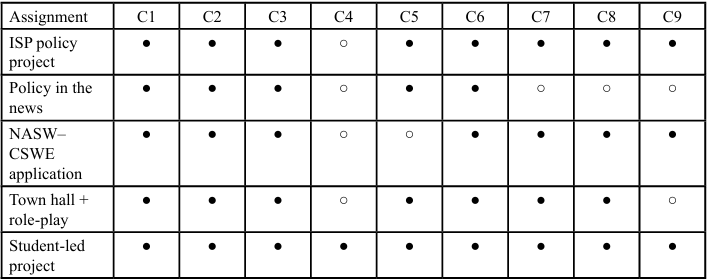
Table 2: Assignments Mapped Against the Nine CSWE Competencies
Implications for Practice
Linking the NASW Code of Ethics, the CSWE 2022 EPAS competencies, critical pedagogy, and constructivist learning theory (CLT) is important when discussing student advocacy and empowering student voice because both organizations play complementary roles in the social work profession. CSWE ensures that social work education aligns with professional standards, including ethical principles outlined by NASW, while NASW provides the ethical framework and professional support for practicing social workers. Social work programs accredited by CSWE often incorporate the NASW Code of Ethics into their curriculum, as mentioned earlier.
Critical pedagogy incorporates constructivist principles and applies them to power dynamics. Students learn how to challenge the status quo through critical lens based on the current environment and to evoke change as needed. Constructivist learning theory (CLT) is a student-centered teaching model that suggests that students construct knowledge through active participation and experiences, rather than passively receiving information.
These recommendations and guidelines support instructors as they begin facilitating students’ development of both foundational knowledge and meaningful experiential learning opportunities. By engaging with structured activities, reflective exercises, and applied policy analyses, students gradually deepen their understanding of social welfare policy and the complexities of social justice. Throughout this process, they also strengthen their ability to critically evaluate societal structures, recognize inequities, and articulate informed perspectives on policy issues. As their confidence and competence grow, students learn to use their voices more effectively both in academic settings and in broader community contexts to examine, interpret, and advocate for social welfare policies through a comprehensive social justice framework. These experiences equip students with the analytical and communicative skills necessary to promote equitable and transformative changes within their future professional roles.
Classroom activities and tasks must focus on activities and actions in experiential learning that build skills and knowledge in a social justice setting. This begins with demanding the same basic rights, protections, opportunities, and benefits for all, acknowledging racism, oppression, cultural differences, and marginalization, and creating change to existing social welfare policies. It is important to teach students the process of addressing uncomfortable and difficult social justice issues. Offering meaningful experiential assignments and opportunities can lead to strong advocacy and a social justice foundation.
Acknowledgments
The first author would like to acknowledge external reviewers, for helpful comments on previous versions of the manuscript.
Competing Interests:
The authors declare they have no competing interests.
References
Reisch, M. (2002). Defining social justice in a socially unjust world. Families in Society: The Journal of Contemporary Social Services, 83(4), 343–354. View
Segal, E. (2015). Empowerment series: Social welfare policy and social programs, enhanced (4th ed.). Cengage Learning. View
Segal, E. A., & Wagaman, M. A. (2017). Social empathy as a framework for teaching social justice. Journal of Social Work Education, 53(2), 201–211. View
National Association of Social Workers [NASW]. (2022). NASW code of ethics. Author. View
Council on Social Work Education [CSWE]. (2022). The nine competencies social work competencies. In CWSE and Commission on Educational Policy (Eds.), 2022 Educational Policy and Accreditation Standards (pp. 8-12). Author. View
Friere, P. (2005). Pedagogy of the oppressed: 30th anniversary edition. Continuum. (Original work published 1968) View
Kincheloe, J. L. (2004). Critical pedagogy primer. Peter Lang Publishing, New York, p. 10 View
Freire, P. (2018). Pedagogy of the oppressed (M. B. Ramos, Trans.). Bloomsbury Academic. (Original work published 1970). View
Harvard Graduate School of Education (December 8, 2025). Introduction to critical pedagogy, View
Rollins School of Public Health. (2025). Teaching and learning principles: Critical pedagogy. Emory. View
Almulla, M. A. (2023). Constructivism learning theory: A paradigm for students’ critical thinking, creativity, and problem solving to affect academic performance in higher education. Cogent Education, 10(1). View
Çibukçiu, B. (2025). The relationship between constructivist approach and inclusive education in primary school. Frontiers in Education, 10. View
Harris, M. D. (2024). Policy in action: Using reflection of experiences to teach social welfare policy. Journal of Social Work and Social Welfare Policy, 2(2), 1-5. View
Bransford, J. D., Brown, A. L., & Cocking, R. R. (Eds.). (2000). How people learn: Brain, mind, experience, and school. National Academy Press. View
Bulut, O., Gorgun, G., & Yildirim Erbasli, S. N. (2024). The impact of frequency and stakes of formative assessment on student achievement in higher education: A learning analytics study. Journal of Computer Assisted Learning. Advance online publication. View
Ambrose, S. A., Bridges, M. W., DiPietro, M., Lovett, M. C., & Norman, M. K. (2010). How learning works: Seven research- based principles for smart teaching. Jossey-Bass. View
Carney, E. A., Zhang, X., Charsha, A., Taylor, J. N., & Hoshaw, J. P. (2022). Formative assessment helps students learn over time: Why aren’t we paying more attention to it? Intersection: A Journal at the Intersection of Assessment and Learning, 4(1). View
Kolb, D. A. (1984). Experience Learning: Experience as the source of learning and development. Prentice Hall. View