
- About the Journal
- Editorial Board
- Review Process
- Author Guidelines
- Article Processing Charges
- Special Issues
- Current Issue
- Past Issue
 Journal of Social Work and Welfare Policy
Journal of Social Work and Welfare Policy Volume 4 (2026), Article ID: JSWWP-212
https://doi.org/10.33790/jswwp1100212Research Article
The Relationship Between Widowhood and Mortality Among Older Adults: The Role of Religiosity
Hyejin Kim
Professor, Department of Social Work, Wright State University, Dayton, OH 45435, United States.
Corresponding Author Details: Hyejin Kim, Professor, Department of Social Work, Wright State University, Dayton, OH 45435, United States.
Received date: 05th May, 2026
Accepted date: 08th August, 2026
Published date: 10th August, 2026
Citation: Kim, H., (2026). The Relationship Between Widowhood and Mortality Among Older Adults: The Role of Religiosity. J Soci Work Welf Policy, 4(2): 212.
Copyright: ©2026, This is an open-access article distributed under the terms of the Creative Commons Attribution License, which permits unrestricted use, distribution, and reproduction in any medium, provided the original author and source are credited.
Abstract
Background and Purpose: The death of a spouse can harm mental health and physical functioning and can even increase mortality among surviving spouses. On the other hand, religious factors are positively related to health outcomes among older adults. The relationship between widowhood, religiosity, and mortality among older adults can be better understood by clarifying the main and moderating effects of religiosity. Therefore, this study examines the main and moderating effects of three measures of religiosity on mortality among older adults in widowhood.
Methods: The sample included 9,956 older adults aged 65 and over who participated in the Health and Retirement (HRS) RAND study. Hierarchical binary logistic regression procedures were used to analyze the data. Religiosity was measured using three variables— religious preference, religious service participation, and religious importance. Models controlled for demographic, socioeconomic, and health status factors.
Results: Widowed older adults were more likely to die than married older adults. However, when demographic and socioeconomic factors were controlled, the effect of widowhood on mortality was no longer significant. Two religiosity variables—religious service participation and religious importance—had a direct impact on mortality. The odds of mortality were lower for older adults who participated in religious services (OR=.86; p < .001) but higher for those with stronger beliefs about the importance of religiosity (OR=1.17; p < .01). Religious participation moderated the relationship between widowhood and mortality in that the odds of mortality increased among widowed older adults who participated in religious services more often (OR=1.21; p < .001).
Conclusions and Implications: Unlike religious service participation, which was related to a lower risk of mortality, religious importance was associated with a higher risk of mortality. The protective moderating effect of religious participation on the relationship between widowhood and mortality is also incongruent with our hypothesis and requires further investigation. More sophisticated longitudinal models need to be conducted to clarify the causal relationships between widowhood, religiosity, and mortality, and potentially relevant factors such as social support should be considered in future studies.
Keywords: Widowed older adults, Religious preference, Religious participation, Religious importance, Moderating effect of religiosity
Introduction
As people age, they experience loss of loved ones. Particularly, the death of a spouse is a traumatic event in one’s life [1]. Several studies have shown negative effects of widowhood on mental health, physical functioning and positive effects of widowhood on mortality [2-9].
On the other hand, religion have shown positive effects on health outcomes [10-12]. In addition, religion may have more influence on older adults than the young because older persons were more likely to report religion’s significance on their lives [13]. Recent studies showed that religiousness could decrease the negative effects of widowhood on the well-being of older adults [14-17].
In spite of the importance of religion among older adults in widowhood, available studies have rarely considered the effects of religion on older adults’ mortality in widowhood. The relationships between widowhood, religion, and mortality among older adults can be much better understood by clarifying the main and moderating effects of religion. Therefore, this study examines the effects of religiosity on mortality among older adults in widowhood, especially focusing on the moderating effects of religiosity. That is, the study mainly explains the effects of religiosity on mortality by comparing widowed older adults to married ones.
Effects of Religiosity on Mortality
Hypotheses
This study tries to clarify main and moderating effects of religiosity on mortality. Because the loss of a spouse is a stressful life event, the negative effects of widowhood on the risk of mortality are obvious. Many previous studies have reported the positive effects of widowhood on mortality, that is, widowed older adults have higher risks of mortality than married ones [3,6,7,18].
Previous studies, however, have rarely considered the effects of religion on mortality among older adults. Religion may give solace to older adults, so they may have a lower risk of mortality. Several previous studies have reported the positive effects of religion on health outcomes [10-12,15,16,19]. The stress-buffering theory suggests that religion could also decrease the risk of mortality by providing personal activities and social networks. This indicates main effects of religiosity on mortality. The effects of religiosity may differ by various components of religiosity such as religious participation and religious importance. Therefore, the study suggests the first hypothesis as follows:
Hypothesis 1. Religiosity influences mortality.
The more religious participation and the more religious importance, the lower their risk of mortality.
In addition, the effects of widowhood on mortality could differ by religiosity. This indicates moderating effects of religiosity on the relationships between widowhood and mortality. Widowed older adults are likely to be more influenced by religiosity because they are exposed to more vulnerable situation than married older adults. Therefore, this study suggests the second hypothesis as follows:
Hypothesis 2. The effects of widowhood on mortality differ by religiosity.
The effects of religiosity (i.e., religious participation and religious importance) are stronger for widowed older adults than for married ones.
Conceptual Model
Main purpose of the study is to examine the effects of religiosity on mortality, comparing widowed older adults to married ones. Therefore, mortality is a dependent variable, widowhood is an independent variable, and religiosity is a moderating variable. Religion can be regarded as a social institution that intends to find the meaning of life and death. Religious behavior and beliefs can have several scales ranging from external manifestations such as religious denominations to internal manifestations such as faith and emotions [1]. In this study, religiosity was measured by religious preference, participation, and importance.
Additionally, when examining the effects of religiosity on mortality in widowhood, other factors which can affect widowhood effects should also be considered. Based on previous studies, demographic (e.g., age, gender, race) and socioeconomic factors (e.g., educational attainment) should be considered as control variables. Widowed men showed a higher risk of mental health such as depressive symptoms than widowed women [5,9,14]. On the other hand, the widowhood effects did not differ by race [20]. The negative relationship between mental health and lower household income increased over the life course [21], and lower socioeconomic status was positively related to the risk of mortality among widows [3,7].
The diagram of the conceptual framework is shown in Figure 1. The arrow from widowhood to mortality shows the positive direct effect of widowhood on mortality. The arrow from religiosity to the arrow of the direct effect indicates the negative moderating effects of religiosity on mortality.
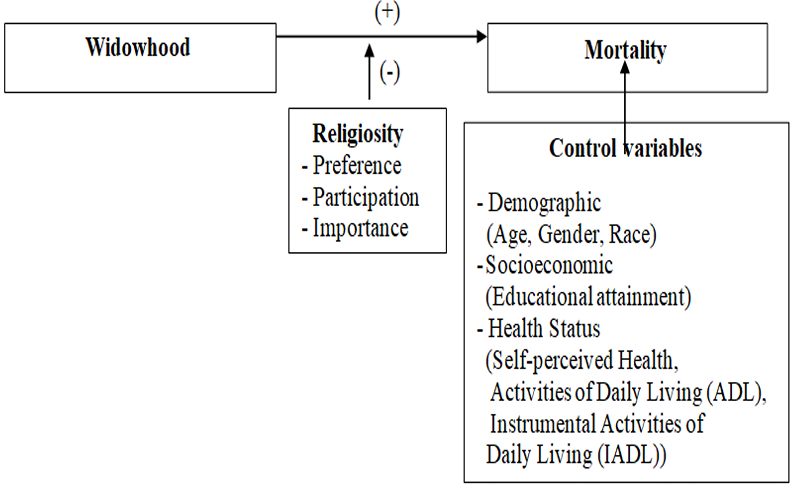
Figure 1. Conceptual framework for the effects of widowhood on mortality, focusing on moderating effects of religiosity.
Methods
Datasets
This study utilized datasets of the Health and Retirement Study (HRS), a nationally- representative and longitudinal study of the U.S. population aged 50 and over. The original target group in 1992 included older adults born during the years between 1931 and 1941 who resided in households. Every six years, a new cohort group is selected and added to the original sample, and the datasets have nine waves until 2008. Although the HRS provides biennial data products such as Core, Exit, Post-Exit, and Imputation datasets and products for longitudinal data analysis such as Tracker File and Master ID, these datasets are enormous and complicated.
The Research and Development (RAND) Center for the Study of Aging, therefore, created datasets in order to help users better understand and easily utilize the datasets. Two kinds of datasets produced by RAND are available: The RAND Enhanced Fat Files and the RAND HRS Files. The Fat Files include most of the public release data from each questionnaire section for each wave. The RAND HRS Files, on the other hand, incorporate Core datasets for all nine waves as well as Tracker File; therefore, these files are useful in longitudinal analysis although the files do not include all variables from the questionnaire section as the Fat Files do. This study analyzed the datasets from 2004 to 2008. Among several files, the RAND HRS File (version K, hereafter RAND) was mainly used. This file was merged with the Fat File in 2004, 2006, and 2008 because the RAND does not include variables relating to religion, namely importance of religion and participation in religion. Each individual has a unique HHIDPN value which consists of household ID (hhid) and a person number (pn); therefore HHIDPN was used as the key variable for merging. All other variables except religion were taken from the RAND file.
Study Sample
Older Adults. From the RAND file including all 30,547 respondents from 1992 to 2008, the 20,129 respondents from 2004 to 2008, in wave 7, 8, and 9, were selected. Of those, the number of older adults age 65 and over was 11,786. The older adults were defined as those who had lived for more than 768 months at the interview in 2004.
Decision of Marital Status. The marital status variable in the RAND file included eight categories: married, married but spouse absent, partnered, separated, divorced, separated/divorced, widowed, and never married. Those married, married but spouse absent, and partnered were assigned into the married group. Those widowed were assigned into the widowed group. Those separated, divorced, and separated/divorces were assigned into the third group. Those never married were assigned into the fourth group.
Of 11,786, the 10,482 respondents who were assigned into the married and widowed groups in the first wave were firstly selected, and then changes of marital status across the three waves were examined in order to decide the marital status of respondents. Married ones were defined as those who kept their marital status to be married during the waves where they were alive. Widowed ones were defined as those who had been widowed since the first wave or those who changed their marital status from married to widowed during the three waves. For the cases which had only one missing observation for marital status during the three waves, if other two observed marital status of the respondents were the same, the missing marital status was assumed to be the same with the observed marital status. When applying the logistic regression analysis, the results were the same in the sample with the assumed cases and the sample without the cases. The total number of the sample after considering overall marital status and missing cases was 9,956; the number of the married ones was 6,034, and that of the widowed ones was 3,922.
Survival Status. All 9,956 respondents in 2004 were alive. Of those, 983 were dead between 2004 and 2006, and 864 were dead between 2006 and 2008; therefore, approximately 81% of the respondents were alive, and 19% were dead between 2004 and 2008.
Considering both marital and survival status, the number of live and married older adults was 5,167 whereas that of live and widowed ones was 2,942. The number of dead and married older adults was 867 while that of dead and widowed ones was 980. The cross tabulation between the marital status and the survival status is shown in Table 1.
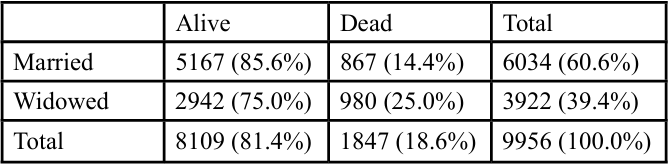
Table 1: Cross Tab Between Marital and Survival Status
Variables
Mortality. Mortality is the dependent variable in this study and was measured as an incidence of death during a 4-year period time, from 2004 to 2008. Survival status was dichotomized into alive and dead.
Widowhood. Widowhood is an independent variable. Widowhood was defined as a state in which someone lives without a new partner after his or her spouse dies. Widowhood was measured based on someone’s marital status. Marital status includes two categories: married and widowed.
Religiosity. Religiosity is a moderating variable. In this study, religiosity was measured by religious preference, participation in religious services, and importance of religion. Religious preference includes five categories: Protestant, Catholic, Jewish, None, and Other. Participation in religious services was coded as follows: ‘more than once a week’ into 5, ‘once a week’ into 4, ‘two or three times a month’ into 3, ‘one or more times a year’ into 2, or ‘not at all’ into 1. Importance of religion was coded as follows: ‘very important’ into 3, ‘somewhat important’ into 2, or ‘not too important’ into 1. High scores indicate high involvement of religiosity.
Control Variables. Demographic, socioeconomic, and health factors were considered to be control variables.
Demographic. Age is a continuous variable. Gender is dichotomized to male and female.
Race includes three categories: Caucasian, African-American, and Other (American Indian, Alaskan Native, Asian, and Pacific Islander).
Socioeconomic. Educational attainment is a continuous variable and was measured by years of education.
Health. Health status includes self-perceived health and functional status. Self-perceived health is defined as an individual’s response regarding his or her overall health. It is measured by a 5-point scale: excellent, very good, good, fair, and poor. Functional status was measured by the activities of daily living (ADL) and the instrumental activities of daily living (IADL). ADL includes 5 items: bathing, eating, dressing, walking across the room, and getting in or out of bed; IADL also includes 5 items: using a telephone, taking medication, handling money, shopping, and preparing meals. Each item was dichotomized to either need for help (1 point) or no need for help (0 points). Both ADL and IADL were calculated by adding the 5-item points, respectively, ranging from 0 to 5. In all health status variables, a higher value means poorer functional status.
Data Analysis
The binary logistic regression analysis was performed. Variables that explain mortality were entered in 6 steps. In step 1, the widowhood variable, indicating whether or not an individual is widowed, was entered. From step 2 to step 4, demographic, socioeconomic, and health status variables were entered in order. In step 5, religious variables such as religious preference, participation in religious services, and importance of religion were entered. Lastly, interaction terms between widowhood and religious variables were entered.
Missing Data Analysis
The impact of missing data across all variables on the analysis was assessed by examining the number of variables missing per case, the number of cases missing per variable, and the correlations among variables. Results showed that the impact of missing data was extremely minimal. First, considering missing data for each case, 99.1 % (n = 9,869) of the cases had no missing observations. The cases which have one missing observation were .7 % (n = 69), and the cases which have two missing observations were .2 % (n = 18). Considering missing data for each variable, five variables had no missing observations. Other variables had missing observations ranging from .04 % (n = 4) to .3 % (n = 29). Although the correlations between missing observations of some variables (i.e., religious importance and religious participation, years of education and religious preference, self-perceived health and religious preference, and ADL and IADL) were statistically significant, the impact of the missing cases was ignorable because the number of the missing observations was remarkably small (less than 1 % of overall cases). Overall, these results indicated that missing observations of this study are well below conventional levels of acceptability.
Results
Descriptive Analysis
As shown in Table 2, 81% of 9,956 respondents were alive, and 19% were dead between 2004 and 2008. 61% of respondents were married while 39% were widowed. A majority of respondents preferred Protestant, 47% of respondents participated in religious services at least once a week, and 72% considered that religion is very important in their lives. The average age of the sample was 75 years old. Female older adults were a majority of the sample, and most of the respondents were Caucasian. 67% of the respondents reported their health status is good or more than good, 80% of the sample did not experience any functional difficulty because of a health problem.
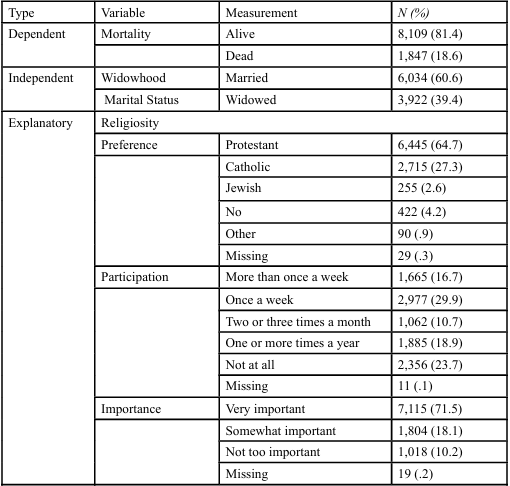
Table 2: Descriptive Analysis (N=9,956)
Logistic Regression Analysis
The binary logistic regression analysis was performed to examine the relationships between widowhood and mortality, considering religious factors. As shown in Table 3, the odds ratio of widowhood was 1.97, which means that the widowed older adults tend to be 1.97 times more likely to die than the married older adults (see Model 1). However, when demographic variables such as age, gender, and race were controlled, the positive effect of widowhood on mortality was no longer significant (see Model 2). The odds ratio of age was 1.13, which indicates that as older adults aged, the risk of mortality increased. The odds ratio of women was less than 1 while that of African-American individuals was more than 1, which means that men and African-American individuals had a higher risk of mortality than women and Caucasian individuals.
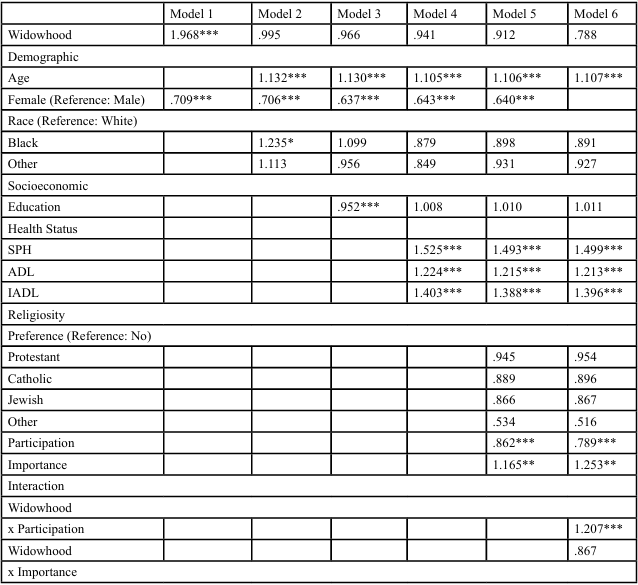
Table 3: Descriptive Analysis (N=9,956)
The odds ratio of education was .952, which means that older adults who had higher educational attainment were likely to live longer (see Model 3). However, the negative effect of educational attainment on the risk of mortality was not significant when health status was controlled (see Model 4). The odds ratios of self-perceived health, ADL, and IADL were 1.5, 1.2, and 1.4, respectively. It means for one unit decrease in health status, older adults tend to be 1.5, 1.2, and 1.4 times more likely to die. That is, older adults who reported healthier health status were likely to live longer. Religious preference was not associated with the risk of mortality, showing no statistical significance, however, participation in religious services and importance of religion were related to the risk of mortality (see Model 5). The odds ratio of participation in religion was .862, which means that older adults who more often participated in religious services had a lower risk of mortality. On the other hand, the odds ratio of religious importance was 1.17, which means that older adults who considered religion more important had a higher risk of mortality. The moderating effects of participation in religious services between widowhood and mortality were significant (see Model 6), however, the direction of the effects was not consistent with the hypothesis; the odds ratio of the interaction term of religious participation was 1.21, which indicates that the protective effect of religious participation on the risk of mortality decreased among widowed older adults relative to married ones.
Discussion
The relationships between widowhood and the risk of mortality were positively associated; that is, the widowed respondents were likely to die than the married ones. This confirms the results of previous studies [3,6,7,18]. However, the positive effects of widowhood on mortality did not last when controlling for demographic variables. Moon et al. [18] pointed out that the relationships between widowhood and mortality should be understood after controlling for other variables that can mediate and moderate these relationships, such as socioeconomic variables. The results of this study support the importance of controlling for related variables.
The relationships between other variables and mortality were consistent with the results of previous studies. Widowed men demonstrated a higher risk of mortality than widowed women in this study, even after controlling for related variables, whereas widowhood effects mostly did not differ by race [20]. Given that widowed men consistently showed a higher risk of mortality and mental health issues [9,14,22], greater support and targeted interventions should be provided for this population. Higher educational attainment was negatively associated with the risk of mortality among older adults [3,7]. The fact that the negative effects of education on the risk of mortality were eliminated after controlling for health status indicates that more services to improve older adults’ health status should be developed in the field of social work and other related fields such as nursing and public health.
The results relating to religiosity are more complicated. Religious preferences were not associated with the risk of mortality. However, religious participation was negatively related to the risk of mortality, being consistent with the hypothesis. On the other hand, religious importance was positively related to the risk of mortality, being against the hypothesis, which may imply reverse causality. Individuals at the end of life may be likely to think religion is important because most religions emphasize an afterlife. Roff et al. [16] reported similar results; frequency of service attendance was positively associated with well-being whereas frequency of prayer was negatively associated with well-being. Idler et al. [11] also reported that religious participation decreased the risk of mortality whereas importance of religion increased the risk. An advanced model which includes time-varying covariates regarding religiosity and employs more sophisticated longitudinal analysis could suggest an answer to the reverse causality issue.
Regarding the moderating effects of religiosity, although the interaction effect between religious participation and the risk of mortality was statistically significant, the direction was against the hypothesis. The beneficial moderating effect of religious participation on the mortality risk was significantly lower among widowed older adults compared to married ones. This may indicate that more services and support should be offered to the widowed older adults because the widowed older adults who more often participated in religious services could be those with low social support. That is, this could imply that geriatric care and church-based social services need to focus more on widowed older adults [17]. More tailored social policies, educational and religious programs, and interventions could also be developed to support widowed older adults and establish early warning systems to identify those at increased risk.
Overall, the effects of religiosity varied across its different components; religious participation was associated with a decreased risk of mortality whereas religious importance was associated with an increased risk. The moderating effect of religious participation was not consistent with the hypothesis. A more sophisticated longitudinal model needs to be conducted to examine the causal relationships between religion and mortality, and more related variables such as social support or social networks should be considered in future studies.
Competing Interests:
The author declares that they have no competing interests.
References
Atchley, R. C., & Barusch, A. S. (2000). Social forces and aging: An introduction to social gerontology. 10th Edition, California: Wadsworth Press. View
Elwert, F., & Christakis, N. A. (2008). The Effect of widowhood on mortality by the causes of death of both spouses. American Journal of Public Health, 98(11), 2092-2098. View
Grundy, E. M., & Tomassini, C. (2010). Marital history, health and mortality among older men and women in England and Wales. BMC Public Health. Published online 2010 September 15. View
Jiang, C., Song, H., & Shi, J. (2023). The impact of widowhood on mental health of older adults. Geriatric Nursing, 50, 38–43. View
Lee, M.-A., & Carr, D. (2007). Does the context of spousal loss affect the physical functioning of older widowed persons? A longitudinal analysis. Research on Aging, 29(5), 457-487. View
Stimpson, J. P., Kuo, Y.-F., Ray, L. A., Raji, M. A., & Peek, M. K. (2007). Risk of mortality related to widowhood in older Mexican Americans. Annals of Epidemiology, 17(4), 313- 319. View
Sullivan, A. R. (2010). Mortality differences in widowhood. Population Studies Center,University of Pennsylvania, Philadelphia. View
Wilcox, S., Evenson, K. R., Aragaki, A., Wassertheil-Smoller, S., Mouton, C. P., & Loevinger, B. L. (2003). The effects of widowhood on physical and mental health, health behaviors, and health outcomes: The women’s health initiative. Health Psychology, 22(5), 513-522. View
Zheng, J., & Yan, L. (2024) The impact of widowhood on the mental health of older adults and the buffering effect of social capital. Frontiers in Public Health, 12, Article e1385592. View
Helm, H. M., Hays, J. C., Flint, E. P., Koenig, H. G., & Blazer, D. G. (2000). Does private religious activity prolong survival? A six-year follow-up study of 3,851 older adults. Journals of Gerontology Series A: Biological Sciences and Medical Sciences, 55(7), 400- 405. View
Idler, E., Blevins, J., Kiser, M., & Hogue, C. (2017). Religion, a social determinant of mortality? A 10-year follow-up of the Health and Retirement Study. PloS One, 12(12), Article e0189134. View
Palmer, R. F., Katerndahl, D., & Morgan-Kidd, J. (2004). A randomized trial of the effects of remote intercessory prayer: Interactions with personal beliefs on problem-specific outcomes and functional status. The Journal of Alternative and Complementary Medicine, 10(3), 438-448. View
Benjamins, M. R. (2006). Does religion influence patient satisfaction? American Journal of Health Behavior, 30(1), 85 91. View
Hawes, F. M., Tavares, J. L., Ronneberg, C. R., & Miller, E. A. (2024). The effects of religiosity on depression trajectories after widowhood. OMEGA - Journal of Death and Dying, 88(4), 1240-1257. View
Momtaz, Y., A., Ibrahim, R., Hamid, T.A., & Yahaya, N. (2010). Mediating effects of social and personal religiosity on the psychological well being of widowed elderly people. Omega, 61(2), 145-162. View
Roff, L. L., Durkin, D., Sun, F., & Klemmack, D. L. (2007). Widowhood, religiousness, and self-assessed well-being among older adults. Journal of Religion, Spirituality & Aging, 19(4), 43-59. View
Ukeachusim, C. P., Okwor, C. O., Eze, E., Okoli, A. B., Ugwu, C. I., & Ebimgbo, S. O. (2024). The Impacts of spirituality and religious participation on the emotional well-being of widowed older adults in Southeast Nigeria. Innovation in Aging, 8(4), Article igad128. View
Moon, J. R., Kondo, N., Glymour, M. M., & Subramanian, S. V. (2011). Widowhood and mortality: A meta-analysis. PLoS ONE, 6(8): e23465. View
Benjamins, M. R. (2004). Religion and functional health among the elderly: Is there a relationship and is it constant? Journal of Aging and Health. 16(3), 355-374. View
Carr, D. (2004). Black/White differences in psychological adjustment to spousal loss among older adults. Research on Aging, 26, 591-622. View
Miech, R. A., Shanahan, M. J., & Elder, Jr., G. H. (2000). Socioeconomic status and depression over the life course. Journal of Health and Social Behavior, 41, 162-176. View
Lee, G. R., DeMaris, A., Bavin, S., &Sullivan, R. (2001). Gender differences in the depressive effect of widowhood in later life. Journal of Gerontology: Social Sciences, 56, 56-61. View