
- About the Journal
- Editorial Board
- Review Process
- Author Guidelines
- Article Processing Charges
- Special Issues
- Indexing
- Current Issue
- Past Issue
 Journal of Comprehensive Nursing Research and Care
Journal of Comprehensive Nursing Research and Care Volume 9 (2024), Article ID: JCNRC-199
https://doi.org/10.33790/jcnrc1100199Review Article
Transforming Healthcare Delivery: The Role of Collaborations, Innovations, and Technologies in Addressing the Nursing Shortage
Chizoba I. Anako*, Emory L. Perkins & Janice K. Williams
Bowie State University, 1400- Jericho Park Rd, Bowie, MD 20715, United States.
Corresponding Author Details: Chizoba I. Anako, Department of Nursing, Bowie State University, 1400- Jericho Park Rd, Bowie, MD 20715, United States.
Received date: 21st June, 2024
Accepted date: 26th July, 2024
Published date: 29th July, 2024
Citation: Anako, C. I., Perkins, E. L., & Williams, J. K., (2024). Transforming Healthcare Delivery: The Role of Collaborations, Innovations, and Technologies in Addressing the Nursing Shortage. J Comp Nurs Res Care 9(1):199.
Copyright: ©2024, This is an open-access article distributed under the terms of the Creative Commons Attribution License 4.0, which permits unrestricted use, distribution, and reproduction in any medium, provided the original author and source are credited.Creative Commons Attribution License, which permits unrestricted use, distribution, and reproduction in any medium, provided the original author and source are credited
Abstract
Amidst the current nursing crisis, nurse educators and practitioners are pivotal, necessitating innovative collaborations and partnerships to elevate healthcare models. To address the intricacies of our healthcare system nationwide, it is imperative to explore inventive approaches. With the advent of artificial intelligence (AI), nursing practice is set to advance significantly in the modern healthcare landscape. AI has the potential to transform healthcare delivery, improve patient outcomes, and redefine the nursing role. One of the strategies to enhance healthcare models involves technology integration. Partnering with technology companies can facilitate developing and implementing advanced simulations, telehealth platforms, and remote monitoring devices through AI. By automating routine tasks, AI enhances nursing efficiency, allowing nurses to concentrate on urgent patient care. Furthermore, AI can improve the quality and accuracy of nursing diagnoses and interventions by providing real-time information and evidence-based recommendations. Patients can also benefit from AI-driven virtual assistants that aid in accessing medication information, expanding knowledge of self-care practice, and addressing healthcare inquiries.
The recent approval by the U.S. Food and Drug Administration (FDA) to integrate AI technologies into the medical sector highlights AI's potential to enhance healthcare services and reduce health risks. Collaborations among research, healthcare, and academic institutions are crucial for transformative changes. Research should focus on nursing staffing ratios, strategies to enhance job satisfaction, and practical nursing models to improve patient outcomes and relieve the burden of administrative and clinical tasks on individual nurses.
Furthermore, healthcare and academic institutions should implement comprehensive employee wellness programs. These initiatives should prioritize mental health, stress management, and work-life balance to enhance nurses' well-being and reduce burnout and turnover.
Keywords: AI in nursing, AI in education, Integration and AI, Academic and AI, Students and AI
Background
Innovative technologies like telehealth, artificial intelligence (AI), and remote monitoring systems are significant in addressing the ongoing nursing crisis. The shortage seriously impacts healthcare workforce capacity. However, advancements in the healthcare landscape hold immense potential to reduce the nursing shortage and significantly enhance healthcare delivery by implementing AI [1]. Healthcare organizations and educational institutions should encourage nurses and nursing students to assess their awareness of AI technologies, a key area for future healthcare advancement and development. Integrating AI into nursing practice can modernize healthcare and significantly improve workforce outcomes [1]. This integration has numerous benefits: more accurate diagnoses, personalized patient care, low burnout rates, better healthcare outcomes, and improvements. Addressing the nursing crisis through collaboration, innovation, and technology integration involves several vital steps: 1) Needs assessment, 2) Stakeholder involvement, 3) Development/Implementation, and 4) Progress monitoring.
Needs Assessment
A thorough evaluation of nursing workforce shortages, staffing levels, workload burdens, and challenges is essential to identifying areas for improvement. Informal surveys may also be conducted to gauge the knowledge levels of faculty and nursing students, emphasizing the urgency of addressing these issues [2].
Stakeholder Involvement
Success relies on stakeholders' expertise and active participation. Stakeholders include nurses, educators, patients, other clinicians, policymakers, and administrators from healthcare organizations, educational institutions, professional associations, and the nursing workforce. Their collective expertise is crucial for driving systemic changes at all levels [3].
Development/Implementation
A comprehensive plan and strategy for addressing the nursing crisis should be developed, integrating collaborations among stakeholders, innovation, and, most importantly, technology integration, such as AI for patient monitoring and education and telehealth for health visits/consultations. This approach, when implemented, has the potential to improve patient outcomes significantly. Each phase of the plan/strategy must have specific goals and timelines; continuous monitoring and feedback are required at every stage.
Progress Monitoring includes:
1. Continuous improvement and learning.
2. Collection of regular data on key performance indicators, such as the number of AI training sessions conducted, the percentage of nurses and nursing students who have completed these sessions, and the impact of AI integration on patient outcomes.
3. Data analysis is a critical component of progress monitoring. It identifies trends and areas for improvement and allows us to disseminate findings, challenges, and best practices to stakeholders. Finally, we ought to identify trends, pinpoint areas for improvement, disseminate findings and best practices to stakeholders to drive ongoing improvement and innovations, and be critical in addressing the nursing crisis [4].
Artificial intelligence (AI) has been utilized in healthcare since as early as 1950, marking the beginning of its rapid evolution and widespread adoption. It has played pivotal roles in diagnosing illnesses, performing surgeries, aiding in rehabilitative practices, and, more recently, guiding clinical decision-making. AI's integration into healthcare systems has yielded multifaceted benefits, enhancing overall healthcare quality [5].
A comprehensive literature review conducted by Secinaro et al. [6] outlines the current understanding of AI's advantages, risks, and future requirements in healthcare. The review highlights AI's capacity to support healthcare providers and nurses through data-driven diagnostics, real-time medical information management, patient diagnosis and treatment, and clinical decision support. However, challenges associated with AI implementation include the initial costs and ongoing management of AI systems [7], as well as the necessity for enhanced understanding and training. Concerns have also been raised about potential reductions in healthcare providers' knowledge, skills, and abilities due to AI reliance, alongside patient apprehensions regarding AI use [8,9]. These considerations underscore the importance for healthcare providers to comprehend AI's diverse applications and effectively mitigate associated risks.
AI's current and future integration into healthcare systems necessitates educational reforms in academic institutions. AI education should be incorporated into curricula tailored for future healthcare professionals, including nurses, providers, administrative staff, clinical support personnel, and managers. Such integration should equip individuals with essential knowledge, skills, and attitudes required for the judicious use of AI in healthcare settings. Furthermore, education should prepare healthcare professionals to recognize and address associated risks and challenges and to leverage AI effectively to enhance patient care and outcomes [7].
Incorporating AI education into nursing curricula is crucial for preparing nurses to harness AI effectively to advance clinical outcomes, enhance critical thinking capabilities, and address complex healthcare challenges. However, before embarking on educational initiatives, conducting a thorough needs assessment regarding AIamong educators and students is essential. Understanding the perspectives and specific requirements of nursing students, faculty, and professionals will enable tailored education and training programs to effectively utilize AI while proactively managing associated risks in delivering evidence-based, high-quality healthcare.
This paper aims to underscore the fundamental importance of understanding the perspectives of nursing students and faculty in developing and implementing strategies to enhance their comprehension of AI implementation. By doing so, we can foster advancements in our healthcare system and shape a future where AI is a pivotal tool in overcoming nursing challenges and improving patient outcomes.
Materials and Methods
This survey research investigates the theme “Transforming Healthcare Delivery: The Role of Collaborations, Innovations, and Technologies in Addressing the Nursing Shortage.”
Sampling Procedures:
Participants were selected from a Historically Black College (HBCU) in the Mid-Atlantic region of the United States using a probability, simple random sampling method. The survey was conducted online, and the sample consisted of nineteen nursing faculty members and students aged 30- 60, deemed representative of the nursing faculty at the HBCU. Inclusion criteria stipulated that all nursing faculty and students over 18 could take the survey. Exclusion criteria included anyone under 18, not a nursing faculty member, or students with the Department of Nursing. Informed consent was obtained from all participants before their involvement in the study.
Collection Procedures:
Data were collected using a self-assessment survey administered via Google Docs, with IRB approval secured for the study. Over two weeks, nineteen nursing faculty and students were invited to participate voluntarily and confidentially, ensuring adherence to eligibility criteria.
Data Collection Instrument:
Researchers developed pertinent questions to gauge AI knowledge among nursing faculty and students. The survey, facilitated through Google Docs, encompassed quantitative and qualitative inquiries. Quantitative aspects covered demographic details such as age, gender, race, student status, and educational background. At the same time, qualitative components included open-ended queries exploring topics like concerns about AI implementation at their institution and perceptions regarding AI's potential to enhance healthcare outcomes.
Data Analysis:
Data analysis employed the latest version of Google Docs, ensuring completeness and consistency in responses. Descriptive statistics were utilized to categorize nursing faculty and students from the HBCU in the Mid-Atlantic region, with results presented through frequency distributions. Qualitative data underwent thematic analysis to illuminate nursing faculty and students' lived experiences and perspectives.
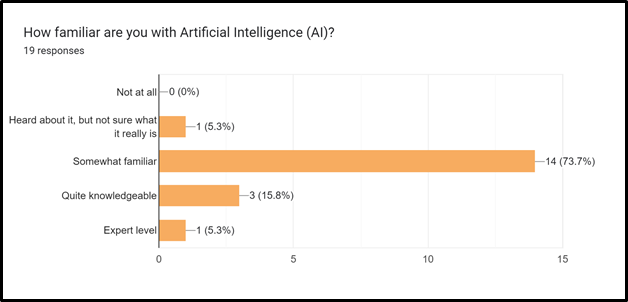
Figure. 1
Results
Based on survey responses, 14 out of 19 respondents (73.7%) indicated familiarity with Artificial Intelligence (AI). A smaller proportion, 5.3%, had heard of AI but needed to be more particular about its specifics. Additionally, 15.8% of the respondents demonstrated an elevated level of knowledge regarding artificial intelligence.
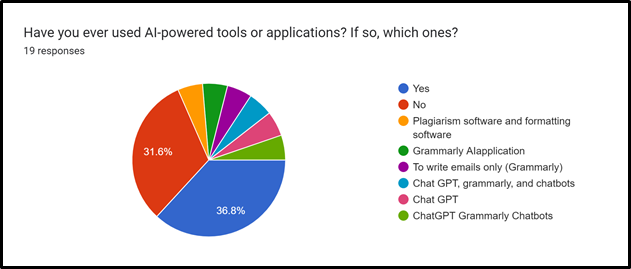
Figure. 2
Among the 19 participants, only 7 (36.8%) reported having used AI-powered tools or applications, while 31.6% had not used any AI-powered tools. Grammarly emerged as the participants' most familiar AI tool, followed by ChatGPT. This highlights a significant knowledge gap in understanding AI's comprehensive capabilities. Despite their limited knowledge of AI benefits, participants perceive substantial potential for AI in healthcare and healthcare education.
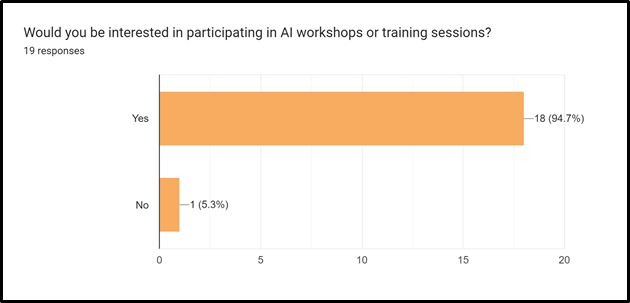
Figure. 3
Moreover, participants demonstrated strong enthusiasm for further learning, with 18 out of 19 respondents (94.7%) expressing keen interest in attending AI workshops or training sessions. This underscores a growing fascination with AI and its potential to revolutionize healthcare and healthcare education. Participants identified numerous implications of AI in teaching and learning, emphasizing its capacity to significantly enhance faculty productivity and resource development. AI-powered tools can assist in creating course materials, developing lesson plans, and refining teaching methods to better suit individual student needs. This recognition of AI's potential to streamline and enrich educational processes reflects participants' forward-thinking approach to learning.
• AI-powered tools also hold promise in enhancing students' research efficiency and analytical capabilities by enabling analysis of large datasets and generating valuable insights. These tools support brainstorming and optimize research planning, contributing to innovative academic pursuits.
• At the institutional level, participants envision AI-powered tools addressing recruitment and enrollment challenges, fostering innovative teaching strategies such as virtual tutoring and personalized learning platforms, and shaping new program curricula through adaptive technologies like AR/VR simulations.
• In academic research, AI is seen as a catalyst for efficiency, reducing labor-intensive tasks through enhanced data collection, analysis, and cross-institutional knowledge sharing.
Regarding healthcare, many of the respondents (over half) hold an optimistic view of AI's potential. They firmly believe that AI can significantly improve healthcare outcomes in various ways. These include enhancing alerts to the medical team for changing conditions in patient care, improving bedside nursing, providing experiential learning opportunities, ensuring timely responses to patient needs, and tailoring interventions for specific patient groups (e.g., Sickle Cell). This overwhelmingly optimistic outlook on AI's role in healthcare underscores the participants' unwavering trust in its capabilities and should inspire excitement for the future of AI in healthcare.
Strengths and Limitations
Due to competing priorities among faculty and staff, this study is constrained by its small sample size and challenges in participant recruitment. Many respondents required education on AI despite the university's recent introduction of tools like Grammarly, and there currently needs to be established AI guidelines at the institution. Nonetheless, the study provides a valuable snapshot of faculty and student needs within their contexts, offering insights to guide organizational efforts in meeting these needs based on comprehensive survey feedback.
Discussion
The survey administered to faculty and students revealed that there is insufficient familiarity, comprehension, and engagement with AI among nursing faculty and students while emphasizing the necessity for a specialized curriculum aimed at preparing nursing faculty to instruct nursing students on AI utilization throughout their educational journey, which will subsequently manifest in their clinical practice. Although there is a gap in the knowledge, skills, and abilities reported in the survey regarding AI, the survey affirms the willingness and recognition of the necessity for developing and implementing AI education in the nursing curriculum among nursing faculty and students. Ultimately, AI knowledge has the potential to empower them as clinicians, enabling them to deliver high-quality, evidence-based healthcare. The development and use of AI continue to evolve and expand within healthcare, requiring a commitment by academic institutions to prepare healthcare professionals to understand the benefits while mitigating the risks. Hence, with nursing being a pivotal profession within all healthcare system levels, it is essential to prepare them for AI. An educational curriculum developed and implemented because of a needs assessment is essential to effective teaching, allowing nursing students to learn how to leverage AI tools to streamline and customize processes that optimize patient care and make more informed clinical decisions.
Furthermore, the integration of AI education has the potential to teach students, before graduation, about AI tools that can significantly reduce the burden of administrative and clinical duties for the nursing profession in carrying out routine tasks. This shift in responsibilities can allow nurses to focus more on delivering personalized care to patients with complex healthcare needs. The potential of AI to improve nurse retention by reducing burnout and stress, leading to enhanced job satisfaction and retention of nurses entering the profession, is promising. Therefore, nurses who demonstrate effective KSAs in AI can potentially transform healthcare systems by enhancing efficiency, accuracy, and effectiveness in patient care delivery and fostering a more positive and sustainable work environment for the nursing profession.Conclusion
While valid concerns exist regarding the integration of AI in healthcare and education, it is imperative to underscore its potential benefits. AI stands poised to significantly enhance efficiency and elevate learning experiences, which are substantial advantages. While concerns about excessive dependence on AI, potential impacts on intellectual growth, and ethical considerations are legitimate, they should not overshadow the promising benefits. The expressed interest in incorporating Grammarly and ChatGPT into the HBCU environment reflects this perspective. Establishing appropriate policies to ensure responsible and beneficial AI use within the HBCU community and academic settings is crucial.
Healthcare organizations and academic institutions must develop clear guidelines to address ethical concerns and reassure new AI adopters. Embracing AI presents an opportunity to effectively tackle the ongoing nursing crisis by improving healthcare outcomes and easing nurses' workloads. This requires robust collaboration with technology firms, continuous engagement with emerging healthcare technologies and methodologies, and a commitment to embracing transformative changes that can bolster nursing workforce capacity and sustainability.
Conflict of Interests:
The authors declare that there are no conflicts of interest.
Acknowledgments:
Special thanks to Onize Oniwon, MPH, MBA for helping with data analysis. We also thank Jessica Elkin BS for proofreading the article.
References
Rony, M. K. K., Parvin, M. R., & Ferdousi, S. (2024). Advancing nursing practice with Artificial intelligence: Enhancing preparedness for the future. Nursing Open, 11, e2070.View
American Nurses Association. (2021). Nursing workforce issues and the impact on patient care. Retrieved from https:// www.nursingworld.org/practice-policy/workforce/View
National Academies of Sciences, Engineering, and Medicine. (2021). The Future of Nursing 2020-2030: Charting a Path to Achieve Health Equity. National Academies Press. View
Institute of Medicine. (2011). The future of nursing: Leading change, advancing health. National Academies Press.View
Dhabliya, D., Kulkarni, S. V., Jadhav, N., Ubale, S, A., Sharma, P., Gavali, A, B., Kadam, Y, R.Gaidhane, A. (2024). Strategic integration of artificial intelligence in public health: Policy recommendations for improved healthcare delivery, 13(1),4-15. Journal of Krishna Institute of Medical Sciences University. View
Secinaro, S., Calandra, D., Secinaro, A., Muthurangu, V., & Biancone, P. (2021). The role of artificial intelligence in healthcare: A structured literature review. BMC Medical Informatics and Decision Making, 21:125.View
Rahman, A., Victoros, E., Ernest, J., Davis, R., Shanjana, Y., & Islam, R. (2024). Impact of Artificial Intelligence (AI) technology in the healthcare sector: A critical evaluation of both sides of the coin. Clinical Pathology. 17:1-5View
Richardson, J. P., Smith C., Curtis, S., Watson, S., Zhu, X., Barry, B., & Sharp, R, R. (2021). Patient apprehensions about the use of artificial intelligence in healthcare. Nature Partner Journals Digital Medicine. 4:140.View
Huang, W., Chong Ong, W., Kei Fong Wong, M., Yin Kwee NG, E., Koh, T., Chandramouli, C.,Ta Ng, C., Hummel, Y., Huang, F., Su Ping Lam, C., & Tromp, J. (2024). Applying the UTAUT2 framework to patients’ attitudes toward healthcare task shifting with artificial Intelligence. BMC Health Services Research, 24:455.View