
- About the Journal
- Editorial Board
- Review Process
- Author Guidelines
- Article Processing Charges
- Special Issues
- Current Issue
- Past Issue
 Journal of Mental Health and Social Behaviour
Journal of Mental Health and Social Behaviour Volume 8 (2026), Article ID: JMHSB-216
https://doi.org/10.33790/jmhsb1100216Research Article
Six Evidence-Based Pathways to Enhance Learning and Academic Performance: A Pragmatic Qualitative Case of How to Translate Evidence into Classroom-Ready Interventions
Su Jin1, Xiaoxi Li2*, Ph.D., Ting Wen3, Ph.D., and Aimin Wang4, Ph.D.
1Department of Educational Leadership, Miami University, Oxford, Ohio, United States.
2Department of Deyu School of Marxism, Dalian University of Foreign Languages, Dalian, Liaoning, China.
3School of International Business Communications, Dongbei University of Finance and Economics, Dalian, Liaoning, China.
4Department of Educational Psychology, Miami University, 201 McGuffey Hall, Oxford, OH 45056, United States.
Corresponding Author Details: Xiaoxi Li, Ph.D., Department of Deyu School of Marxism, Dalian University of Foreign Languages, Dalian, Liaoning, China.
Received date: 28th October, 2025
Accepted date: 19th May, 2026
Published date: 21st May, 2026
Citation: Jin, S., Li, X., Wen, T., & Wang, A., (2026). Six Evidence-Based Pathways to Enhance Learning and Academic Performance: A Pragmatic Qualitative Case of How to Translate Evidence into Classroom-Ready Interventions. J Ment Health Soc Behav 8(1):216.
Copyright: ©2026, This is an open-access article distributed under the terms of the Creative Commons Attribution License, which permits unrestricted use, distribution, and reproduction in any medium, provided the original author and source are credited.
Abstract
This qualitative case translates an established body of published intervention studies into a classroom-ready portfolio guided by utility validity. The study does not repeat a literature review. It begins with a screened collection of interventions that have already demonstrated effects on learning behavior and academic performance. The analysis identifies six evidence-based pathways across cognitive, emotional, behavioral, and cross-domain areas and turns them into clear, student- centered strategies that teachers can use with minimal resources. These strategies include note-taking, error management, mind mapping, mindfulness focus, daily questioning, and a fifteen-minute task routine. Each connects with specific mechanisms of attention, emotion, and behavior that support learning in real classroom environments. The findings illustrate a transparent methodology by which proven interventions can be re-expressed as simple, low- burden daily practices. Whether these translated practices retain the active ingredients of the source interventions when implemented in real classrooms is an empirical question that we frame for subsequent validation work.
Keywords: Utility Validity; Qualitative Translation; Classroom Implementation; Learning Behavior; Academic Performance; Cognitive, Emotional, Behavioral Pathways data collected was analysed as descriptive, observational statistics.
Introduction
Many studies have already shown that cognitive, emotional, and behavioral interventions can improve students’ learning and academic performance. However, most of these studies stay at the research level. They describe statistical outcomes and theoretical implications but often do not explain how to apply the intervention in real classrooms. Teachers and students can understand the results, yet they still do not know exactly what to do next. This situation creates a gap between research and practice.
This study aims to close that gap. It builds on existing evidence and translates it into strategies that are clear, simple, and ready for classroom use. The goal is not to prove whether an intervention works again, but to show how already proven methods can be implemented in ways that are easy to follow and measure. The focus is on utility validity, which emphasizes the usefulness of interventions in real educational environments.
The qualitative case reported here starts from published findings and reorganizes them into six practical pathways: cognitive, emotional, behavioral, and three cross-domain combinations. Each pathway links a specific learning mechanism with classroom delivery. For example, cognitive strategies strengthen planning and reflection; emotional strategies support motivation and resilience; behavioral strategies stabilize habits and participation. The cross-domain strategies combine these processes to achieve balanced growth in both learning and well-being.
This approach reflects a pragmatic view of educational research. It treats the classroom not as a site for testing theory, but as a living environment where theory must work. By rewriting mechanisms into simple, daily procedures, this study may provide educators with concrete guidance on how to promote self-regulation, engagement, and academic progress through practical and low-cost interventions.
Literature Review
Educational interventions have long been recognized as an effective way to improve learning outcomes. A wide range of studies has examined how cognitive, emotional, and behavioral factors jointly influence students’ academic performance [1,2]. Cognitive interventions such as goal setting, data-based decision-making, and mental contrasting have shown consistent effects on attention control, metacognition, and problem solving [3-5]. These programs strengthen students’ capacity to monitor their own learning and adapt strategies to meet goals.
Emotional interventions, including mindfulness, social-emotional learning, and positive psychology training, have also demonstrated measurable benefits for emotional regulation, resilience, and motivation [6-8]. For example, mindfulness awareness practices can improve both academic performance and perceived well-being by reducing anxiety and promoting focus [9,10]. Similarly, programs that reappraise social or academic adversity help students sustain engagement and recover from failure [8].
Behavioral interventions such as self-monitoring, positive behavior support, and classroom management systems are equally important. These approaches improve attendance, participation, and time-on- task behavior [11,12]. Long-term studies of the Good Behavior Game show that consistent reinforcement in early school years can lead to delayed but lasting gains in both academic and social domains [13].
Although these findings confirm that interventions work, most studies focus on internal validity and statistical outcomes rather than how interventions can be implemented in daily educational practice. Many intervention reports stop at effect sizes and omit detailed guidance on timing, instruction, and feedback. As a result, teachers often know what works but not how to use it in real contexts. Few studies have explored how cognitive, emotional, and behavioral strategies can complement one another when adapted to the dynamic conditions of secondary classrooms [14].
The present study addresses this gap through a qualitative translation of published evidence. It reorganizes previously tested interventions into a classroom-ready framework based on utility validity. Utility validity emphasizes practical usability and the value of interventions in authentic educational environments [15]. While Messick’s [15] unified conception of validity provides our starting point, contemporary validity theory has substantially elaborated the consequential dimension on which utility claims depend. Kane’s [16] argument-based approach reframes validation as the construction and evaluation of an interpretive argument linking observed performance to intended use. Mislevy’s [17] evidence-centered design treats assessment and intervention design as a chain of inferences that must be made explicit and tested. Pellegrino et al. [18] extend this further to the validation of learning environments in situ. Under these frameworks, the present translational case constitutes the articulation of an interpretive argument: that synthesized, simplified classroom procedures preserve the active mechanisms of the original interventions. It shifts the question from whether a program works to whether it can be applied and sustained by educators and learners. This pragmatic orientation aligns with current discussions in learning sciences and educational psychology that call for research with demonstrable real-world impact [19,20].
By transforming theoretical constructs into daily strategies, this study is expected to provide an actionable bridge between research and practice. It illustrates how teachers and students can adopt evidence-based methods through simple, structured, and measurable activities that foster both learning and well-being.
Method
This qualitative translational case is grounded in a previously completed program of work that identified, screened, and organized interventions across cognitive, emotional, behavioral, and cross- domain processes in formal education settings. The prior pipeline included PRISMA-guided identification, expert review, psychometric validation, and a second systematic review focused on intervention strategies and their mapping to classroom use, providing the analytic corpus for the present study. The current task is to translate that corpus into a small portfolio of student- and teacher-facing strategies that are feasible in secondary school contexts and consistent with utility validity.
Analytic stance and corpus
The analytic stance is utility validity: interventions are valued for technical soundness and for functional, contextual, and motivational relevance to learners and classrooms. The corpus comprises empirically tested interventions previously categorized into cognition, emotion, behavior, and cross-domain entries, with selection and refinement procedures already documented in the prior phases of work.
The target population for these classroom-ready strategies is secondary school learners (grades 7–12, approximately 12–18 years of age). All six strategies were screened for developmental appropriateness, classroom feasibility within a standard 40–50 minute lesson period, and compatibility with the cognitive load typical of adolescent learners.
Procedure
The analysis proceeded in three stages. The first stage was mechanism coding. Each intervention was re-read with attention to its core change pathway. Cognitive entries were marked for metacognition, attention control, and goal regulation. Emotional entries were marked for stress appraisal, mindfulness, resilience, and belonging. Behavioral entries were marked for environmental structure, reinforcement, time use, and self-monitoring. Cross-domain entries were marked for combinations of these codes. The second stage was feasibility screening. Interventions were examined for resource demands, delivery complexity, and fit with secondary school scheduling. Items that required specialized equipment, intensive pull-out models, or long external training were set aside in favor of procedures that can be delivered by classroom teachers or by students themselves. The third stage was rewriting for implementation. Mechanisms were translated into student-facing instructions and teacher-facing prompts, keeping the original logic of action while specifying when and where to use the strategy and what evidence to expect.…
Trustworthiness and analytic rigor
Trustworthiness was supported by constant comparison across entries, explicit mechanism-to-procedure mapping, and memoing of decisions where two or more delivery options were viable. Rigor was further enhanced through the same iterative refinement logic applied in the feedback template work, aligning with design-based implementation principles and preserving the original logic of action while making procedures classroom-ready. Throughout, utility validity anchored judgments toward low-cost, low-burden strategies that fit existing measurement and feedback practices.
Link to outcome structure
The staged procedure above yields six evidence-based, classroom- ready strategies that correspond to the mechanisms most frequently supported in the screened corpus: note-taking, error management, mind mapping, mindfulness focus, daily questioning, and a fifteen- minute task routine. Their selection flows directly from the coding (mechanism relevance), feasibility (fit and acceptability), and rewriting (implementation clarity), and their cross-domain placement remains consistent with the earlier triadic framework and the matrix logic used for strategy-student alignment.
Results
A Diverse Range of Interventions
The systematic review encompassed a diverse range of interventions targeting various aspects of academic performance, examining their effects on students across different domains. Noteworthy findings emerged from interventions addressing emotional, cognitive, and behavioral dimensions.
Emotion intervention, as an example, developed mental toughness, or personal control, which showed a notable positive effect on academic achievement [21] when assessed via standardized testing for reading and math. Likewise, interventions that included mindfulness training as well as socio-emotional learning processes showed positive results with respect to academic performance as well as perceived well-being.
At the cognitive level, interventions such as cost-oriented motivational interventions as well as goal-setting interventions had positive effects in terms of exam scores as well as academic performance [22]. However, the results of some cognitive interventions were not uniformly positive; for example, the growth mindset intervention as reported by McCabe et al. [23], did not show any effect on academic performance and/or retention. These mixed outcomes suggest the need to consider how cognitive interventions may interact with behavioral and emotional domains, highlighting the potential value of integrated or multi-dimensional approaches to educational intervention design.
Behavioral interventions ranging from self-monitoring strategies to positive behavior support demonstrated varying degrees of success [12]. For example, interventions such as the Good Behavior Game and the Positive Behavior Game were associated with improvements in academic achievement over time [13]. In contrast, the growth mindset intervention showed positive effects on GPA and standardized test performance [24].
Some interventions operated at the intersection of cognitive and behavioral domains. For instance, the persistence mindset intervention demonstrated positive effects on both academic performance and student retention [25]. Additionally, the Unique Minds School Program, designed to enhance cognitive-social-emotional teaching skills, was found to promote growth in students’ self-efficacy, problem-solving abilities, social-emotional competencies, and mathematics achievement [26]. A more detailed breakdown of the intervention domains is presented in Table 1.
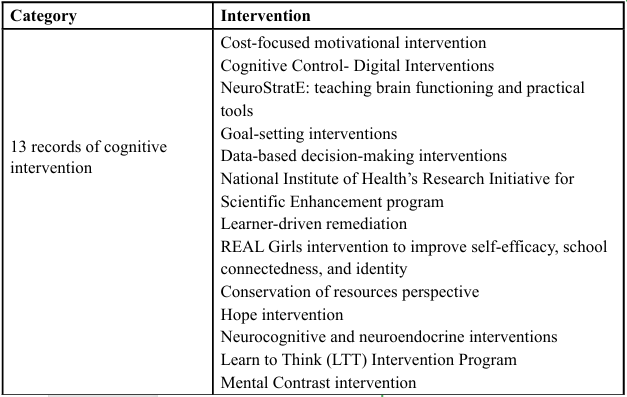
Table 1. Interventions Among Domains
Selection and Justification of Intervention Strategies
This study systematically selected intervention strategies and linked them with well-established experimental foundations identified through empirical results from the thorough systematic review. Each intervention method was carefully mapped onto a comprehensive intervention taxonomy to ensure methodological rigor and theoretical coherence. These intervention strategies were not only recognized for their effectiveness but also demonstrated complementarity in forming a consolidated support system that is practically applicable to real-life educational settings. Together, these interventions can represent a multi-dimensional approach to improving learning behavior, addressing cognitive, behavioral, and emotional constructs.
This section used a second-person narrative (“you”) to reflect how the interventions would be delivered in student-facing feedback platforms. The language is intentionally clear and instructional, designed to maximize practical engagement rather than remain abstract or academic.
Note-Taking (Behavioral Strategy)
Start by choosing a notebook and pen you enjoy using, as this can boost your motivation and sense of engagement. During class, focus on writing down as much content as possible without worrying about structure or neatness capturing quantity helps ensure you don’t miss important information. After class, review your notes and highlight key points, grouping related ideas to strengthen memory retention. This practice leverages the External Storage Effect [27], which turns your notes into a powerful memory aid, and engages generative processing to deepen your understanding. Begin this habit immediately to avoid procrastination and develop consistent learning routines. This strategy reflects core elements of learning strategy interventions and mastery learning, and is further supported by early literacy techniques and self-monitoring practices.
Error Management (Cognitive & Behavioral Strategy)
Begin by collecting incorrect answers from previous assessments to identify areas that need targeted improvement. Look for patterns in your mistakes, such as recurring errors, which often reveal underlying misunderstandings that can be addressed directly. Start with a full review of all mistakes. It might take 1–2 hours the first time. When you review again, it often takes just 15 minutes or even less. That’s because you start to remember why you got it wrong. This feeling of “I get it now” builds confidence and makes learning more enjoyable. This method follows the principles of Error Correction Theory [28], which emphasizes that analyzing mistakes promotes cognitive restructuring, while repeated practice can help reinforce positive behavioral habits. This strategy not only shows your progress but also helps cultivate a growth mindset, reflecting the ideas of data-driven decision-making, mastery learning, learning analytics, learner-driven remediation, and growth mindset interventions.
Mind Mapping (Cognitive Strategy)
Start by creating a structured diagram using chapter titles and subtitles to construct a map of your knowledge. Focus on building clear conceptual connections rather than worrying about making the diagram visually perfect clarity matters more than design. Continue refining your mind map regularly to make sure nothing important is missed. Use colors and symbols to highlight relationships between ideas, which helps strengthen memory and cognitive associations. The effectiveness of this method is supported by experimental studies on mind mapping [29], which show that mind maps help students better understand complex topics by promoting richer, more organized thinking. This strategy is grounded in Learn to Think (LTT) and NeuroStratE methodologies and is further supported by mental contrast interventions and neurocognitive approaches.
Mindfulness Focus (Emotional & Cognitive Strategy)
Try mindfulness practice as a simple way to support both emotional and cognitive regulation. Drawing from Mindfulness Awareness Practices and neurocognitive intervention research, set aside five minutes during your study routine to pause and take a few deep breaths this helps reset your cognitive focus. Build a balanced study-rest routine, such as 50 minutes of focused work followed by a 5 to 10-minute break. During the break, close your eyes and focus on your breath to reset your mind and restore energy. If you like, you can keep a simple journal to track how focused or relaxed you feel after each session this helps you reflect and make small adjustments over time. Research on mindfulness training [9,10] shows that consistent practice not only improves attention and cognitive control but also strengthens emotional regulation over time. These benefits are further supported by self-regulation strategies, student-led stress-reduction practices, and interventions based on building hope.
Daily Questioning Strategy (Emotional & Behavioral Strategy)
Make it a habit to ask at least one question each day this simple action can significantly deepen your understanding of the material. Focus on asking questions that are clear and genuinely meaningful to you, even if they seem small. As you continue this practice, you’ll notice growing confidence and improved comprehension, which highlights the power of active engagement. Regular questioning also helps build stronger relationships with teachers, increasing your sense of academic support and connection. Its core mechanism is not the content of the questions; rather, it lies in enhancing emotional engagement through meaningful teacher-student interaction a form of social behavior that fosters a stronger sense of belonging. This approach is perfectly grounded in social-emotional learning and positive behavior interventions, and is further supported by temperament-sensitive approaches and structured social skills training.
15 Minute Task Strategy (Emotional Strategy)
Devoting 15 minutes each day to a task that you believe can support your learning, such as reviewing specific key concepts or organizing notes, helps establish a disciplined and focused routine. This dedicated time signals full engagement with the task and allows students to make steady, purposeful progress. Repeating this simple habit daily fosters a growing sense of control and autonomy over the learning process. Unlike traditional time-management strategies that often emphasize productivity alone, this intervention promotes emotional regulation through achievable, small-scale successes. The short, focused nature of the task serves to interrupt negative emotional cycles and support a more positive mindset. Research has shown that forming such intentional micro-habits contributes to increased self- regulation and a greater sense of self-efficacy [30,31]. This strategy is further supported by daily heart lock-in exercises and adversity reappraisal practices, and is reinforced by training programs that build emotional resilience and focus on long-term academic success.
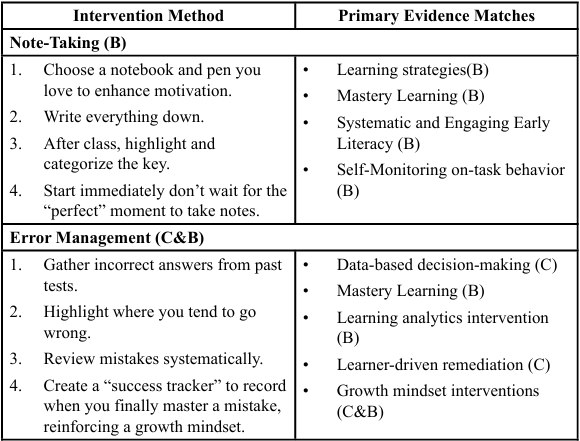
Table 2. Interventions Portfolio
Table 2 illustrated the development of the intervention portfolio was closely aligned with theoretical premises and systematically reviewed in light of empirical research findings. Each of the intervention modules adheres to the principles of education that are already established and have been proven to work in previous studies. The six interventions had incorporated the framework of cognition-behavior-emotion and how they intersect. These selected interventions were prioritized based on their potential for quick implementation in real-life educational settings. Furthermore, the interventions were designed to provide descriptive feedback that is clear, easy to understand, and readily actionable. Through this careful selection, the intervention of choice is shown to be feasible and effective with a reduced likelihood of pestilential effects, which support long-term positive results in academic and life development for the students.
Discussion
The six strategies developed in this study demonstrate how evidence from previous research can be reorganized into procedures that directly serve teachers and students. Rather than testing new interventions, the goal was to connect what is already known with what can be practically done in everyday classrooms. The findings suggest that when cognitive, emotional, and behavioral mechanisms are written into clear instructions, they can work together to support both academic achievement and emotional balance.
The cognitive strategies, such as error management and mind mapping, help students understand their thinking process and take more control over learning. They turn abstract self-regulation theories into visible daily habits. Emotional strategies, such as mindfulness focus and the fifteen-minute task, provide small and consistent ways to improve focus and motivation. These routines help students manage stress and build confidence. Behavioral strategies, such as note-taking and daily questioning, establish structure and connection. They improve engagement and communication with teachers, which in turn strengthens classroom climate.
To illustrate classroom delivery, consider Ms. L., a Grade 9 mathematics teacher. On Monday she introduces the Note-Taking routine, asking students to capture quantity first and refine after class. On Tuesday and Thursday, the first 15 minutes are devoted to Error Management, with students reviewing the previous quiz. The remaining four lessons begin with a one-minute Mindfulness Focus reset and close with a Daily Questioning prompt. By Friday, students complete one 15-Minute Task on a self-selected concept. This sequence requires no extra preparation time, no specialized materials, and integrates directly into the existing lesson plan.
Together, these strategies represent a model of utility validity. They are not only effective in theory but also usable and sustainable in practice. Each procedure fits within regular lesson periods and can be carried out without additional resources or external training. Teachers can easily track progress through existing assessments, and students can receive immediate feedback. This balance between research-based mechanism and classroom feasibility ensures that the interventions can be maintained over time.
The results also highlight the value of cross-domain integration. Many studies in the original corpus showed that cognitive or emotional interventions alone have partial effects. When elements from different domains are combined, they produce stronger and more lasting outcomes. The six strategies in this study illustrate this integration. For example, error management combines cognitive reflection with behavioral reinforcement; mindfulness focus integrates emotion control with attention regulation. These combinations make the interventions more adaptable to different learners and contexts.
The study further supports the argument that educational interventions should not be separated from their delivery context. Schools operate with limited time and resources, and any intervention that requires special conditions often fails to sustain. The present model demonstrates that effective learning support can come from small, repeatable actions built into the school day. This finding echoes broader trends in educational psychology that emphasize self-regulation, emotional safety, and teacher–student relationship as daily practices rather than add-on programs [8,30,32].
Limitations
We explicitly do not claim that the six strategies, as simplified for classroom delivery, will reproduce the effect sizes reported in the original intervention trials. Simplification may dilute, omit, or distort the active components identified in the source studies. Generalizability across grade levels, subject domains, and school cultures remains an open question that this translational case is not designed to answer.
Future validation pathway
The present manuscript serves only as a Stage-1 translational case; its deliverable is a defensible, transparent practice guide rather than evidence of classroom effectiveness. A three-stage external validation program is designed to test the guide. Stage 2 will recruit a panel of 10–15 secondary school teachers to complete a structured acceptability questionnaire and a semi-structured interview about each of the six strategies. Stage 3 will recruit 4–6 teachers to implement the strategies for four weeks, collecting their lesson plans, reflective journals, and student artefacts. Stage 4 will scale to a quasi- experimental study with matched comparison classrooms and pre/ post student outcome measures. This staged design directly addresses the concern that translation work without downstream empirical validation cannot support utility claims.
Conclusion
This study shows that translating existing intervention evidence into classroom-ready strategies can bridge the long-standing gap between research and practice. Through a qualitative and systematic translation process, six pathways were identified and expressed as simple, daily routines that align with the real structure of school life. Each routine note-taking, error management, mind mapping, mindfulness focus, daily questioning, and the fifteen-minute task has clear theoretical grounding and proven empirical support. More importantly, each can be directly implemented without special equipment or intensive training.
The findings confirm that utility validity can serve as a guiding principle for educational design. When evidence-based interventions are rewritten in clear and practical terms, they become tools that teachers and students can use immediately. The resulting framework demonstrates that improving learning behavior and academic performance does not require complex programs, but rather consistent and meaningful engagement with core cognitive, emotional, and behavioral processes.
Future research can expand this approach by testing these six strategies in diverse educational settings and measuring their cumulative effects. It would also be valuable to explore how digital feedback systems or adaptive technologies can support the same principles of clarity, simplicity, and practical relevance. By continuing to align evidence with classroom reality, educational research can remain both rigorous and deeply useful for daily teaching and learning.
Conflicts of Interest:
The authors declare no conflicts of interest.
References
Bandura, A. (2010). Self-efficacy and learning. Stanford University Press.
Pekrun, R., & Linnenbrink-Garcia, L. (2014). Introduction to emotions in education. In R. Pekrun & L. Linnenbrink-Garcia (Eds.), International handbook of emotions in education (pp. 1–10). Routledge. View
Gollwitzer, A., Oettingen, G., Kirby, T. A., Duckworth, A. L., & Mayer, D. (2011). Mental contrasting facilitates academic goal pursuit. Motivation and Emotion, 35(4), 403–412. View
Keuning, T., van Geel, M., Visscher, A., & Fox, J. (2019). Data based decision making in education: Effects on teaching and student achievement. Journal of Educational Measurement, 56(4), 757–792.
Schippers, M. C., Scheepers, A. W. A., & Peterson, J. B. (2020). A scalable goal-setting intervention closes both the gender and ethnic minority achievement gap. Contemporary Educational Psychology, 60, 101823. View
Bakosh, L. S., Mortlock, J. T., Querstret, D., & Morison, L. (2018). Audio-guided mindfulness for school students: Effects on cognitive and emotional outcomes. Learning and Instruction, 58, 34–41. View
Muro, A., Soler, J., Cebolla, À., & Cladellas, R. (2018). A positive psychological intervention for failing students. Learning and Motivation, 63, 126–132. View
Borman, G. D., Rozek, C. S., Pyne, J., & Hanselman, P. (2019). Reappraising academic and social adversity improves middle-school students’ academic achievement, behavior, and well-being. Proceedings of the National Academy of Sciences, 116(33), 16286–16291. View
Prakash, R. S., De Leon, A. A., Mourany, L., Lee, H., Voss, M. W., Boot, W. R., Basak, C., Fabiani, M., Gratton, G., & Kramer, A. F. (2015). Cardiovascular fitness and cognitive training on cognition. Aging, Neuropsychology, and Cognition, 22(3), 284 310.
Prakash, R. S., Hussain, M. A., Lawrence, M., Zhou, S., & McAuley, E. (2024). Mindfulness, self-regulation, and academic performance. Current Psychology, 43(2), 1123–1140.
Bradshaw, C. P., Mitchell, M. M., & Leaf, P. J. (2010). Examining the effects of school-wide positive behavioral interventions and supports on student outcomes. Journal of Positive Behavior Interventions, 12(3), 133–148. View
Rames-LaPointe, L. J., & Hixson, M. D. (2021). On-Task in a Box as a class-wide intervention. Psychology in the Schools, 58(8), 1655–1668. View
Ashworth, E., Panayiotou, M., Humphrey, N., & Hennessey, A. (2020). Game on: Complier average causal effect estimation reveals sleeper effects on academic attainment in a randomized trial of the Good Behavior Game. Prevention Science, 21(2), 222–233. View
Andrzejewski, C. E., Davis, H. A., Shalter Bruening, P., & Poirier, R. R. (2016). Can a self-regulated strategy intervention close the achievement gap? Learning and Individual Differences, 49, 85–99. View
Messick, S. (1995). Validity of psychological assessment: Validation of inferences from persons’ responses and performances as scientific inquiry into score meaning. American Psychologist, 50(9), 741–749. View
Kane, M. T. (2013). Validating the interpretations and uses of test scores. Journal of Educational Measurement, 50(1), 1–73. View
Mislevy, R. J. (2007). Validity by design. Educational Researcher, 36(8), 463–469. View
Pellegrino, J. W., DiBello, L. V., & Goldman, S. R. (2016). A framework for conceptualizing and evaluating the validity of instructionally relevant assessments. Educational Psychologist, 51(1), 59–81. View
Hattie, J. (2009). Visible learning: A synthesis of over 800 meta- analyses relating to achievement. Routledge. View
Carless, D. (2006). Differing perceptions in the feedback process. Studies in Higher Education, 31(2), 219–233. View
Zappala-Piemme, P. K. E., Sturman, E. D., Brannigan, G. G., & Brannigan, M. J. (2023). Building mental toughness and personal control: Implications for academic achievement. Psychology in the Schools, 60(8), 2975–2990. View
Rosenzweig, E. Q., Song, Y., & Clark, S. (2022). Mixed effects of a randomized trial replication testing a cost-focused motivational intervention. Learning and Instruction, 82, 101660. View
McCabe, J. A., Kane-Gerard, S., & Friedman-Wheeler, D. G. (2020). Examining the utility of growth-mindset interventions in undergraduates. Translational Issues in Psychological Science, 6(2), 132–146.View
Li, M. (2022). Growth mindset and GPA: Examining behavioral engagement as a mediator. Journal of Experimental Social Psychology, 99, 104278.
Camacho, A., Alves, R. A., Silva, M., Ferreira, P., Correia, N., & Daniel, J. R. (2023). The impact of combining SRSD instruction with a brief growth-mindset intervention on sixth graders’ writing motivation and performance. Contemporary Educational Psychology, 72, 102127. View
Linares, L. O., Rosbruch, N., Stern, M. B., Edwards, M. E., Walker, G., Abikoff, H. B., & Alvir, J. M. J. (2005). Developing cognitive-social-emotional competencies to enhance academic learning. Psychology in the Schools, 42(4), 405–417. View
Kiewra, K. A., & Frank, B. M. (1988). The relationship of note- taking to student achievement. Human Learning, 2, 73–80.
Metcalfe, J. (2017). Learning from errors. Annual Review of Psychology, 68, 465–489. View
Dhindsa, H. S., Makarimi-Kassim, M., & Anderson, O. R. (2011). Constructivist-visual mind-mapping approach and the quality of students’ cognitive structures. Journal of Science Education and Technology, 20(2), 186–200. View
Pekrun, R. (2006). The control-value theory of achievement emotions: Assumptions, corollaries, and implications for educational research and practice. Educational Psychology Review, 18(4), 315–341. View
Ruthig, J. C., Perry, R. P., Hall, N. C., & Hladkyj, S. (2008). Optimism and academic achievement: Mediating role of students’ achievement beliefs. Journal of Research in Personality, 42(5), 1164–1174.
O’Connor, E. E., Cappella, E., McCormick, M. P., & McClowry, S. G. (2014). An examination of the efficacy of INSIGHTS in enhancing the academic and behavioral development of children in early grades. Journal of Educational Psychology, 106(4), 1156–1169. View