
- About the Journal
- Editorial Board
- Review Process
- Author Guidelines
- Article Processing Charges
- Special Issues
- Current Issue
- Past Issue
 Journal of Rehabilitation Practices and Research
Journal of Rehabilitation Practices and Research Volume 7 (2026), Article ID: JRPR-199
https://doi.org/10.33790/jrpr1100199Case Report
The Effects of a Single Session Virtual Reality Training on Dart Throwing Accuracy and Concentration: A Pilot Study
Xiu-Zhe Yan1, Hau-Ming Wu2, Kuan-Ying Hua3, Chieh Wu1, Yu-Chuan Liu1*, Kai Wu1*, and Yu-Chieh Lin1
1Chang Jung Christian University, No. 1, Changda Rd., Guiren Dist., Tainan City 711, Taiwan.
2Chung Hwa University of Medical Technology, No. 89, Wenhua 1st St., Rende Dist., Tainan City 717302, Taiwan.
3College of Medicine, I-Shou University, No. 8, Yida Rd., Yanchao Dist., Kaohsiung City 824005, Taiwan.
Corresponding Author Details: Kai Wu and Yu-Chuan Liu, Chang Jung Christian University, No. 1, Changda Rd., Guiren Dist., Tainan City 711, Taiwan.
Received date: 31st December, 2025
Accepted date: 07th March, 2026
Published date: 11th March, 2026
Citation: Yan, X. Z., Wu, H. M., Hua, K. Y., Wu, C., Liu, Y. C., Wu, K., and Lin, Y. C., (2026). The Effects of a Single Session Virtual Reality Training on Dart Throwing Accuracy and Concentration: A Pilot Study. J Rehab Pract Res, 7(1):199.
Copyright: ©2026, This is an open-access article distributed under the terms of the Creative Commons Attribution License 4.0, which permits unrestricted use, distribution, and reproduction in any medium, provided the original author and source are credited.
Abstract
Purpose: This study aims to evaluate the immediate effects of Xbox 360 virtual dart training on accuracy and concentration throwing performance of the novice and veteran.
Method: The subjects included one inexperienced novice and one veteran, as novice and veteran represent distinct populations in motor skill performance. The experimental process is divided into three stages including pre-test, training process and post-test. 15 physical throws according to the World Darts Federation competition specifications are performed for both the pre-test and the post-test. During training process, 60 virtual darts throwing training sessions without darts were conducted on Xbox 360. In the pre- and post- test of the novice or veteran, accuracy and concentration throwing performance were analyzed. Independent sample t-test was utilized to compare the difference of accuracy or concentration between pre- and post-test of the novice or veteran.
Result: No significant differences in accuracy or concentration were observed between the pre- and post-tests for the novice, although slight trends toward decreased accuracy and improved concentration were noted. Veteran showed a significant decline in accuracy after training (p < 0.05), while concentration did not change significantly despite a slight trend toward improvement.
Conclusion: VR dart training did not produce significant immediate improvements in throwing accuracy or concentration. No significant change in accuracy was observed in the novice. but declined significantly in the veteran, while concentration showed only nonsignificant trends toward improvement in the novice and veteran, suggesting that bare-hand VR training may be insufficient and that incorporating physical darts could enhance training effectiveness.
Keywords: Darts, Virtual reality, Digital intervention, Sport training, Throwing performance.
Introduction
Simulators themselves are important tools for enhancing motor skills and cognitive abilities, and their core training purpose is to provide safe and controllable training conditions using simulated sports scenarios [1]. With the addition of virtual reality (VR) technology, the level of immersion in this type of training has increased significantly. Through devices such as head-mounted displays (HMDs) or Xbox 360 VR sensors, learners can directly use computer-generated scenarios for training, and the advantage of VR is that it reduces the financial and risk costs associated with traditional training, and provides sufficient exercise feedback and a large number of repetitive practice opportunities [2-4].
In terms of limitations, the study points out that the limitations of VR training are also quite clear, such as the physical fidelity of VR is still not exactly the same, and the lack of actual tactile feedback may lead users to form different action performance or motor decisions from the real environment. Even so, with the increasing precision and cost reduction of VR equipment, immersive VR training has gradually been proven to improve actual sports performance and is regarded as a training method with great potential for development [5,6]. For example, Wiemeyer and Schneider [7] showed that basketball shooting has a certain transfer ability after VR training, which can improve basketball performance.
Based on the above literature, although VR training lacks technology in terms of realism and haptics, it has advantages in cost-effectiveness, learning transfer, training safety, and immersive experience, making it an effective alternative to traditional training. As hardware and equipment technology continue to mature, the application of VR in sports training is expected to become more extensive, bringing more specific and stable practical sports benefits in the future.
In the study of darts, Rienhoff et al. [8] differences between skilled and less-skilled dart players were examined under varying field of vision conditions. The findings confirmed that a longer 'quiet eye' duration before the throw is a critical characteristic of elite performers.
When studying throwing performance, accuracy and concentration of throwing are important. Throwing accuracy is defined as the actual distance between the dart landing point and the bullseye, with smaller values indicating better performance. Tirp et al. [4] used a digital camera (Sony HDR-CX320, 890 megapixels) to capture the results of each throw, capture the image image with VLC media player software, and then use Microsoft Paint software to position the X and Y axis coordinates, measure the pixel distance between the dart landing point and the bullseye, and convert it into centimeters as a value for accuracy. As for throwing concentration, the Bivariate Variable Error (BVE) used by Mousavi et al. [9] is one of the most widely used methods of measuring concentration, which aims to evaluate the distribution of the throwing point rather than the degree of hitting the bullseye. The smaller the BVE value, the more stable the throwing action and the more concentrated the landing point, and the more mature the action control ability; Concentration is also often measured in terms of mean radius (MR). The researcher first finds the "average center point" (non-bullseye) of all arrow landing points, then calculates the distance of each throw relative to this center point and finally takes the average.
With the development of digital VR and gamified training technology, sports training methods have gradually shifted from simple repetitive exercises to digital training models that combine real-time feedback, situational variation, and motivation enhancement. Darts is a highly precision-dependent sport, and different training methods may have differences in performance. Tirp et al. [4] pointed out that a one week simulation dart training on Xbox 360 for novices reduced the throwing error from 5.5 cm to 5.0 cm, indicating an improvement in accuracy in the short term. Carlson et al. [10] found that novices also improved by about 10% (from 12 cm to 10.82 cm) in traditional "simple repetitive throwing" practice. Based on previous research, this study uses Xbox 360 to conduct VR training to preliminarily examine whether a single session of VR training has an immediate effect on dart throwing accuracy and concentration in a novice and a veteran dart thrower. In this study, the term “immediate effect” refers to changes in dart-throwing performance that occur over a short period following a single virtual reality training session. Specifically, this study aims to determine whether a single VR training session produces short-term effects on dart-throwing accuracy and concentration performance separately in novice and veteran dart throwers.
Materials and Methods
Subject
The research subjects of this study were based on the classification method of "novice" and "veteran" in VR training by Harris et al. [11]. The novice (subject A) is defined as someone who has not received systematic darts training in the past and has no actual throwing experience. The veteran (subject B) is a subject with more than four years of competitive experience, having competed in international and national tournaments, including a top 32 finish in the International Darts Asian Cup and a championship title in the Taiwan National Darts League. This classification method helps to compare the performance differences of different professional levels under VR training interventions [11].
Measurement and analysis
The dart experimental standards in this study are set according to the official competition rules of the World Darts Federation (WDF) to ensure that the experimental scenario complies with international competition regulations. The bullseye height is set at 1.73 meters above the ground, and the throwing distance is 2.37 meters; the length of the darts used is 44.5 mm, and the weight of the darts is 15.2 grams. During the throwing process, the subject's toes must not exceed the throwing line, the upper body can lean forward, and must be thrown with one hand, and only one dart can be thrown at a time, with a maximum of three darts per round, all of which comply with the requirements of the WDF (World Darts Federation).
The research tools used in this research include: standard darts sets that comply with the World Darts Federation (WDF) specifications; A measuring ruler used to measure the straight-line distance from the dart landing point to the bullseye; a set of tripods for fixed photography and measurement positions; a record measurement sheet that records the throwing results and measurement data; Microsoft Excel and SPSS 22.0 used for data collation and error calculation; and the Xbox 360, which is used as a VR training intervention device, is equipped with a Kinect sensor and uses the darts sports module in Kinect Sports for training, and the VR screen is played on the AODC computer screen (model: C24Q). Xbox 360 with Kinect sensor has been widely used in related VR sports training studies, with good operational feasibility and research consistency [10,11].
The VR training design of this study is based on the Microsoft Xbox 360 VR somatosensory training mode adopted by Tirp et al. [4]. The training equipment uses Xbox 360 with Kinect sensors, then uses the built-in darts of Kinect Sports as the training content. During the training process, the subject is required to stand in the same position as the physical darts competition (the distance between the subject and the computer screen during training and the test between the subject and the target surface is 2.37 meters) to ensure that the arm swing action and force sensation can be effectively transferred to the physical throwing situation, and improve the movement similarity and learning transfer effect of VR training [4].
The experimental process of this study was conducted by both the novice and the veteran according to the same procedure. The first stage is the pre-test, which aims to establish the subject's baseline throwing performance before receiving any training on the day, and has been widely used in darts and precision throwing-related studies to facilitate the comparison of subsequent training effectiveness [4,10].
In the pre-test stage, the two subjects, one veteran and one novice were tested by alternating throws. The veteran threw three darts first, followed by the novice throwing three darts, and this sequence was repeated for a total of five rounds. Each subject completed a total of 15 throws, with each dart aimed at the bullseye. During the experiment, the camera equipment was fixed on a tripod to shoot the dart target, and the straight-line distance (cm) between the landing point of each dart and the bullseye was measured as an evaluation index for throwing accuracy. As for the concentration index, it refers to the statistical method of Mousavi et al. [9], that is using the x and y coordinates during archery, calculating the average value of each (x-y) coordinate, forming a new origin for each (x-y) coordinate, and finding the distance between each x and y coordinate to the new origin centered on the new origin, and then averaging the distance from the center point of the 15 darts.
The second stage is the training process, during which the subjects aim and correct through the Xbox 360 with the Kinect sensor and the crosshair presented on the AODC computer screen, and then perform the dart throwing action empty-handed without holding the dart, and the training volume is 60 throws. According to research, this training method and amount can strengthen hand-eye coordination and improve the consistency of concentration and action execution through real-time sound effects and score feedback mechanisms provided by the game [4]. This type of VR training design with real- time feedback and simulated scenarios as the core has also been shown to help promote motor performance and learning efficiency [11]. The interval between the second phase and the pre-test is one week, and relevant studies have shown that appropriate time intervals can reduce the performance familiarization and temporary improvement caused by immediate repeated testing, so that the measurement results are more reflective of the effects of actual training interventions [12]. Therefore, this study used a one-week rest period to ensure that the post-test results had better intrinsic validity.
The third stage is post-test, which is used to verify the effectiveness of VR training. According to the test design of motor memory and learning transfer by Trip et al. [4], the subjects returned to the physical dartboard for the test after the training, and then compared the post- test results with the pre-test to understand the motor memory effect generated by VR training, and to evaluate the immediate impact of this effect on the subjects' dart throwing performance. In terms of execution, the post-test method is the same as the pre-test method. According to the study of Tripp et al. [13], most upper limb joints in the human body will recover within 7 minutes after fatigue, so the 10-minute rest interval in this study should be appropriate.
In the data analysis and statistics part, all records and analysis are analyzed and organized using Microsoft Excel; The statistical part noted in the study that repeated measures or correlation analyses traditionally used by populations of subjects are not appropriate for a single subject. It is appropriate to treat each test of a single subject as independent and use a separate sample analysis method [14,15]. Therefore, this study used SPSS 22.0 statistical software to analyze the data. To evaluate the real-time effects of the training intervention, a one-way analysis using paired sample t-tests (two-tailed) was conducted to compare the differences in accuracy and concentration between the pre- and post-tests for both the novice and veteran groups. The statistical significance criterion was set at p < 0.05.
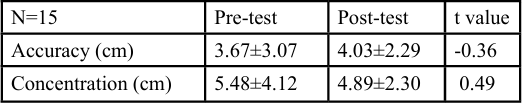
Table 1: Statistics on accuracy and concentration in the pre- and post-tests for the novice

Table 2: Statistics on accuracy and concentration in the pre- and post-tests for the veteran
Results
Table 1 showed that there was no significant difference in accuracy or concentration performance among the pre- and post-test of the novice. The accuracy value in the post-test increased slightly (from 3.67 to 4.03), and post-test performance was slightly worse than pre-test performance; however, this difference did not reach statistical significance. In terms of concentration, the post-test value for the novice decreased slightly, indicating a slight improvement in performance; however, this change also did not reach a statistically significant difference.
Table 2 showed that there was a statistically significant difference in accuracy among the pre-and post-test of the veteran (p < 0.05), whereas no significant difference was observed in concentration. The mean post-test accuracy value for the veteran (3.84) was significantly higher than the pre-test value (2.09), indicating that post-test accuracy performance was significantly worse than pre-test performance. In terms of concentration, post-test values decreased slightly, reflecting a slight improvement in performance; however, this change also did not reach statistical significance.
Discussion
The results in the above indicate that, in the accuracy test, no significant improvement was observed in results of the novice, and the accuracy in post-test was even slightly lower than that in the pre-test. The accuracy in post-test of veteran decreased significantly compared with the result of pre-test. These findings differ from those of previous studies. For example, Tirp et al. [4] reported that novices improved their throwing accuracy after one week of VR dart training, with throwing error reduced from 5.5 cm to 5.0 cm. A possible explanation for this discrepancy is that the present study examined the immediate effects of VR training, whereas Tirp et al. [4] investigated short-term training effects following one week of continuous practice. Therefore, the present findings suggest that VR training does not lead to immediate improvements in dart-throwing accuracy and may even result in performance regression among the pre- and post-test of the veteran. Moosavi et al. [16] pointed out that the equipment characteristics of darts, including weight, shape, and material, may influence key throwing parameters such as speed, angle, and release height, thereby affecting performance outcomes. In the present study, both the novice and the veteran trained using bare-hand movements during VR practice, whereas actual dart throwing was performed during the pre-test and post-test. This mismatch between training and testing conditions may partially explain the slight decrease in accuracy observed in the novice and the more pronounced decline in the veteran. Based on these findings, future studies should consider modifying the training protocol to allow participants to throw actual darts during VR training. This approach may help the novice and the veteran better adapt to the physical properties of the dart, enabling them to integrate haptic feedback with visual information during training.
In addition to requiring accuracy in archery, analyzing the concentration of archers' landing points is also another way to evaluate the performance of archers [17]. The worse the concentration of the arrow points, the more dispersed the arrow points are, and vice versa, the more concentrated the arrow points are [18]. In training practice, the better the concentration of the arrow landing point, the better the bow position, the same strength, and the same degree of body muscle contraction [19]. Of course, these views are also true in dart throwing, which is also a precision sport, so Mousavi et al. [9] also pointed out that the better the concentration performance of darts throwing, the more mature and stable their motion control ability is. Because of this, if a darts player has good concentration and poor accuracy, it may not be the stability of his movements that needs to be improved, but the ability to shoot darts to the bullseye. From the above results of this study on the concentration of dart throwing before and after receiving VR dart training, although there is no statistically significant improvement, it still shows that there is a trend of improvement in dart throwing concentration. However, this improvement is still not enough to significantly improve performances of the novice and the veteran, especially after VR training, the throwing accuracy of the veteran will be significantly reduced immediately. If darts can also be held during VR throwing training, so that throwers can receive the feedback brought by the weight of the darts, it may be easier for novice and veteran in this study to shoot darts to the bullseye during post-test. It should be emphasized that this study included only one novice and one veteran participant. All results are therefore presented descriptively and exploratorily, focusing on individual pre- to post- test changes. No statistical inferences between the two participants should be made, and comparisons are provided solely for illustrative purposes. This limitation should be considered when interpreting the findings and planning future research.
Conclusion
The results of the present study indicate that VR dart training did not produce a significant immediate improvement in throwing accuracy within a short period. No significant difference was observed between the pre-test and post-test accuracy of the novice, whereas a significant decline in accuracy was found in the veteran following training. These findings may be attributed to the fact that the present study focused on the immediate effects of VR training. In addition, performance may have been influenced by inconsistent sensory feedback resulting from the use of bare-hand movements during VR training and actual dart throwing during the testing phase, the veteran with ample experience being more sensitive to such discrepancies.
With respect to concentration performance of dart throwing, both the novice and the veteran exhibited a trend toward improved dart throwing concentration following VR training; however, these improvements did not reach statistical significance. This suggests that the immediate effects of VR training on concentration performance were limited for both subjects.
Overall, the use of bare-hand VR dart training was insufficient to effectively enhance throwing performance immediately in either the novice or the veteran within a short time frame. Future studies are therefore encouraged to incorporate physical darts into VR training to strengthen haptic feedback and improve consistency between training and testing conditions, thereby enhancing the effectiveness of VR dart training.
Competing interest:
All authors have no competing interests when completing this article.
Acknowledgement
Running Head
VR training affects dart accuracy and concentration.
References
Schmidt, RA. & Lee, TD. (2020). The Motor Learning Process. In: Lee TD, editor. Motor learning and performance from principles to application. 2nd ed. Champaign, IL: Human Kinetics, 526. View
Magill, R. (2017). Motor learning and control: concepts and applications. New York, NY: McGraw-Hill. 497. View
Kim, YM., Rhiu, I. & Yun, MH. (2020). A systematic review of a virtual reality system from the perspective of user experience. Int J Hum Comput Interact. 36(10), 893-910. View
Tirp, J., Steingröver, C., Wattie, N., Baker, J. & Schorer, J. (2015). Virtual realities as optimal learning environments in sport - A transfer study of virtual and real dart throwing. Psychological Test and Assessment Modeling. 57, 57-69. View
Brock, K., Vine, S., Ross, J., Trevarthen, M. & Harris, D. (2023). Movement kinematic and postural control differences when performing a visuomotor skill in real and virtual environments. Exp Brain Res. 241(7), 1797-1810. View
Drew, SA., Awad, MF., Armendariz, JA., Gabay, B., Lachica, IJ. & Hinkel-Lipsker, JW. (2020). The trade-off of virtual reality training for dart throwing: a facilitation of perceptual-motor learning with a detriment to performance. Front Sports Act Living. 2, 59. View
Wiemeyer, J. & Schneider, P. (2012). Applying Serious Games to Motor Learning in Sport. International Journal of Game Based Learning (IJGBL). 2(4), 61-73. View
Rienhoff, R., Baker, J., Fischer, L., Strauss, B. & Schorer, J. (2012). Fields of vision influence sensory-motor control of skilled and unskilled dart players. Journal of Sport Science & Medicine. 11, 542-550. View
Mousavi, SA., Shahbazi, M., Arabameri, E. & Shirzad, E. (2019). The effect of virtual reality training on learning and kinematics characteristics of dart throwing. Int J Sch Health. 6(1), 1-7. View
Carlson, J., Walker, H., Manning, M., & Dresner, H. (2022). Combining Physical and Mental Practices of a Dart-throwing Task Enhances Motor Learning and Impacts Psychological Skills. International Journal of Exercise Science. 16(1), 242. View
Harris, DJ., Buckingham, G., Wilson, MR., Brookes, J., Mushtaq, F., Mon-Williams, M., Vine, SJ. (2020). The effect of a virtual reality environment on gaze behavior and motor skill learning. Psychol Sport Exerc. 50, 101721. View
Gawron, V. (2019). The doing-A Review of the skill retention research. Center for Advanced Aviation System Development (McLean, VA: The MITRE Corporation, 1. View
Tripp, B. L., Yochem, E. M. & Uhl, T. L. (2007). Recovery of upper extremity sensorimotor system acuity in baseball athletes after a throwing-fatigue protocol. Journal of athletic training, 42(4), 452–457. View
Bates, B. T. (1996). Single-subject methodology: an alternative approach. Medicine & Science in Sports & Exercise. 28(5), 631- 638. View
Knief, U., & Forstmeier, W. (2021). Violating the normality assumption may be the lesser of two evils. Behavior research methods. 53(6), 2576-2590. View
Moosavi, MS., Raimbaud, P., Guillet, C. & Mérienne, F. (2024). Enhancing weight perception in virtual reality: an analysis of kinematic features. Virtual Real. 28(2), 72. View
Lin, K. B. & Hwang, C. K. (2004). Analysis of Correlation between Aiming Procedure and Shot Points. Annual Journal of Physical Education and Sports Science. 4, 49-61. View
Chen, S. Y., Hung, T. M. & Chiu, P. K. (2006). The Effect of Different Weights of Arrow Points and Shooting Distances on the Precision of the Distribution of Shooting Locations. Journal of Physical Education and Sports. 17(3), 123-134.
Lin, K. B. (2005). A Study of the Aiming Time and the Target Coordinates in Archery. Sports & Exercise Research. 7(1), 235-245.