
- About the Journal
- Editorial Board
- Review Process
- Author Guidelines
- Article Processing Charges
- Special Issues
- Current Issue
- Past Issue
 Journal of Rehabilitation Practices and Research
Journal of Rehabilitation Practices and Research Volume 7 (2026), Article ID: JRPR-201
https://doi.org/10.33790/jrpr1100201Research Article
Occupational Therapy Practitioners’ Perceptions of the Impact of DEI Training on Clinical Practice
Lovett Lowery*, OTR/L, Sydney Wilbert, OTR/L, Emma Hampton, OTR/L, Adrianne Leynes, OTR/L, Mallory Stubbs, OTR/L, and Alexandria Winston, OTR/L
Department of Occupational Therapy, Alabama State University, 915 S Jackson St, Montgomery, AL 36104, United States.
Corresponding Author Details: Lovett Lowery, Assistant Professor, Department of Occupational Therapy, Alabama State University, 915 S Jackson St, Montgomery, AL 36104, United States.
Received date: 19th November, 2025
Accepted date: 31st March, 2026
Published date: 02nd April, 2026
Citation: Lowery, L., Wilbert, S., Hampton, E., Leynes, A., Stubbs, M., and Winston, A., (2026). Occupational Therapy Practitioners’ Perceptions of the Impact of DEI Training on Clinical Practice. J Rehab Pract Res, 7(1):201.
Copyright: ©2026, This is an open-access article distributed under the terms of the Creative Commons Attribution License 4.0, which permits unrestricted use, distribution, and reproduction in any medium, provided the original author and source are credited.
Abstract
Background: The terms of diversity, equity, and inclusion (DEI) have been widely used in a variety of contexts, but have only been introduced in healthcare recently [1]. Studies have shown that having access to DEI education and/or training can be influential, and effective DEI education and/or training can enhance workplace effectiveness [2]. Students and occupational therapy practitioners being aligned in DEI practices will ultimately result in better patient care because it fosters inclusive environments and encourages the exchange of diverse perspectives [3]. Although the existing literature addresses the benefits of DEI implementation in education and healthcare and its positive impact on clinical practice, there is limited research that investigates occupational therapy practitioners’ perceptions of the impact of DEI education and/or training on their clinical practice. Future research needs to focus on the changes in the healthcare practitioner’s knowledge, attitudes, behaviors, and patient outcomes after receiving DEI education and/or training. This study investigated occupational therapy practitioners’ perceptions of the impact of DEI education and/or training and the effects of DEI education and/or training on their clinical practice.
Hypothesis: Occupational therapy practitioners’ clinical practice will be positively impacted by the knowledge gained from participating in DEI education and/or training.
Methods: A mixed-method, both quantitative and qualitative, cross- sectional research survey was conducted with occupational therapy practitioners, which included occupational therapists and occupational therapy assistants, who were licensed in the state of Alabama and actively providing occupational therapy services in Jefferson County, Alabama. This allowed participants to provide subjective responses while also offering quantitative data for analysis. The 20 question survey was divided into three sections to investigate the demographics of the OT practitioners, their experience participating in DEI education and/or training sessions, and their perception on the impact of DEI on their clinical practice. Participants who had not participated in DEI education or training sessions as either a student or practitioner were excluded. To streamline the research process, facilitate feedback collection, and generalize data information for this population, we limited our search to facilities located within Jefferson County, Alabama because it is the most populous county in the state of Alabama and it is located in the central portion of the state.
Results: The research study found that most participants had completed DEI education and/or training, and these OT practitioners reported integrating their knowledge gained from the education and/or training into their clinical practice and relationships with patients. The quantitative and one qualitative result showed that these participants agreed that their clinical relationships, communication, and their abilities to better address the needs of their patients had improved from participating in DEI education and/or training. Despite these findings, some of the study’s qualitative findings revealed skepticism among the participants of the effectiveness of DEI education and/or training and the integration of its principles into clinical practice and an emphasis on equality or preference for skill over diversity and inclusion.
Keywords: DEI, diversity, equity, inclusion, DEI education, DEI training, occupational therapy practitioner, perceptions, impact on practice
Introduction
Within the recent past, the healthcare industry has seen a shift in the awareness of initiatives seeking to promote fair treatment and participation of individuals from various backgrounds, races, ethnicities, genders, religions, et cetera. As a result, many schools, corporations, and healthcare organizations have implemented different types of education and training programs related to diversity, equity, and inclusion (DEI). The development of DEI in healthcare has numerous benefits, including better problem-solving, creativity, adaptability, and patient outcomes [5,6], and the implementation of DEI- related initiatives and programs can lead to improved quality of healthcare and access to healthcare [4,7,8,9]. The understanding and implementation of DEI initiatives are crucial for healthcare professionals to provide equitable care, as well as advocate for DEI-centered policies and programs. Studies show that a diverse workplace understands its patient populations' different issues and needs, leading to better insight into how to serve them and positively impact patients' experiences [4,9]. According to Trentham et al. [4], future research should focus on the changes in healthcare practitioners' knowledge, attitudes, behaviors, and patient outcomes after receiving DEI education and/or training. Due to the diverse populations that they serve, occupational therapy practitioners are among the healthcare professionals who would greatly benefit from integrating DEI practices into their patient interactions [10].
Diversity, Equity, and Inclusion
Diversity includes an individual's unique qualities, values, and beliefs [11]. Equity ensures that each individual has access to the same opportunities while considering the advantages and disadvantages of all individuals [12]. Lastly, inclusion is recognizing the inherent worth and dignity of all individuals [13]. Specifically related to healthcare, the terms diversity, equity, and inclusion can be applied when delivering care to patients. These terms have been used widely in a variety of contexts but have only been introduced in healthcare recently [1]. It is important to have a healthcare workforce which represents the different individuals within our communities to help provide the most appropriate care to our patients [1]. Occupational therapy practitioners fall into the healthcare workforce and should strive to have a wide representation in communities to deliver the best possible care to patients.
DEI Education and Training
The most popular DEI educational and training strategies include enhancing mentoring to diversify the workforce, cultural humility, and bias training [13]. When used as institutional-wide interventions, DEI instructional materials can have the greatest success and longest- lasting effects since they are not viewed as separate or autonomous curricula. There are numerous ways, plans, and initiatives to do this [13]. DEI education and training are offered by occupational therapy in a variety of formats, such as conferences, webinars, workshops for professional development, and certification programs [3]. The most evidence in favor of DEI approaches comes from the transformational adult learning approach. According to Hill [3], the transformational adult learning theory aims to improve one's view of others and one's own self-actualization. Health professionals that underwent training utilizing the transformational learning technique reported improved understanding of humanistic principles such as patient-centeredness, humility, and honesty [3].
The Impact of DEI Education and Training
Research shows that implementing DEI practices in healthcare has many benefits. Because healthcare providers acquire the skills and awareness needed to promote positive patient- provider interactions and care through participation in DEI education and/or training, these types of programs have been associated with positive patient outcomes, as well as with the development of a more responsive workforce to patients. However, it is crucial that DEI education and training are integrated into the education curricula for students enrolled in healthcare programs and incorporated prior to one becoming a practicing clinician. Research proposes that the inclusion of DEI in the education curricula better prepares graduates to meet the needs of all patients and that having access to DEI education and/ or training can be influential in enhancing workplace effectiveness [2,14].
Purpose of the study
In the review of the existing literature, many articles covered the benefits of DEI implementation in education and healthcare and its positive impact on clinical practice. However, few articles investigated occupational therapy practitioners’ perceptions of the impact of DEI education and/or training on their clinical practice. Trentham et al. [4] state that there is a need to investigate the effectiveness and benefits of DEI education and training because an assumption often appears that DEI education and/or training will undoubtedly lead to better outcomes. Future research needs to focus on the changes in the healthcare practitioner’s knowledge, attitudes, behaviors, and patient outcomes after receiving DEI education and/ or training [4]. Despite the growing number of practices dedicating resources to DEI education and/or training, little is known about the effectiveness of the education and/or training [15]. This study investigated occupational therapy practitioners’ perceptions of the impact of DEI education and/or training on their clinical practice. We aimed to answer the following questions: What are the occupational therapy practitioners’ experiences with DEI education and/or training? How are occupational therapy practitioners incorporating their knowledge of DEI into their clinical practice? Does DEI education and/or training have a positive impact on occupational therapy practitioners’ relationships, communication, and behaviors with their patients?
Methods
Research Design and Instrumentation
In this study, a mixed methods (quantitative and qualitative) cross sectional research survey was conducted to investigate occupational therapy practitioners' perceptions on the impact of diversity, equity, and inclusion (DEI) education and/or training on their clinical practice. This allowed participants to provide subjective responses while also offering quantitative data for analysis. An online survey was developed via Qualtrics which consisted of twenty (20) questions, including open-ended, close-ended, and Likert scale type questions. The survey was divided into three sections: Demographic Section, Occupational Therapy Practitioners’ Experience with DEI Education and/or Training Section, and Occupational Therapy Practitioners’ Perceptions on the Impact of DEI Education and/or Training on Their Clinical Practice Section. After obtaining approval from the Institutional Review Board of Alabama State University, participants received, reviewed, and signed an informed consent form before participating in the study.
Participants
Participants were purposively sampled, and the survey was distributed online to licensed occupational therapy practitioners practicing in facilities located within Jefferson County in the state of Alabama. To streamline the research process, facilitate feedback collection, and generalize data information, recruitment was limited to facilities in this area because it is located in the central portion of the state, as well as the most populous county in the state of Alabama. Occupational therapy practitioners, which include occupational therapists and occupational therapy assistants, were eligible to participate in this study if they were currently licensed in the state of Alabama, actively providing occupational therapy services in Jefferson County, Alabama, and had previously participated in DEI education or training were eligible to participate in this study. The researchers had no authority over any of the potential participants of this study.
Data Analysis
Completed surveys were reviewed, and responses were analyzed using various methods. Descriptive statistics were utilized to summarize and organize demographic data through measures of central tendency and variability. Automatic data analysis through the Qualtrics Survey tool and Microsoft Excel were utilized to analyze quantitative data. For the qualitative data, constant comparative analysis was utilized to analyze themes from the data.
Results
Demographic Characteristics
Surveys were distributed to a total of 24 occupational therapy practitioners. A total of 10 occupational therapy practitioners initiated the survey. However, one was excluded for not meeting the inclusion criteria of practicing occupational therapy at a facility located in Jefferson County, Alabama. After completing the demographic screening, a total of four other practitioners were excluded from the study due to reporting they had not participated in any DEI education and/or training. Therefore, there were a total of five participants who completed the survey in its entirety.
Majority of the survey participants worked in an outpatient rehab setting (n=4) or skilled nursing facility (n=4) and ranged in age from 20-35 years old (n=3) and 51-65 years old (n=3). This section also verified that participants were practicing at a facility located in Jefferson County, Alabama (n=9), and that the occupational therapy practitioner was currently licensed to practice occupational therapy in the state of Alabama (n=9). (See Figure I).
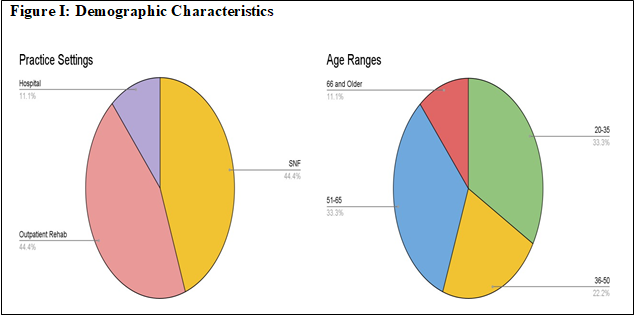
Figure I. Demographic Characteristics
OT Practitioners’ Experience with DEI Education and/or Training
Questions six through eight of the survey focused on this topic and were based on a “select all that apply” style question or a five-point Likert scale. The Likert scale style questions based on a timeframe included the answer choices of annually, quarterly/semesterly, monthly, weekly, or never. Whereas, for the other Likert scale style questions, the answer choices included always, often, sometimes, seldom, never. All five study participants were questioned whether they participated in DEI education and/or training as a student, as well as a practitioner. Out of the five participants, one participant reported participation in DEI education/training annually as both a student and an OT practitioner, three participants participated annually as students, but never as an OTP, and one never participated as a student, but did annually as an OTP. Overall, it was found that the majority of participants (80%) participated annually as a student (n=4), despite a majority of participants (60%) who had never participated in DEI education and/or training as a practitioner (n=3).
OT Practitioners’ Incorporation of DEI Knowledge into Clinical Practice
Next, the researchers investigated how OT practitioners incorporated the knowledge obtained from DEI education and/or training into their clinical relationships and clinical practice. All the participants reported incorporating the DEI knowledge gained into their clinical relationships with patients and their overall clinical practice; participants answered always (n=2), often (n=2), and sometimes (n=1). See Figure II.
Figure II. OT Practitioners' Incorporation of DEI Knowledge into Clinical Practice
OT Practitioners’ Perceptions on the Impact of DEI Education and/or Training
To investigate the OT practitioner’s perception on the impact of DEI Education and/or Training on their clinical practice, participants were posed questions related to their clinical relationships and interactions with patients. Majority of the participants (80%) either strongly agreed or agreed that DEI education and/or training had a positive impact and reported improvements in their clinical relationships with patients, communication with patients, ability to meet the individual needs of patients, and behaviors towards patients. (See Figure III).
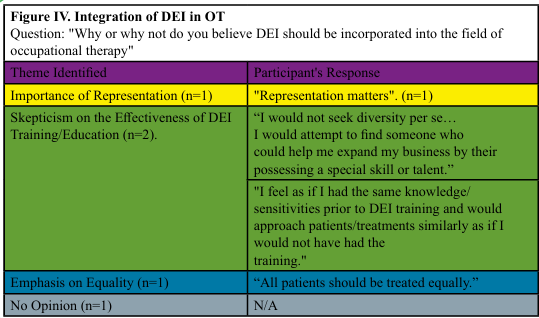
Figure III. Impact of DEI Education/Training on clinical Practice- Areas of Improvement
The last two questions on the survey were free response style questions, and the participants were given the option to respond. One asked the participants to explain their experiences incorporating DEI into their clinical practice. One of the five participants answered this question stating, “It is helpful to have baseline knowledge of DEI principles to ensure patients feel comfortable with me during treatments”. Based on this finding, it is suggested that integrating one’s DEI knowledge into clinical practice enhances therapeutic relationships and the practitioner’s therapeutic use of self. In addition, the participants were asked to expound on whether or not they believed DEI education and/or training opportunities should be incorporated into the field of occupational therapy. Four of the five participants opted to answer this last question. Although these responses varied among the participants, the following three themes were identified: the importance of representation and inclusivity (n=1), skepticism of the effectiveness of DEI strategies (n=2), and an emphasis on equality rather than diversity (n=1). (See Figure IV).
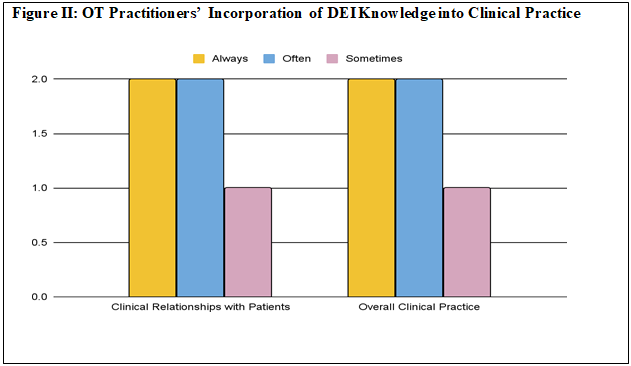
Figure IV. Integration of DEI in OT
Discussion
The survey results presented in this study shed light on the influence of DEI education and training in occupational therapy practice. The study’s quantitative findings were consistent with information found in the literature that DEI-related resources have a positive impact at the workplace and practitioners who provide culturally appropriate care improve patient experiences and better address the individual needs of their patients [9]. Through researching occupational therapy practitioners’ personal experiences, our findings highlight the positive impact of DEI education and/or training including improved clinical relationships, behaviors towards patients, communication, the practitioner’s ability to meet the needs of their patients, and patient outcomes. The study’s quantitative results, along with one qualitative response suggest that DEI initiatives and strategies should continue to be incorporated in the field of occupational therapy so that occupational therapy practitioners can gain the knowledge and skills for improved overall clinical practice and experience for their patients. Despite these findings, some of the study’s findings did not support the positive impact or the need for DEI education and/ or training. One participant experienced no change in knowledge or sensitivity after DEI education or training. Another respondent reported a preference for hiring based on skill and not diversity per se. This emphasis on equality or preference for skill over diversity and inclusion revealed skepticism among the participants of the effectiveness of DEI education and/or training and the integration of its principles into clinical practice.
Limitations
While the majority of participants reported positive experiences and outcomes associated with DEI education/or training, several limitations were identified that warrant consideration. Limitations of this study included the small sample size, participant recruitment, and limited availability of the study. Despite identifying a total of 73 service providers of occupational therapy in Jefferson County, Alabama, investigators were limited by the availability of the OT practitioners' email addresses for survey distribution. Therefore, the survey was only distributed to a total of 24 participants, with a total of nine participants who initiated the survey and five who completed the survey in its entirety due to not meeting the inclusionary criteria. This study was also confined to sampling solely within Jefferson County, Alabama. The study's reliance on sampling exclusively from this area restricted the scope of data collection and may have limited the generalizability of findings to a broader target population. Broadening the scope of the study to include a larger regional area or multiple states allows for the exploration of regional variations and trends. This expansion could also facilitate comparisons between different areas, which can lead to broader implications of the research findings.
Additionally, the entire survey could only be completed if the participants had participated in DEI education and/or training, thereby excluding individuals who did not meet this criterion. Although the study explored if participants received DEI education/ training either as a student or practitioner, it did not investigate the specific types of DEI education and/or training the participants had received. These two limitations prevented the researchers from seeing how non-participation in DEI education and/or training or participation in certain types of DEI education and training may have impacted their clinical practice. This resulted in a limited number of respondents, which in turn limited the generalizability of the results. The final limitation of the study was the limited number of qualitative questions or descriptive responses. The majority of the survey questions produced a broad perspective or a general overview from the participants. Due to the Likert-scale type of questions that elicited an agreement or frequency response, descriptors that may have expounded more on the specific improvements the OT practitioners perceived because of DEI training and education were not provided. Additional information regarding the timeframe in which the participants completed DEI training and education would be beneficial to determine how recent it may have been received.
Future Implications to OT Practice
For future implications, addressing the previously identified limitations through broader sampling efforts, survey availability, and inclusive survey criteria will be essential to ensure the validity and applicability of future research findings. It will also be beneficial to explore the specific types of DEI education and training OT practitioners have received to determine any correlation between the type of training received and the impact each may have on clinical practice. By further exploring the impact of DEI on occupational therapy practice, it can be used to advocate for its integration into professional training programs as a useful tool to promote positive and inclusive healthcare practices.
Conclusion
The impact of diversity, equity, and inclusion (DEI) education and/ or training on occupational therapy practitioners' clinical practice was examined in this study. The hypothesis that occupational therapy practitioners’ clinical practice would be positively impacted by the knowledge gained from participating in DEI education and/or training was supported by the findings. The research presented leads to the conclusion that while most study participants did not receive DEI training, those who did believe that it is essential and positively impacted clinical practice. The findings of our study support the idea that DEI education and/or training can equip occupational therapy practitioners with the knowledge and skills to improve the quality of healthcare provided to their patients.
Competing interests:
All authors have no competing interests when completing this article.
References
Stanford, F. C. (2020). The importance of diversity and inclusion in the healthcare workforce. Journal of the National Medical Association, 112(3). View
Creary, S., Rothbard, N., & Scruggs, J. (2021). Improving workplace culture through evidence-based diversity, equity and inclusion practices. The Wharton School of the University of Pennsylvania. 10.31234/osf.io/8zgt9. View
Hill, D. (2022). Supporting diversity, inclusion and equity efforts in a professional organization. SOPHIA, 1. View
Trentham, B., Cockburn, L., Cameron, D. & Iwama, M. (2007). Diversity and inclusion within an occupational therapy curriculum. Australian Occupational Therapy Journal, 54, S49-S57. View
Newburry, W., Rašković, M., Colakoglu, S. S., Gonzalez-Perez, M. A., & Minbaeva, D. (2022). Diversity, equity and inclusion in international business: Dimensions and challenges. AIB Insights, 22(3). View
Regis, K., Phan, Q., Cadoret, A., Weaver Parker, N., & Swan, B. A. (2023). Gaining insight into member demographics and perceptions of diversity, equity, and inclusion initiatives in a professional organization (AAACN). Nursing Economics, 41(2), 96–103. View
American Occupational Therapy Association. (2020). Occupational therapy’s commitment to diversity, equity, and inclusion. American Journal of Occupational Therapy, 74(Suppl. 3). View
Rosenkranz, K. M., Arora, T. K., Termuhlen, P. M., Stain, S. C., Misra, S., Dent, D., & Nfonsam, V. (2021). Diversity, equity and inclusion in medicine: Why it matters and how do we achieve it? Journal of Surgical Education, 78(4), 1058-1065. View
Smith, T., Bordelon, C., & Holland, A. (2023). Integrating diversity, equity, and inclusion training in graduate nursing curriculum. The Journal for Nurse Practitioners, 19(6). View
Anderson, S. H. (2022). Cultivating cultural humility in occupational therapy through experiential strategies and modeling. The Open Journal of Occupational Therapy, 10(4), 1-7. View
Taff, S. D., & Blash, D. (2017). Diversity and inclusion in occupational therapy: Where we are, where we must go. Occupational Therapy in Health Care, 31, 72-83. View
World Health Organization. (2019). Health equity. View
Corsino, L., & Fuller, A. T. (2021). Educating for diversity, equity, and inclusion: A review of commonly used educational approaches. Journal of Clinical and Translational Science, 5(1). View
Lerner, J. E., & Kim, A. (2022). Developing an anti-racist practice in occupational therapy: Guidance for the occupational therapist. The Open Journal of Occupational Therapy, 10(4), 1-13. View
Wang, M. L., Gomes, A., Rosa, M., Copeland, P., & Santana, V. J. (2023). A systematic review of diversity, equity, and inclusion and antiracism training studies: Findings and future directions. Translational Behavioral Medicine. View