
- About the Journal
- Editorial Board
- Review Process
- Author Guidelines
- Article Processing Charges
- Special Issues
- Current Issue
- Past Issue
 Journal of Rehabilitation Practices and Research
Journal of Rehabilitation Practices and Research Volume 7 (2026), Article ID: JRPR-204
https://doi.org/10.33790/jrpr1100204Research Article
Interprofessional Education to Reduce Repeat Falls for Community Dwelling Older Adults through Emergency Response
Betty Sitt, OTD, Denise Crowley, OTD, and Alysson Goodwin, PhD,
Department of Occupational Therapy, Monmouth University, 400 Cedar Ave, West Long Branch, NJ 07764, United States.
Corresponding Author Details: Alysson Goodwin, PhD, Specialist Professor, Department of Occupational Therapy, Monmouth University, 400 Cedar Ave, West Long Branch, NJ 07764, United States.
Received date: 14th February, 2026
Accepted date: 22nd May, 2026
Published date: 25th May, 2026
Citation: Sitt, B., Crowley, D., & Goodwin, A., (2026). Interprofessional Education to Reduce Repeat Falls for Community Dwelling Older Adults through Emergency Response. J Rehab Pract Res, 7(1):204.
Copyright: ©2026, This is an open-access article distributed under the terms of the Creative Commons Attribution License 4.0, which permits unrestricted use, distribution, and reproduction in any medium, provided the original author and source are credited.
Abstract
Community-dwelling older adults often utilize Emergency Medical Services (EMS) for “lift-assists” after falling and rarely report fall incidents to their primary care physicians. Lack of reporting may limit intervention for falls and increase subsequent falls. The purpose of this study was to utilize OT-led interprofessional education to increase Emergency Medical Service Professionals’ (EMSP)’ baseline knowledge of fall risk, reduction, and referral as a starting point in the development of an EMS fall protocol. The study utilized a quasi-experimental pretest-posttest design to examine EMSP’s fall knowledge before and after training. Sixty-two EMSPs attended in person and virtual trainings led by an occupational therapy practitioner (OTP) including fall risk, environmental screening, fall referral, and transfer techniques. A significant increase in knowledge was observed (p <0.01), suggesting that OTP-led education enhances EMSPs’ ability to assess fall risk and make referrals. The study provided pilot information toward feasibility of OTP led training for improving EMSP knowledge of fall prevention and referral for community dwelling older adults during first response to falls. Training could lead to better overall outcomes for fall-prone community dwelling adults and reduce repeat and unreported falls.
Introduction
When a community dwelling older adult falls, Emergency Medical Services (EMS) is contacted for help, but is not equipped with the appropriate resources to provide to these ‘frequent fallers’ besides basic medical assessment and transportation to the emergency room. Fall calls have increased 268% over the 10-years between the years of 2008 through 2018 [1]. A record of 70,262 fall-related calls were made by adults 65+ from 2013-2022. This number is expected to double by 2040 and is projected to triple by 2060 [2]. Ten to twenty- five percent of emergency calls by adults 65+ are attributed to falls, which places EMS professionals (EMSP) in an opportunistic position to provide fall prevention education, referrals, and resources [3]. In 2020, the Centers for Disease Control and Prevention (CDC) reported that 332,750 adults over the age of 65, or ¼ older adults, sustained a fall in New Jersey [4]. In 2020, every 6 minutes in New Jersey, an older adult over the age of 60 was seen in the emergency room for a fall (New Jersey Leadership, 2020). Of these calls, approximately 25% are not transported to an emergency department, ceasing the opportunity for referrals for follow up fall care [5]. Follow-up to emergency fall calls is limited; approximately half of older adults who experience a fall do not discuss it with their healthcare provider [6].
Falls affect outcomes for community dwelling older adults. Falling once doubles the individual’s chances of falling again, putting these individuals at a significant risk of serious injury, 20% of falls result in fractures or traumatic brain injury [7]. Fractures and injuries, decreased quality of life, fear of falling, reduced mobility, or even death can occur due to falls [8].
Besides the impact on outcomes for community dwelling older adults, the total medical cost in the United States for fatal and nonfatal falls was $80 billion in 2020 accounting for fees, prescription medication, hospital/nursing home care, professional services, medical equipment, rehabilitation, community-based services, and insurance processing [9,10]. Those costs include ambulance rides and related resources, such as EMSPs. The cost avoidance of ambulance transport, emergency department visits, and in-patient hospital admission can range between $10,000 -$17,000 collectively [7].
Community dwelling older adults rely heavily on EMSPs to respond to falls with little follow up, limited improvement and outcomes, and high costs. This study aims to explore ways that occupational therapists can, in collaboration with early responders, impact outcomes for community dwelling older adults who experience falls.
Literature Review
Snooks et al. [11] conducted a cluster randomized trial in the United Kingdom to determine a clinical protocol for paramedics to implement when responding to fall calls. Three ambulance services participated by assessing and referring the callers to more than 10 community-based fall services rather than transporting them to emergency departments [11]. Results showed that there was a statistically significant lower rate of subsequent emergency ambulance fall calls within 6 months in the intervention group compared to the control group [11]. Bonner et al. [3] conducted a systematic review of fall call protocols in Great Britain, revealing that specific fall-call protocols resulted in a reduction of subsequent falls. Mikolaizak et al. [5] formed a multidisciplinary approach to fall calls, their results indicated that those in the intervention group that adhered to the recommendations and suggestions experienced fewer subsequent falls than those in the intervention group that did not follow protocol suggestions. However, their research relies on their paramedics to exclusively refer to other disciplines, rather than educating the paramedics and disseminating materials. Chu et al. [12] studied the impact of an occupational therapy education session for community-dwelling older adults who sustained a fall on subsequent calls in Hong Kong, and findings revealed a significant reduction in the number of falls in the experimental group compared to the control group.
Research on fall-prevention EMS protocol is limited in the United States; Recent research that has been conducted has been carried out in the United Kingdom [3,11,13]. Snooks et al. [13] found that implementing a fall protocol was cost-effective at a modest cost in Great Britain. The reimbursement system in Great Britain differs from the United States’ capitalist system, where access to care often depends on insurance coverage and out-of-pocket affordability. This disparity may influence the implementation and effectiveness of fall protocols, particularly among older adults affected by social determinants of health such as income, insurance status, and geographic location. Medical costs for falls in the United States are expensive; The average hospitalization stay due to fall-related injuries cost over $30,000 in 2014 [9].
The literature review highlighted research gaps in the United States regarding outcomes related to the use of EMS protocols for fall prevention for health outcomes for community dwelling older adults and public health cost savings resulting from the use of EMS protocols for fall prevention. These limitations should be addressed to prevent public health bystander watch as accidental falls rise to the second leading cause of accidental injury deaths [14].
This project aims to cover a gap in research in the United States, by educating EMSPs and disseminating fall preventative resources to the community-dwelling older adults. The purpose of this study is to utilize occupational therapy practitioner (OTP)-led interprofessional education to increase EMSPs’ baseline knowledge of fall risk, reduction, and referral as a starting point in the development of an EMS fall protocol.
Method
A quasi-experimental pretest-posttest design was used to evaluate the relationship between OTP-led interprofessional education and increased EMSP knowledge related to supporting community- dwelling older adults on a fall call. The central research question, “Does a significant change in EMSP knowledge of fall prevention for community-dwelling older adults occur following an OT-led education session?,” was used to guide research activities. The null hypothesis is that there is no significant change in EMSP knowledge following OT-led education indicated by no significant differences between pretest and posttest scores.
Ethical Considerations
The research protocol underwent review and approval by the Institutional Review Board of Monmouth University. Informed consent was reviewed and obtained by all study participants. Participants were notified that they could withdraw from the study at any point, and procedures and confidentiality were reviewed, including the research purpose, potential risks and benefits.
Recruiting/Participants
The intended number of participants was between 20 to 100. Potential participants were recruited in Maine (ME) and New Jersey (NJ). Maine EMS stations sent an email script announcing a virtual Fall Prevention Education Training to all their professionals. New Jersey Monmouth County EMS stations were recruited through a verbal script phone call to schedule in-person presentations. Participants met the following inclusion criteria: current and active EMSPs, aged 18 or older, cognitively intact, able to read, able to communicate through written or verbal means, and able to express discomfort, understanding, or lack thereof. Exclusion criteria were as follows: protected populations, vulnerable groups (children/ minors, those with diminished autonomy or decision-making capacity, prisoners), and individuals who could not give voluntary consent. There was no relationship between the investigators and the participants. Access to participants was granted through their employment agencies. Convenience sampling was employed, which allowed any member of the organization to participate based on their availability/accessibility. Participants who agreed to partake in the project were de-identified using randomly generated numbers (i.e., 001, 002, and subsequent numbers). A linking file was created and stored in the primary investigator's institutional password-secured computer, separate from the data.
Instruments
The Safety Awareness Matrix for Community-Dwelling Older Adults in Fall Prevention for EMS Professionals who Answer Fall Calls (SAM) is an eleven-question survey authored to gather data to answer the central research question. The intended population for the SAM is EMSPs who respond to fall calls and enter the homes of fall callers. Face and content validity were established by expert review, and the reliability of the scale was measured during the process of this study. The SAM was designed to collect data on participants' current knowledge as it applies to their frequent fall callers. The questions on the SAM survey were developed based on the main topics presented in the learning modules (transfer training, in-home assessment, assessment of footwear, visual acuity, obtaining fall history, and OT/PT value). The intended population is EMSPs who answer fall calls and enter the homes of the callers. The SAM survey takes 10 minutes or less to complete and is presented on a five-point Likert scale for simplicity and to lend itself to data analysis in many forms. Additionally, it offers a balanced neutral midpoint, which is useful for respondents who do not lean toward agreement or disagreement [15]. When scoring, strongly disagree = 1 point, disagree = 2 points, neutral = 3 points, agree = 4 points, and strongly agree = 5 points, with a maximum score of 55. The pre-score indicates the participant’s level of knowledge about fall prevention prior to the training. The post-score is the participant’s level of knowledge of fall prevention following the training. A twelfth question appeared only on the post-test, determining the value of OT within fall prevention, with a highest possible score of 5. In addition to the SAM, demographic characteristics were gathered including age in years and years of experience as an EMSP.
Procedures
The NJ participants received a participant ID number upon arrival at an EMS station for an interprofessional educational presentation. The ME participants received their participant ID code within private chat settings on Zoom. For both settings, the presentation included a scannable QR code and a link to access a pre-survey test. Electronic informed consent was obtained before accessing the pre- survey. The informed consent, SAM pre-survey, and demographics form were completed prior to participation in the education session. The educational content included recommended changes to EMSP standard operating procedures when responding to fall calls. Provided information included environmental screening for fall risk, transfer techniques, referral recommendations to healthcare providers, and a fall prevention assessment. Information provided in the educational module highlighted the importance of reporting falls to primary care physicians and the specific roles of physical therapy and occupational therapy related to fall prevention and rehabilitation following a fall.
Following the educational session, a scannable QR code was displayed for post-survey completion. After completing the post survey, individuals were given the option to submit feedback. Lastly, participants received a debriefing message thanking them for their participation, outlining the project's purpose, providing a brief recap of the procedures, emphasizing confidentiality, providing contact information for further questions, and reminding them that they may withdraw from the program at any time. No incentives were offered to any participants.
Data Collection
The SAM pre- and post-surveys were administered through Qualtrics and accessed using a QR code and link on their personal devices. Following completion of the pre-survey by all participants, an in- service took place (in-person for NJ, virtual for ME), focusing on fall prevention and education for EMS professionals. After completing the education, the post-survey was administered on Qualtrics. The total time commitment for participants was 1.5 hours. The data was exported from Qualtrics and analyzed using the Statistical Package for Social Sciences (SPSS), version 29.
Data Analysis
The SAM was administered through the Qualtrics platform, as a pre-survey before any educational training, and then as a post survey after all education. The impact on EMS education levels was determined by comparing scores. All survey responses were anonymous, with a participant ID number used to compare scores between the two surveys.
The pre-intervention and post-intervention surveys were compared through SPSS, with the significance level set to p< .05. Data were analyzed in pre-test and post-test sets for normality using a Shapiro- Wilk test with significance set at p >.05. indicating normality of the data. Inferential statistical analysis was determined based on normality. If the data met the parameters for normal distribution, a paired t-test would be done. If the data did not meet parameters for normality, a Wilcoxon signed rank test was employed to determine statistical significance. The significance level was set at p<.05. To ensure internal reliability of the SAM, non-parametric testing using Cronbach’s alpha was completed. The results indicated acceptable internal consistency, with Cronbach’s alpha (α) = .716.
Demographic data were analyzed using descriptive statistics to identify sample characteristics. For the purpose of this study, only age and years of experience were gathered from participants. Age and years of experience were used to create groups to determine if demographics influenced scoring. Comparison of demographic groups began with analysis of normality, to determine if smaller group distributions met normality constraints, Shapiro-Wilk tests were completed on the grouped data to determine normality. If the distributions met normality, t-tests were used to compare scores between age and experience grouping. If the distributions did not meet normality, Mann-U Whitney tests were used to compare the two groups.
Results
A total of 81 participants were recruited for the study; 62 completed both pre-and post-surveys. Participants were EMS professionals with ages ranging from 19-82 and years of experience ranging from 1-43 years. Table 1 provides participant demographics.
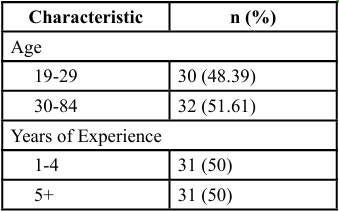
Table 1. Participant Demographics
Two groups were created from the data for age: 19-29 years and 30-84 years. The 84-year-old participant was an outlier in the demographic distribution; the age groups were chosen to create similar sample numbers and distributions for comparison. Two groups were created from demographics gathered for years of experience: 1-4 years and 5+ years. Groups were chosen to create similar sample numbers and distributions for comparison. Table 2 reports the descriptive statistics resulting from analysis of SAM scoring. On question 12 relating to the value of OT in fall prevention, out of the 62 participants, 8 selected "Neutral" (11.8%), 17 participants selected “Agree” (25%), and 37 participants selected "Strongly Agree" (54.4%).
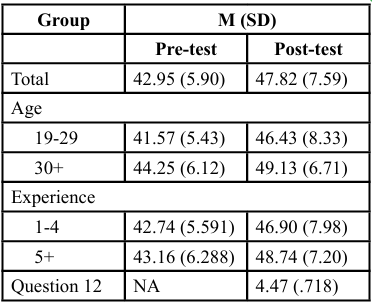
Table 2. Descriptive Statistics
A Shapiro-Wilk test confirmed that the pre-scores for the entire group were normally distributed (p=.299) whereas the post-survey scores were not (p<.001). Table 3 reports normality statistics on the SAM scoring.
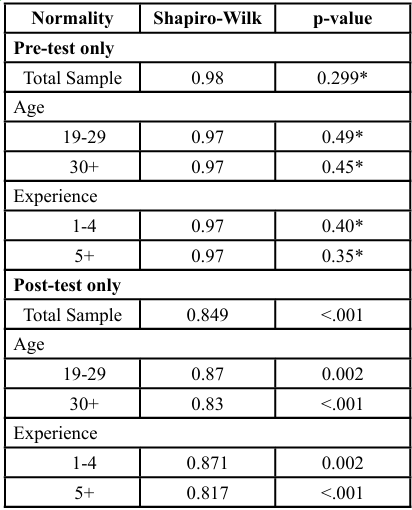
Table 3. Tests of Normality
A non-parametric Wilcoxon signed-rank test was conducted for whole group differences, which indicated that the post-survey scores were significantly higher than pre-survey scores, Z=4.98, p<0.001. Effect size was calculated using the formula r=Z/√n for the total sample. The effect size statistical results are interpreted in the same manner as Cohen's d. Effect size for the total sample was r=.63 indicating a medium effect size.
Due to normality of the pre-test data, t-tests were used to compare the pre-test scores for age and experience groupings. For the age groups a significant difference was observed between the 19-29 year age group and the 30–84 year age group, t(60) = -1.829, p = .036. The younger group scored significantly lower than the older group on the pre-test. For the experience groups no significant difference was observed between the 1-4 years of experience group and the 5 or more years of experience group, t(60) = -.277, p = .391. Due to non normality of the post-test data, a Mann-U Whitney comparison was used to compare groups' scores by age and experience. Comparison of post-test scores showed no significant difference between age groups, U = 399.50, p = .251. Mann-U Whitney comparison of post-test scores showed no significant difference between experience groups, U = 431.50, p = .485. Table 4 reports the statistical comparison of pre-test and post-test scores.
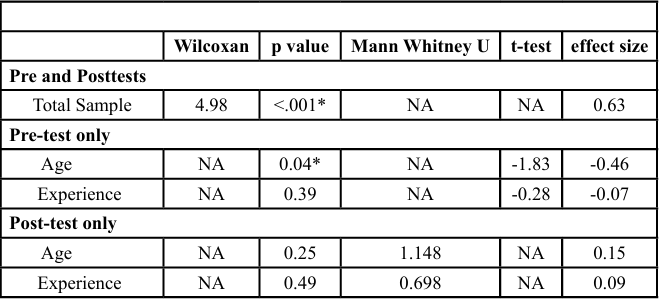
Table 4. Statistical Comparison of Pre-test and Post-test scores
Analysis
In answer to the research question, “Does a significant change in EMSP knowledge of fall prevention for community-dwelling older adults occur following an OT-led education session,” we reject the null hypothesis due to a significant difference found between the pre-test and post-test scores, Z=4.98, p<0.001. A relationship exists between the completion of fall prevention training led by an OT and a change in EMS fall responders' knowledge of fall prevention. More specifically, EMSPs who received OT-led fall prevention education and resources demonstrated a significantly higher level of fall related knowledge. On average, participants' post-training scores increased by 4.87 points, demonstrating improved understanding of fall prevention and assessment after the educational intervention.
Participant groupings based on age and experience level indicated a significant difference between two age groups on pre-test scoring. The younger age group scored significantly lower on the pre-test indicating a relationship between age and knowledge of fall prevention before educational intervention. No relationship was found between pre-test scores and years of experience, indicating that knowledge of fall prevention was consistent across experience levels before the educational intervention. No significant differences were found for age and experience in post-test scoring. The educational intervention reduced age differences in pre-test scores and demonstrated educational effectiveness across all age and experience levels.
The final survey question (#12), "The training enhanced my understanding of Occupational Therapy’s role in fall prevention," yielded a highly positive response, with 54 out of 62 participants (87.1%) selecting "Strongly Agree," or “Agree.” This distribution indicates strong consensus among EMS professionals that fall prevention training delivered by an OT significantly improved their understanding of fall prevention and the OT's role in it. The majority of participants who responded positively suggests that fall prevention education and resources provided by an OT lead to a marked enhancement in EMS professionals' knowledge compared to a baseline in which no prior education on the subject from an OT existed. This finding highlights the impact of OT-led education on fall prevention knowledge in this professional group, and advocates for the inclusion of OTP-led training in fall prevention.
Discussion
The results of this study demonstrate that OTP-led fall prevention education significantly improved EMSPs knowledge. These findings reinforce those of Mikolaizak et al. [5] regarding the positive effects of interdisciplinary collaboration in designing fall-prevention strategies for first responders. The extension of the OT role into the EMS context positions the OT as an educational consultant guiding system-level change, such as creating fall protocols to improve the quality of life for community-dwelling older adults and preventing subsequent falls. Furthermore, this study contributes to emerging evidence that OTPs can serve as educational consultants between first responders and community services for older adults [12]. By collaborating with EMS teams, OTPs translate fall prevention principles into field-specific guidelines that are compatible with emergency care. The pre-test demonstrated a significant difference in fall-related knowledge between age groups but not experience groups, indicating that life experience may affect the understanding more than EMS experience. The lack of significant differences in post-test scores between experience and age groupings indicated the effectiveness of OT educational design in accommodating differing levels of pre-knowledge and resulting in consistent improvement of knowledge across age groups. This reinforces the scope of OT beyond direct patient care to systemic educational consultation, which are essential roles to public health initiatives, specifically aimed at reducing subsequent falls in community-dwelling older adults.
Conclusion
Community dwelling older adults experience limited access to care following fall response by EMS. Many falls are not reported or further addressed for the prevention of repeat falls or identification of underlying issues contributing to falls. The purpose of this quasi- experimental study was to examine if interprofessional education led by OTPs resulted in an increase in EMSP’s knowledge of fall assessment, reporting, and referral. Results indicated a statistically significant difference in level of EMSP knowledge pre and post intervention. The findings of this study indicate that OTP-led fall prevention training is effective, improving EMSP’s fall prevention knowledge, ability to assess fall risks, and refer repeat fall callers appropriately to address the root cause of fall and prevent future falls. Interdisciplinary collaboration between EMS and occupational therapy in reducing fall risk among community-dwelling older adults, specifically promoting timely referrals and post-fall interventions, represents a first step in improving access to care. Integrating this training into routine EMS initial and continuing education can have a significant impact on the coordination of care provided to community-dwelling older adults who sustain a fall. Beyond training, EMS agencies may consider incorporating fall prevention assessments into standard operating procedures and protocols to ensure that the knowledge gained from the training is applied in real- world scenarios, enhancing the overall management of fall-related incidents for community-dwelling older adults.
Conflicts of Interest:
The authors declare no conflicts of interest.
References
Quatman, C.E., Mondor, M., Halweg, J., & Switzer, J.A. (2018). Ten years of EMS fall calls in a community: An opportunity for injury prevention strategies. Geriatric Orthopaedic Surgery & Rehabilitation, 9. View
Uemura, S., Nakayama, R., Koyama, M., Taguchi, Y., Bunya, N., Sawamoto, K., Ohnishi, H., & Narimatsu, E. (2024). Prediction of the future number of fall-related emergency medical services calls in older individuals. International Journal of Emergency Medicine, 17, 72. View
Bonner, M., Capsey, M., & Batey, J. (2021). A paramedic's role in reducing number of falls and fall-related emergency service use by over 65s: A systematic review. British Paramedic Journal, 6(1), 46–52. View
Centers for Disease Control and Prevention. (2023). Falls data. View
Mikolaizak, A. S., Lord, S. R., Tiedemann A., Simpson, P., Caplan, G. A., Bendall, J., Howard, K., Webstar, L., Payne, N., Hamilton, S., Lo, J., Ramsay, E., O’Rourke, S., Roylance, L., & Close, J. C. (2017). A multidisciplinary intervention to prevent subsequent falls and health service use following fall-related paramedic care: A randomised controlled trial. Age and Ageing, 46(2). View
Bergen G, Stevens M.R., & Burns E.R. (2016). Falls and fall injuries among adults aged ≥65 years– United states, 2014. Morbidity and Mortality Weekly Report, 65, 993–998. View
Cohen, D., & Morrison, A. (2017). Cochrane for clinicians: Interventions for preventing falls among older adults living in the community. American Family Physician, 95(3), 152-153. View
Vaishya, R., & Vaish, A. (2020). Falls in older adults are serious. Indian journal of orthopaedics, 54(1), 69–74. View
Choi, N., Choi, B.Y., DiNitto, D.M., Marti, C.N., & Kunik, M.E. (2019). Fall-related emergency department visits and hospitalizations among community-dwelling older adults: examination of health problems and injury characteristics. BMC Geriatrics, 19(303). View
Haddad, Y.K., Miller, G.F., Kakara, R., Bergen, G., Burns, E.R., & Atherly, A. (2024). Healthcare spending for non-fatal falls among older adults, USA. Injury Prevention, 30, 272-276. View
Snooks, H. A., Anthony, R., Chatters, R., Dale, J., Fothergill, R. T., Gaze, S., Halter, M., Humphreys, I., Koniotou, M., Logan, P., Lyons, R. A., Mason, S., Nicholl, J., Peconi, J., Phillips, C., Porter, A., Siriwardena, A. N., Wani, M., Watkins, A., Wilson, L., … Russell, I. T. (2017a). Paramedic assessment of older adults after falls, including community care referral pathway: Cluster randomized trial. Annals of Emergency Medicine, 70(4), 495- 505.e28. View
Chu, M.M., Fong, K.N., Lit, A.C., Rainer, T.H., & Cheng, S.W. (2016). An occupational therapy fall reduction home visit program for community-dwelling older adults in Hong Kong after an emergency department visit for a fall. Journal of the American Geriatrics Society, 65(2). View
Snooks, H. A., Anthony, R., Chatters, R., Dale, J., Fothergill, R. T., Gaze, S., Halter, M., Humphreys, I., Koniotou, M., Logan, P., Lyons, R. A., Mason, S., Nicholl, J., Peconi, J., Phillips, C., Porter, A., Siriwardena, A. N., Wani, M., Watkins, A., Wilson, L., … Russell, I. T. (2017b). Support and assessment for fall emergency referrals (SAFER) 2: a cluster randomized trial and systematic review of clinical effectiveness and cost- effectiveness of new protocols for emergency ambulance paramedics to assess older people following a fall with referral to community based care when appropriate. Health Technology Assessment, 21(13). View
World Health Organization. (2021). Falls. World Health Organization. View
Bishop, P.A. & Herron, R.L. (2015). Use and misuse of the likert item responses and other ordinal measures. International Journal of Exercise Science, 8(3), 297-302. View