
- About the Journal
- Editorial Board
- Review Process
- Author Guidelines
- Article Processing Charges
- Special Issues
- Current Issue
- Past Issue
 Journal of Rehabilitation Practices and Research
Journal of Rehabilitation Practices and Research Volume 7 (2026), Article ID: JRPR-206
https://doi.org/10.33790/jrpr1100206Research Article
Examining the Significance of Student-Centered Learning in Occupational Therapy
Megan Edwards-Collins, Ph.D., OTR/L, FAOTA, CAPS, CFPS, Jeffery Lucas*, Ph.D., OTR/L, CDP, CKTP, CAPS, and Micheal Jarrett, Ph.D., CSCS
Assistant Professor, Department to Occupational Therapy, Winston-Salem State University, 601 S. Martin Luther King Jr. Drive Winston Salem, NC 27110, United States.
Corresponding Author Details: Jeffery Lucas, Ph.D., OTR/L, CDP, CKTP, CAPS, Assistant Professor, Department to Occupational Therapy, Winston-Salem State University, 601 S. Martin Luther King Jr. Drive Winston-Salem, NC 27110, United States.
Received date: 06th March, 2026
Accepted date: 28th May, 2026
Published date: 30th May, 2026
Citation: Edwards-Collins, M., Lucas, J., & Jarrett, M., (2026). Examining the Significance of Student-Centered Learning in Occupational Therapy. J Rehab Pract Res, 7(1):206.
Copyright: ©2026, This is an open-access article distributed under the terms of the Creative Commons Attribution License 4.0, which permits unrestricted use, distribution, and reproduction in any medium, provided the original author and source are credited.
Abstract
Meaning and purpose are central motivational constructs that influence occupational engagement across the lifespan. Purpose organizes behavior, while meaning drives performance. In educational contexts, student-centered pedagogy fosters both by positioning learners as active agents in their own learning. This approach has been shown to enhance motivation, engagement, and emotional investment, leading to deeper cognitive processing and improved knowledge retention [1].
Within occupational therapy, practitioners emphasize the use of meaningful and purposeful activities to improve physical, cognitive, and social participation. This principle extends to academia, where educators share a parallel responsibility to design learning experiences that are engaging and relevant. Student-centered learning particularly when incorporating active learning strategies has been associated with improved academic outcomes and stronger analytical skills.
This pedagogical approach emphasizes personalized instruction, experiential and collaborative learning, rigorous expectations, and performance-based assessment, while also encouraging educator reflection and shared leadership. Given these responsibilities, occupational therapy educators must ensure that instructional methods align with students’ learning needs.
The present study evaluated whether a student-centered learning experience enhances occupational therapy students’ confidence and competence in activity analysis, as well as their willingness to apply novel intervention strategies. Using a quantitative design, the study examined students’ understanding of activity analysis, perceived challenges and benefits, and overall learning outcomes. Participants were recruited through convenience sampling from entry-level Master of Science in Occupational Therapy and Occupational Therapy Assistant programs. A student-centered instructional approach using origami was implemented to strengthen comprehension of the activity analysis process.
Introduction
Client-centeredness is a foundational principle of occupational therapy, emphasizing collaboration and the integration of clients’ values, goals, and lived experiences into intervention planning. Practitioners act as facilitators, using shared decision-making to tailor interventions across individual, family, and population levels [1]. This philosophy is equally relevant in occupational therapy education, where recognizing students’ learning styles and experiences is essential for effective course design.
Student engagement plays a critical role in academic success, encompassing emotional, relational, and cognitive involvement in the learning process. Research in occupational therapy education has increasingly examined how students learn, interact with their environments, and perceive educational experiences. These insights support a shift from traditional instructor-centered teaching toward student-centered learning approaches.
As the demand for occupational therapy professionals continues to grow, educational programs must prepare students to meet diverse and evolving healthcare needs. Rapid advancements in healthcare, technology, and patient expectations require curricula that integrate both theoretical knowledge and practical skills. Students must develop competence in areas such as therapeutic interventions, activity analysis, environmental modification, and client-centered practice skills that are often complex and challenging to master.
A student-centered approach provides a framework for addressing these challenges by aligning instructional strategies, assessments, and learning experiences with students’ needs. This approach supports the development of competent, adaptable professionals capable of transitioning effectively from academic settings to clinical practice.
Literature Review
Student-Centered Learning
Traditional instruction typically relies on lecture-based, instructor centered models in which students play a passive role. In contrast, student-centered learning positions learners as active participants in constructing knowledge [2-4]. These approaches emphasize collaboration, inquiry, and real-time interaction to deepen understanding.
In occupational therapy education, student-centered learning promotes active participation, reflection, and the integration of theory with practice [5]. It supports the development of competencies required for client-centered care [6]. Research across health professions education demonstrates the effectiveness of these strategies in improving learning outcomes and engagement [7].
As educational models evolve, institutions increasingly adopt active learning approaches to prepare students for complex professional environments [8,9]. These methods foster critical thinking, problem solving, creativity, and adaptability, while encouraging openness to diverse perspectives [10].
Student-Centered Learning in Occupational Therapy Education
In occupational therapy programs, student-centered learning fosters collaboration and encourages exploration of current practices and innovations. Students take an active role in directing their learning, while educators guide the process through structured inquiry and appropriately challenging experiences [11]. Scaffolded learning experiences further support the gradual development of critical thinking skills [12].
Critical thinking is essential to occupational therapy practice, underpinning clinical reasoning, safety, and effective intervention planning. Practitioners must assess, analyze, and adapt interventions based on client needs. Developing autonomy in these skills is key to delivering client-centered care [13]. Early exposure to student centered learning may therefore ease the transition from education to practice.
Activity Analysis in Student-Centered Learning
Activity analysis is a core component of occupational therapy practice, involving the systematic breakdown of tasks to evaluate their therapeutic potential [14]. The use of origami in the classroom underscores its practical, hands-on nature, thereby fostering active student engagement in the learning process. Through this process, students learn to assess activity demands and adapt tasks to match individual abilities. Research indicates that activity analysis coursework enhances students’ competence, awareness, and interest in accessibility and inclusion [15].
Student-centered learning supports this process by promoting active engagement, collaboration, and reflection [16]. By incorporating learner-selected activities, the origami activity strengthens practical skills, self-efficacy, and confidence while enhancing overall engagement.
Complexity of Teaching Activity Analysis
Teaching activity analysis presents unique challenges, as it requires students to move beyond surface-level understanding to develop clinical reasoning and precision. Educators must guide students in recognizing therapeutic potential, grading activities, and considering environmental influences. The process can be time-intensive and cognitively demanding.
Breaking activities into clear, structured steps can improve accuracy and consistency. Instructional strategies often include visual supports, such as images or physical objects, to clarify each stage of the process. These tools reduce ambiguity, enhance comprehension, and make learning more accessible.
As a teaching method, activity analysis helps students master complex skills by dividing tasks into manageable components that can be adapted to individual learning needs. This structured yet flexible approach aligns well with student-centered pedagogy and supports the development of competence in occupational therapy practice.
Methodology
Participants
The research study received approval from the Institutional Review Board at Winston-Salem State University in Winston-Salem, North Carolina. A quantitative approach was used to explore participants’ understanding of the activity analysis process, including the challenges they encountered, the benefits they perceived, and how the experience contributed to their overall comprehension of the process. Participants were obtained using convenience sampling methods from an entry-level MS Occupational Therapy Program and an entry level Associates Occupational Therapy Assistant Program. As part of one of their classes, students participated in the origami learning experience. The courses for both the Occupational Therapy and Occupational Therapy Assistant students were foundational courses, where key concepts of the Occupational Therapy Profession, such as the activity analysis process, are introduced and then built upon as students' progress in their respective curriculums. Participation in the study was optional. All students engaged in the learning experience, regardless of whether they participated in the study. Information on the study, and links for the pre and post surveys, were posted in the Canvas Shell of the course. Completing the pre and post survey was an indicator of their consent to participate. In all, 35 students completed both the pre and post survey. The pre and post surveys are provided below [17]. This article focuses on findings from the quantitative data obtained from the surveys. The origami learning experience included an origamist providing a lesson on the history of origami, exploring its application across multiple professions such as healthcare. They then made origami cranes. Origami was chosen for the learning experience as it requires multiple physical and cognitive skills, and most students are not familiar with how to do origami. Both an art and science, origami was a novel, new activity for the majority of students that required the detailed breakdown of steps [17]. From a student-centered learning perspective, students were actively engaged throughout, having to reflect and process what they were learning and doing as it relates to occupational therapy. Students were encouraged to think about how the activity analysis could be applied as they were given verbal instructions to make the crane. The overall experience lasted between 60 and 90 minutes.
Pre-Survey Questionnaire
1. Please select if you are an OT or OTA Student.
2. So the research team can correlate pre/post surveys while maintaining participant confidentiality, please enter the following below
First letter of your own first name (A–Z)
First letter of your father’s first name (A–Z)
First letter of your mother’s first name (A–Z)
The year you were born (YYYY format) Example: MJA1996
3. What is your age?
4. What is your gender?
Man
Woman
Non-Binary
Prefer not say
5. What is your race? Select all that apply
African American/Black Asian
Hispanic/Latino
Native American
White/Caucasian
Prefer not say
6. What is your knowledge of origami on a scale of 1 to 5? 1 being not having any knowledge at all, 5 being very knowledgeable
7. What is your comfort with origami on a scale of 1 to 5? 1 being not comfortable at all, 5 being very comfortable
8. How likely are you to use origami as a therapeutic intervention?
Somewhat likely
Somewhat Unlikely
Very Likely
Neither Likely or Unlikely
Very Unlikely
9. I understand how to apply the activity analysis process?
a. True
b. False
c. Unsure
d. Other
10. I understand the benefits of the activity analysis process?
a. True
b. False
c. Unsure
d. Other
11. How comfortable are you with the activity analysis process on a scale of 1-5? 1 being not comfortable at all, 5 being very comfortable?
12. In 2-3 sentences define the activity analysis process for occupational therapy
13. Please add any additional comments you may have about origami and/or the activity analysis process
Post-Survey Questionnaire
1. What is your age?
2. What is your gender?
Man
Woman
Non-Binary
Prefer not to say
3. What is your race? Select all that apply
African American/Black Asian
Hispanic/Latino
Native American
White/Caucasian
Prefer not to say
4. What is your knowledge of origami on a scale of 1 to 5? 1 being not having any knowledge at all, 5 being very knowledgeable
5. What is your comfort with origami on a scale of 1 to 5? 1 being not comfortable at all, 5 being very comfortable
6. How likely are you to use origami as a therapeutic intervention?
Somewhat likely
Somewhat Unlikely
Very Likely
Neither Likely or Unlikely
Very Unlikely
7. I understand how to apply the activity analysis process?
True
False
Unsure
Other
8. I understand the benefits of the activity analysis process?
True
False
Unsure
Other
9. How comfortable are you with the activity analysis process on a scale of 1-5? 1 being not comfortable at all, 5 being very comfortable?
10. In 2-3 sentences define the activity analysis process for occupational therapy
11. What did you find most challenging about the origami learning experience and why
12. What did you find most beneficial about the origami learning experience and why?
13. How did the origami learning experience enhance your understanding of the activity analysis process, if at all?
14. Please add any additional comments you may have about origami and/or the activity analysis process
Statistical Analysis
Descriptive data was collected from the pre-activity survey. Pre- and post-activity surveys were compiled and matched based on participant ID. A 5-point Likert scale with 1 being “not at all” and 5 being “very” was used to assess pre-post activity changes in the student’s perceived level of knowledge on origami and perceived comfort level with origami and the activity analysis process. Pre-post Likert scale data was treated as scalar data and comparisons for those three variables were evaluated using paired t-tests with effect size calculated based on Cohen’s d. A Pearson Chi-Square test was used to assess pre-post activity changes in categorical survey data given that all variables had more than two options. Cramer’s V was used to determine the relative strength of all significant differences amongst categorical variables. All analyses were conducted in SPSS version 28.0.0.0 with significance set at α = 0.05.
Results
Participants
Descriptive data is presented in Table 1. A total of 35 students completed both the pre- and post-activity surveys, with 97% of the students identifying as female (n=34), 89% identifying as “white” (n=31), and with an average age of 24.1 years ± 6.1. The majority of the students were currently enrolled in an occupational therapy assistant (OTA) program (77%) with 8 students currently enrolled in a Master of Occupational Therapy (OT) program. Demographics of participants are provided in Table 1.
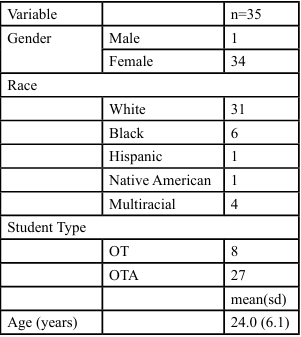
Table 1. Participant Demographics
Likert Scale Data
Paired t-test results of the Likert scale data related to knowledge and comfort with the origami process and activity analysis process are presented in Table 2. On average, participants reported statistical higher values of knowledge (t(34) = 6.733, p<.001) and comfort with origami (t(34) = 6.706, p<.001) on the post-activity surveys compared to pre-activity survey values. Knowledge of origami increased by an average of 22.8% while participants reported comfort with origami increased by an average of 19.4%. The pre-post activity differences displayed a large effect size for both variables as measured by Cohen’s d (1.004 and 0.875, respectively). Participants perceived comfort with the activity analysis process significantly (t(34) = 4.978, p<.001) increased pre- to post- activity by an average of 16.6% with an Cohen’s d value of 0.985, indicating a large effect size.
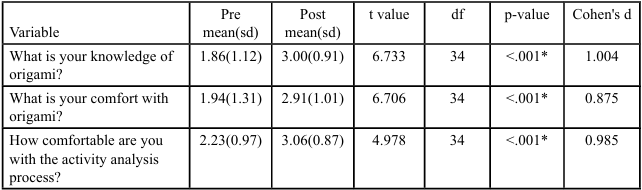
Table 2. Knowledge and Comfort with the Origami and Activity Analysis Processes Paired t-tests
Categorical Data
Frequency data and Chi-square results related to likelihood of using origami as a therapeutic intervention and understanding how to apply the activity analysis process and the benefits of the activity analysis process are outlined in Table 3. There was a significant pre- post difference (X2 (df = 4, N = 34) = 19.564, p < .001) in response to the question, “How likely are you to use origami as a therapeutic intervention?”, with 88.6% of the participants reporting that they would be at least somewhat likely to use origami as a therapeutic intervention post activity compared to 51.4% pre-activity. This difference was determined to have a large effect on the group differences with a Cramer’s V value of 0.529. Similarly, the significant (X2 (df = 2, N = 34) = 8.640, p = .013) increase in participants reporting that they, “Understand how to apply the activity analysis process” in the post-activity survey compared to the pre-activity survey (74.3% and 40%, respectively) had a moderate effect size with a Cramer’s V value of 0.351. There was a 20% increase in the number of participants reporting that they, “Understand the benefits of the activity analysis process” on the post-activity survey compared to the pre-activity survey, (85.7% and 65.7%, respectively), however there was no significant difference between the surveys in terms of this variable (X2 (df = 2, N = 34) = 3.848, p = .146).
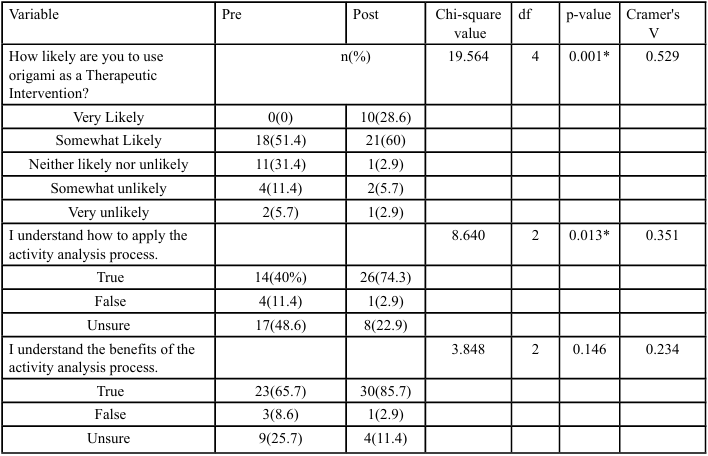
Table 3. Likelihood of Using Origami as a Therapeutic Intervention, Understanding How to Apply the Activity Analysis Process, and Understanding the Benefits of the Activity Analysis Process
Discussion
For occupational therapy educators, findings from the current study indicate that a student centered learning experience such as origami lessons provide may increase their confidence and comfort with the activity analysis process, and their willingness to use new intervention strategies in future treatment plans. There was a statistically significant increase in students’ reported understanding of how to apply the activity analysis process after a single session of this student-centered learning activity (p-value = 0.013). The activity analysis process is important for occupational therapy students to understand and be able to apply. The occupational therapy practitioner must effectively use the activity analysis process throughout their time with a client, from evaluation to discharge, to provide the most effective interventions and best help clients achieve their goals. A lesson like the one used in this study may be a way to help increase students' understanding of and comfort with the activity analysis process. As this was one brief experience (between 60 and 90 minutes), a lesson that spans a longer period of time across a few class sessions could further increase the impact on understanding of and comfort with the activity analysis process. The students reported a significant increase in their comfort with the activity analysis process (p-value = <.001), which may assist students in applying the process to other activities they are not familiar with. An understanding of and comfort with applying the activity analysis process can help students provide client-centered interventions, an essential aspect of occupational therapy.
Understanding the activity analysis process can also be useful in helping find new and creative treatment interventions to best meet the needs of clients. This includes being able to grade and adapt activities to maximize the benefits of an activity and promote engagement of clients. Self-reported perception of knowledge on and comfort with origami increased following the student-centered learning activity. Additionally, there was a significant increase in the reported likelihood of using origami as a therapeutic intervention post leaning activity (p-value = 0.001). The idea of grading an activity was modeled during the origami lesson to best meet the needs of learners- an important aspect in helping students develop critical thinking and reasoning skills [12]. When implementing a similar lesson in occupational therapy education, it is important for educators to provide students with the opportunity to complete the activity they are trying to analyze. This is consistent with what has been discussed in current literature [14]. Doing so enables students to experience the activity first-hand, and to better determine requirements of the activity that may not be immediately obvious. This can include physical and cognitive aspects of the task, such as the amount of time each step can take, and the skills required.
The hands-on approach used during the origami lesson exemplifies student-centered learning and is consistent with previous literature regarding student-centered teaching, in that the experience was geared towards the level and learning needs of the students to help them learn and apply the complex idea of an activity analysis [5,16]. Overall, this student-centered learning activity significantly increased knowledge and comfort with a new motor task (origami), increased their understanding of how to apply the activity analysis process, and their preserved comfort with the activity analysis process. This included increased self-efficacy with applying the activity analysis process, an essential skill for occupational therapy students and practitioners. While there was no significant difference in student understanding of the benefits of the activity analysis, this might be because the students started with a strong understanding of the benefits before the experience. Approximately 66% of the students reported understanding the benefits of the activity analysis process before the origami activity, thereby limiting the ability to make statistically significant gains in the perceived benefits of the process.
Conclusion
The current study explored the impact of engaging occupational therapy and occupational therapy assistant students in an origami learning experience. Findings highlight the importance of engaging students in student-centered learning activities, reinforcing current literature. Faculty should consider diversifying their teaching approaches to better address the individual preferences and needs of their students. Such an approach is likely to foster greater student engagement with the material and lead to enhanced learning outcomes [18]. Occupational therapy and occupational therapy assistant educators are encouraged to utilize student-centered learning activities in their courses. Allowing students to actively participate in their educational experiences creates a learning environment that supports autonomy, cultivates competence, and strengthens relatedness, thereby enhancing motivation and confidence. Such conditions are associated with increased engagement, sustained effort, and, ultimately, improved academic achievement among learners. A successful implementation of a student-centered learning environment requires comprehensive professional development and training for faculty. These initiatives provide educators with pedagogical knowledge and skills necessary to adapt to instructional practices and effectively support student learning [19]. This can help students better apply and understand complex ideas and concepts, such as the activity analysis process.
Limitations
Limitations of the present study warrant consideration. The use of a convenience sample restricts generalizability, and the origami presentation was delivered in a virtual format; notably, many students indicated that an in-person presentation by the origamist would have been more beneficial. The sample also lacked diversity with respect to race and gender and included a disproportionately larger number of occupational therapy assistant students relative to occupational therapy students. Additionally, participants were at varying stages in their professional education, resulting in differences in baseline understanding of the activity analysis process.
Data completeness further constrained the analysis. Not all students who participated in the origami lesson completed both the pre-test and post-test; many completed only one, and consequently, only paired responses could be included in the final analysis. To mitigate potential bias, researchers emphasized the voluntary nature of participation, thereby reducing the likelihood that students would feel compelled to infer the researchers’ expectations or alter their responses accordingly.
Implications For Further Research
The current study highlights the need to continue researching the impact and perceptions of student-centered learning activities that can assist educators in preparing entry-level occupational therapists and occupational therapy assistants. Looking at the duration and type of student-centered learning activities will be important to help guide educators in their pedagogy, as well as student perceptions of their benefits and drawbacks.
The Knowledge Take Away
It is important for occupational therapy and occupational therapy assistant educators to engage students in interactive, student-centered learning activities. This helps students better understand and apply complex concepts such as the activity analysis process.
Competing Interests:
The authors of this research declare no competing interest regarding this study.
References
Mroz, T. M., et al. (2015). Client centeredness and health reform: Key issues for occupational therapy. American Journal of Occupational Therapy, 69(5), 6905090010p1–6905090010p8. View
Blumberg, P. (2019). Making learner-centered teaching work: Practical strategies for implementation. Stylus Publishing. View
Faulcon, R. Y. (2015). Innovative teaching strategies with simulation technology in nursing education. Journal of Bermuda College, 1, 47–50. View
Wright, G. B. (2011). Student-centered learning in higher education. International Journal of Teaching and Learning in Higher Education, 23(3), 92–97. View
Knowles, M. S., Holton, E. F., & Swanson, R. A. (2015). The adult learner: The definitive classic in adult education and human resource development (8th ed.). Routledge. View
Accreditation Council for Occupational Therapy Education. (2018). 2018 ACOTE standards and interpretive guide. American Occupational Therapy Association. View
Abdelkhalek, N., Hussein, A., Gibbs, T., & Hamdy, H. (2010). Using team-based learning to prepare medical students for future problem-based learning. Medical Teacher, 32(2), 123- 129. View
Klegeris, A. (2021). Mixed-mode instruction using active learning in small teams improves generic problem-solving skills of university students. Journal of Further and Higher Education, 45(6), 871–885. View
Dogani, B. (2023). Active Learning and Effective Teaching Strategies. International Journal of Advanced Natural Sciences and Engineering Researches, 7, 136-142. View
Gamage, K. A. A., Dehideniya, D. M. S. C. P. K., & Ekanayake, S. Y. (2021). The role of personal values in learning approaches and student achievements. Behavioral Sciences, 11, 102. View
Salvatori, P. (1999). Meaningful occupation for occupational therapy students: A student-centered curriculum. Occupational Therapy International, 6(3), 207–223. View
Wallace, S. (2015). Team-based learning in a capstone course in speech-language pathology: Learning outcomes and student perceptions. Communication Disorders Quarterly, 37(1), 44 52. View
Schwartz, K. B. (1992). Occupational therapy and education: A shared vision. American Journal of Occupational Therapy, 46(1), 12–18.
American Occupational Therapy Association. (2020). Occupational therapy practice framework: Domain and process (4th ed.). American Journal of Occupational Therapy, 74(Suppl. 2), 7412410010. View
Bar, M. A., & Ratzon, N. Z. (2016). Enhancing occupational therapy students' knowledge, competence, awareness, and interest in accessibility. Hong Kong Journal of Occupational Therapy, 27(1), 18–25. View
Weimer, M. (2013). Learner-centered teaching: Five key changes to practice. Jossey-Bass. View
Lucas, J., Edwards-Collins, M., & Jones, T. (2025). Understanding the role of origami in teaching and applying the activity analysis process in occupational therapy education: A pilot study. Journal of Rehabilitation Practice and Research, 6(2), 182. View
Sand-Jecklin, K. (2007). The impact of active/cooperative instruction on beginning nursing student learning strategy preference. Nurse Education Today, 27(5), 474–480. View
Darling-Hammond, L., Hyler, M. E., & Gardner, M. (2017). Effective teacher professional development. Learning Policy Institute. View