
- About the Journal
- Editorial Board
- Review Process
- Author Guidelines
- Article Processing Charges
- Special Issues
- Current Issue
- Past Issue
 Journal of Rehabilitation Practices and Research
Journal of Rehabilitation Practices and Research Volume 7 (2026), Article ID: JRPR-208
https://doi.org/10.33790/jrpr1100208Research Article
Confronting Racism in Counseling Research: Framework for Anti-Racist Research Practices
Bisola E. Duyile1*, Jiale Man2, and Amber Livingston3
1Assistant Professor Department of Counseling, College for Community Health, Montclair State University, 1 Normal Ave., Montclair, NJ, 07043, United States.
2Department of Counseling, College of Education, Seattle University, 901 12th Ave., Seattle, WA, 98122, United States.
3Counselor Education and Supervision, Virginia Commonwealth University, 1015 W Main St. VA, 23284,United States.
Corresponding Author Details: Bisola E. Duyile, Ph.D., Assistant Professor Department of Counseling, College for Community Health, Montclair State University, 1 Normal Ave., Montclair, NJ, 07043, United States.
Received date: 18th April, 2026
Accepted date: 05th June, 2026
Published date: 08th June, 2026
Citation: Duyile, B. E., Man, J., & Livingston, A., (2026). Confronting Racism in Counseling Research: Framework for An ti-Racist Research Practices. J Rehab Pract Res, 7(1):208.
Copyright: ©2026, This is an open-access article distributed under the terms of the Creative Commons Attribution License 4.0, which permits unrestricted use, distribution, and reproduction in any medium, provided the original author and source are credited.
Abstract
Historically marginalized racial and ethnic communities are most vulnerable to misinterpretation of results and data generated from research conducted in their communities. In counseling and rehabilitation research, these risks intensify at the intersection of race and disability, where disparities in diagnosis, service access, therapeutic process, and outcomes are often decontextualized. This conceptual paper presents an anti-racist research framework that examines how power and bias shape the research process. The framework outlines four domains: researcher positionality, research design, critical quantitative practices, and equity- centered research practices across the data lifecycle. This article highlights applications of anti-racist research practices to research methodologies. To support these applications, the authors provide an operationalized model with observable practices and measurable indicators. This framework offers a clear approach for counseling and rehabilitation researchers to align research methods with equity.
Keywords: Anti-Racist Research Practices, Research Design, Researcher Positionality, Quantitative Research, Disability Research
Introduction
Within the counseling code of ethics, practitioners are called to be multiculturally competent in their roles as counselors and counselor educators [1]. The call for multicultural competence in clinical practice also translates to our work as researchers. Although multicultural counseling and anti-racist approaches are both committed to equity and culturally responsive practice, they operate from meaningfully different theoretical foundations and pursue distinct goals within counseling and research contexts. Multicultural counseling frameworks, including the Multicultural and Social Justice Counseling Competencies [2], center the development of individual counselor competence, emphasizing self-awareness, cultural knowledge, and the cultivation of skills necessary to work effectively across diverse populations. These frameworks have made substantial contributions to the counseling profession by encouraging practitioners to examine their own cultural assumptions, develop empathy across differences, and advocate for clients whose identities and experiences differ from dominant norms. The unit of focus within multicultural counseling is primarily the individual practitioner and the therapeutic relationship, with equity pursued through the refinement of interpersonal skills and cultural responsiveness.
Anti-racist frameworks, by contrast, shift the unit of analysis from the individual to the system. Where multicultural counseling asks how a counselor can become more culturally responsive, anti-racist approaches ask why racial inequities exist within the structures, institutions, and knowledge-producing systems, including research, that shape counseling practice in the first place [3,4]. Anti-racist frameworks explicitly name racism as a structural and historical force rather than a byproduct of individual bias or cultural misunderstanding, and they call researchers and practitioners to actively interrogate the policies, practices, and assumptions that reproduce racial hierarchies [5,6]. Within research specifically, this distinction is consequential: a multiculturally informed researcher may attend to cultural sensitivity in data collection, whereas an anti- racist researcher additionally interrogates how the research questions were framed, whose knowledge is centered, how variables are constructed, and whether the findings challenge or reinforce existing inequities. It is from this latter orientation that the present framework is developed. Anti-racist research practices interrogate systems and policies through integration and attention to the production and reproduction of power hierarchies, social inequities, and the taken- for-granted assumptions of ideological hegemonies [5,7].
Research can be used to influence policies and develop stronger communities [4,8]. However, research data has also reinforced the legacies of racist policies and constructed inequitable resource allocation and access [9]. Recent scholarship has further demonstrated that data systems and research infrastructures are not neutral but are embedded within existing power structures that shape whose experiences are represented, how they are interpreted, and how findings are used to inform policy and practice [10,11]. Thus, it is critical for researchers to understand how racism intersects with the different components of one’s identity [12,13]. Racial minorities and/or people living in poverty are frequently overrepresented within government agency data systems, and disparate representation in data can cause disparate impact [14]. These concerns are particularly pronounced in disability and rehabilitation research, where racially minoritized individuals are disproportionately misclassified, overrepresented in certain disability categories, and underserved in access to appropriate services [15,16]. However, the hunt for research data continues. Researchers continue to conduct research on racially minoritized populations rather than paying attention to what is known from previous data, becoming more aware of the disparate representations and analysis of the data collected, and interrogating system outcomes. Given the influential nature of research, equity and community empowerment must be centered within the process [17]. The purpose of this conceptual paper is to provide a framework for counselors and researchers to use in conducting anti-racist research.
Literature Review
Critical Anti-Racist Research
Race and racism are rooted in the practices and dialogues that guide the daily routines of universities [3,17]. Parallel with multicultural and social justice counseling, it is critical that researchers interrogate systems that perpetuate injustice to minoritized populations. Historically, marginalized groups are vulnerable to mistreatment and misinterpretation within counseling and mental health research when cultural context, lived experiences, and systemic inequities are insufficiently considered in data collection, interpretation, and service delivery [2,18]. These results have been researched to impact laws, policies, and access to several social determinants of health, such as housing, employment, health, and medical care [9,19]. Therefore, research must be conducted from a critical anti-racist lens.
Existing studies have explored ways in which research has depicted the risk of perpetuating racism. In rehabilitation and disability research, race and disability intersect in ways that shape identification, service access, and outcomes. For example, Black, Latine, and Indigenous children experience disparities across multiple domains, including disproportionate identification in emotional and behavioral disability categories, delayed diagnosis and intervention, reduced access to culturally responsive and high-quality services, inequitable educational placements, and poorer continuity of rehabilitative care [15,16]. These patterns reflect structural inequities embedded within educational, clinical, and assessment systems rather than individual- level differences. For example, Peguero et al. [20] suggested significant racial/ethnic disparities between school strictness and grade retention rates across US urban, suburban, and rural schools, where students of color, Black and Latine students specifically, are more likely to experience grade retention and school punishment compared to their White counterparts.
In addition, racial stereotypes may explain academic policies and expectations with regard to general education inclusion for students of color with disabilities, as Black/African students were the least included, whereas Asian American Pacific Islanders (AAPI) students are more likely to be included than White and Latine students [15]. Such a phenomenon can be explained by the Model Minority myth that AAPI students are perceived to be academically successful and therefore overlooked for educational support, while Black and Latine students are more likely to be negatively evaluated for not achieving similar academic expectations [21,22]. Hence, educational frameworks and policies were created for communities of learners who are different without considering context, culture, and history, thus continuing to focus on deficit as opposed to intentional collaboration with the community. Accordingly, O’Neil [23] drew on her personal experience as a Harvard-trained mathematician and shared the dreary reality of how data increases inequality and influences world problems, policies, and practices. Also, there is a normative approach to studying race in educational research and policy. These assumptions also apply to underrepresented groups whose researchers' intent has been deficit-focused as opposed to intentional collaboration with the community.
Furthermore, unconscious and unchecked bias influences how racism occurs in research [24,25]. Therefore, understanding and checking our biases related to language, disability, gender, sexuality, socioeconomic status, and class is crucial in research. These biases are rooted in cultural background and experiences and can influence our interrogation of a community or interpretation of data [25]. Contemporary anti-racist scholarship encourages an anti-racist mindset and challenges longstanding institutional claims of objectivity, meritocracy, color blindness, and race neutrality by demonstrating how these frameworks can obscure structural inequities within higher education and research systems [3,26]. Because counseling research can directly inform mental health assessment, treatment planning, and service delivery, anti-racist research practices have important implications for how mental health disparities are conceptualized and addressed within counseling and rehabilitation settings.
Anti-Racist Research, Mental Health, and Disability
Counselors have ethical obligations as per the code of ethics to avoid discriminating against clients based on identity, beliefs, and values to provide culturally competent care [1]. Historically, scholarship in psychology, medicine, and related health professions has at times reinforced harmful racialized assumptions about Black, Indigenous, and other marginalized populations through biased research design, interpretation, and application [4,27,28]. In addition, previous psychology-related research has been used to inferiorize Black/African American and Latine individuals over their White counterparts [27]. Racist biases that denied systemic oppression and disfranchisement while promoting deficit thinking and White supremacy existed in research design, data collection, and data interpretation [4].
These considerations are further compounded when examining the intersection of race and disability in mental health research. Racially minoritized individuals with disabilities often experience disparities in diagnosis, access to care, and treatment quality, reflecting systemic inequities across both mental health and rehabilitation systems. For example, Black and Latine individuals are more likely to experience misdiagnosis or delayed diagnosis of mental health conditions, particularly when co-occurring with developmental or cognitive disabilities, due in part to biased assessment practices and structural barriers to care [29,30]. As a result, observed disparities in mental health outcomes cannot be understood without accounting for how race and disability are co-constructed within clinical, educational, and research contexts.
Fortunately, contemporary scholars have increasingly critiqued the structural inequities that contribute to disproportionate mental health burdens among historically marginalized populations despite the discriminatory legacy of psychology and mental health research [26,29]. To disrupt the historical cycle of oppressive research, it is imperative to interrogate oppressive systems and advocate for equity and social justice through anti-racist research practices. Much well- intended research also yielded valuable findings related to mental health concerns among oppressed populations. However, such findings need to be interpreted with critical reflection and caution. For example, recent research continues to demonstrate that Black Americans (i.e., African Americans and Caribbean Black Americans) experienced disproportionately higher rates of psychological distress, trauma exposure, and unmet mental health needs than did White Americans due to chronic exposure to structural racism, discrimination, and inequitable access to care [29,31]. African American men report higher rates of mental health distress in comparison to foreign-born Caribbean men as well as Caribbean- American men [31]. Instead of stigmatizing Black and African Americans with these findings, researchers need to reflect on chronic discrimination and racial exclusion and mental disorders (e.g., mood disorders), and substance use [32,33]. Therefore, the authors propose an anti-racist research framework to examine the systemic and structural oppression while accounting for how disability intersects with race to shape both the measurement and interpretation of mental health outcomes among historically oppressed communities.
Anti-Racist Research Practices
In Figure 1, the authors present a potential framework to guide researchers in aligning their skills alongside anti-racist research practices. The areas outlined in the figure (i.e., research positionality, research design, critical quantitative (Quantcrit) practices, and equity-centered research practices) will be elaborated in the following sections.
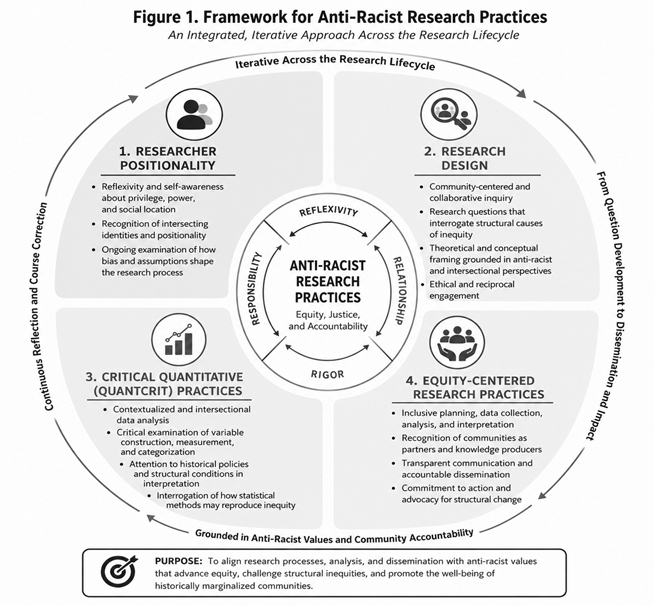
Figure. Framework for Anti-Racist Research Practices
Researchers Positionality
Reflection on researchers' positionality is imperative to anti-racist research practices. Counselor researchers should bring awareness of the impact of identities on therapeutic relationships to research practices. It is vital for researchers to engage in their own reflections on systemic privilege and oppression [4,17], and on how these play a role in research design, collection, analysis, and interpretation. For example, researchers can interrogate their positionality by reflecting on how they identify in society based on their different intersecting identities [12,13]. Reflection on acquired and inherited privileges, as well as oppressive identities, in relation to other groups is necessary. It is important to note that the practice of self-reflection can bring up discomfort, such as guilt and shame for the privileged group and anger and hurt for the oppressed group [34]. Awareness and interrogation of oneself in relation to others are ongoing processes and provide the researcher with insight into their unconscious bias that may be reinforced in research practices.
Anti-Racist Research Design
Counseling organizations and scholars have stressed the ethical obligations of counselors offering multicultural and social justice counseling and evidence-based treatment [1,2]. Therefore, counselor researchers must develop competencies in designing research that aims to promote equity and social justice in counseling.
The authors recommend that researchers design research that can resist the pull toward facile findings that would reinforce racist ideas. Historically, some research within psychology and counseling has contributed to harmful and stigmatizing portrayals of marginalized groups, including Black/African American individuals, Indigenous communities, and persons living in poverty [20,35]. Researchers need to critically reflect on how research designs that lead to biased findings have promoted deficit thinking, denied human agency and experience, and ignored the interinfluence between a person’s psychosocial process, socialization, and health relations [36]. Rather than continuing to spread misperceptions based on biased data, researchers can investigate within- and between-group heterogeneity to adopt the best possible counseling practices to attend to the diverse needs of individuals. Such heterogeneity warrants the imperative to approach research design with background knowledge of the research population and cultural humility [36,37]. The authors contend that research needs to be community-centered and co-constructed through community collaboration and/or through member checking of findings. Community-centered mental health research may help disrupt historically paternalistic relationships between the mental health system by promoting collaboration, shared decision making, and accountability to the communities being served [4,6,17]. For example, community-centered participatory research (CCPR) has benefited community members in gaining valuable skills, a changed perspective of themselves, a sense of empowerment, and a change in the health services they access [38]. Hence, it is critical for researchers to create a community collaborative research design.
The authors join scholars [8] in suggesting a departure from an unnecessary comparison between groups (e.g., White students vs. Black/African American students, heterosexual individuals vs. non- heterosexual individuals), as it perpetuates White supremacy and deficit-thinking of oppressed and marginalized groups. However, such suggestions should not be interpreted as discouragement for between-group research studies. In fact, when research on comparison groups is done appropriately, it allows researchers to contextualize data and discuss how historical policies may have contributed to the differences between groups. The authors also caution against using one-dimensional data to propel an agenda, as it may assume certain experiences or oppressions have the same meaning and occur through similar processes and mechanisms for all members of a community [4,27]. In sum, anti-racist researchers need to approach research design with critical reflection on explicit/implicit biases and collaboration with communities of research.
Critical Quantitative (QuantCrit) Research Skills
The authors are specifically highlighting quantitative research skills because of the generalized assumption that quantitative data can speak for itself [9,14,39]. The lack of research on and the assumptions about different racial minority populations can be traced to the contextualized ‘default’ mode and misuse of quantitative research methods that are often applied to the study of race in higher education [40]. One of the most common approaches to comparative racial analysis is derived from a normative racial framework. In many cases, research study designs do not critically interrogate the “heterogeneity” that exists in a racial group. Quantitative research is often positioned as objective and neutral; however, contemporary critical quantitative scholarship challenges this assumption by demonstrating how statistical methods are embedded within historical and structural systems of power. Quantitative Critical Race Theory extends critical race theory into statistical analysis, interrogating how data construction, variable selection, and modeling decisions can reproduce racial inequities if left unexamined [41,42].
Further, it is important to note that quantitative research in counseling and rehabilitation has historically been framed as objective; however, QuantCrit challenges this assumption by demonstrating how statistical practices are embedded within broader systems of power and inequality. When applied to disability research, these concerns become particularly salient, as diagnostic categories, service classifications, and administrative datasets often reflect institutional practices rather than neutral representations of functioning. Racially minoritized individuals are disproportionately identified, misclassified, or placed in more restrictive services, patterns that persist even after statistical controls are applied [15,16,30]. Within this context, the routine use of race as a control variable without theoretical grounding may obscure the structural conditions shaping these disparities and reinforcing deficit-based interpretations. A QuantCrit-informed approach calls for researchers to interrogate how variables are constructed, to model intersectional relationships explicitly, and to interpret findings within the historical and systemic contexts that shape both race and disability [41-43]. As a result, the real educational and community experiences and processes of individuals from different racial groups as a whole and as distinct parts are often concealed.
Recent applications of QuantCrit in counseling and education research highlight that large secondary datasets, while widely used, can produce unintended harm when marginalized populations are misrepresented, overgeneralized, or interpreted without contextual grounding [41]. This concern is particularly evident when race is included as a control variable without a theoretical justification, effectively masking the structural conditions that produce disparities and reinforcing deficit-based interpretations. Therefore, it is important to be aware of disparities that exist in research studies and highlight areas for researchers to become cognizant of in order to conduct anti-racist quantitative research.
Anti-Racist Research Application
Conducting critical anti-racist research comes from an awareness of the existing active research practices of the researcher and the ways through which the life cycle of the research conducted impacts historically marginalized communities. It is imperative that the researcher centers on racial equity throughout the data life cycle. There has to be intentionality in ensuring anti-racist research practices are present in research planning, data collection, data access, use of statistical tools, data analysis, and data reporting [17]. Therefore, researchers must understand how to incorporate an anti racist research lens in their research.
Data Planning
In the data planning phase, researchers develop research questions, decide what communities will be researched, and deliverables or tokens are given to the community [17]. This phase is critical, as it can determine how the research impacts the community being studied. When preparing grant proposals, researchers must be intentional about the language they use when seeking funding from funders. For example, social science researchers have fallen into the habit of offering research participants a dollar amount as compensation to increase participation in data collection. Compensation in dollar amounts does not necessarily address the community’s collective needs. Language and grants requested should uplift communities' needs and strategies to actively support the communities being researched. Therefore, the researcher should aim to include diverse perspectives, including individuals with lived experiences from minoritized communities, on the research committees. They should incorporate opportunities for collaboration among researchers, administrators, and community members into meetings and agendas [3]. For example, a focus group that encourages discussion of potential research ideas, questions, and designs can allow community members to share their thoughts, opinions, and needs [4]. Focus group responses can also help researchers to discern how to frame problems and ensure questions are asked clearly and respectfully.
Further, researchers should evaluate whether the human participant research cited is representative and elevate participants to research partners [17]. Providing research participants opportunities for book chapter authorship can help elevate research partnerships. These efforts include community members at the decision-making table and empower them to be autonomous in their storytelling. The goal of the research planning phase is to create frameworks that interrogate systems, policies, and outcomes from an anti-racist lens.
Data Collection and Access
There is a need for research equity in the research data collection and access process. Data collection helps provide information about a problem and informs policies and programs [17,26]. Therefore, the researcher needs to ensure the security of the data collected. Who has access to the data? Are they trained in data management and security? Also, ensuring that community stakeholders are involved in decisions about data collection, use, and reporting [6,17]. Incorporating community stakeholders will provide continued collaboration, empowerment, and enhance trust with the community. Further, researchers need to avoid tunnel vision when collecting data [41,42]. For example, collecting data that reinforces and confirms biases rather than interrogating and informing changes to policies and practices. Research equity will grow when researchers understand that facile findings do not equal true findings. Lastly, when collecting data, the researcher needs to be aware and acknowledge that data is not objective [9,23]. Therefore, integrating qualitative stories and lived experiences of communities can provide context for the quantitative data collected.
Data Analysis and Interpretation
Further, the researchers need to avoid the one-size-fits-all approach to analysis and interpretation [17]. In order to incorporate an anti- racist research lens into data analysis, systemic barriers and historical policies must be taken into account to identify potential impacts of the analysis and interpretation of data. The researcher needs to be aware of and learn the racist history of statistics and its impact on underrepresented populations [44]. Several studies have shown that data can reflect the inherent bias and prejudice of the researchers [9,14,45]. Thus, it is important for researchers to be transparent in the statistical analysis of the data collected. For example, researchers can be transparent by describing the research design, testing instruments, and processes, specifying the factors the tool uses, and highlighting the validity and reliability of the statistical tools.
Researchers should consistently inquire about their data integrity and strive to improve data quality. To interrogate data integrity, an antiracist researcher should analyze and interpret findings from an intersectional lens [13]. For example, analyzing data intentionally by identifying the role of minoritized identities can help explain the variation in data results, inform the interpretation of data collected, and influence the type of interventions provided to the community. Similarly, engaging in inclusive citation practices is tied to improving data quality and is critical to conducting anti-racist research practices [46]. There are varieties of materials (e.g., articles, books, and podcasts) written by historically marginalized groups that can align with the experiences of the communities researched. Therefore, researchers must seek out these materials to guide their analysis and interpretation of the data collected. Without this lens, researchers risk attributing disparities in disability prevalence or outcomes to individual characteristics rather than to inequities in diagnostic practices, service systems, and access to care. Furthermore, it should be noted that the simple inclusion of minoritized individuals does not equate to anti-racist research. It is vital to actively place the experience of minoritized individuals, highlight inequities, and bring light to the historical context of racism [4]. The goal of the anti-racist researcher is to demonstrate cultural humility as a path to build and empower the communities researched [6,37]. Hence, analyzing and interpreting data collected encompasses an array of practices aiming to inform policies and practices that can improve the conditions of the communities researched and take steps towards disrupting oppressive systems.
Discussion
Operationalizing Anti-Racist Research Practices Across the Research Process
To move beyond conceptual discussion, the authors provide an operationalization of the anti-racist research practices discussed across the research process. This framework outlines specific researcher behaviors, measurable indicators, and applied examples to support the translation of anti-racist principles into actionable research practices.
The framework presented in Table 1 is intended to serve as a flexible, iterative guide rather than a prescriptive checklist for counseling and rehabilitation researchers. Anti-racist research practices require ongoing reflexivity and critical engagement across all stages of the research process, including study conceptualization, participant recruitment, data collection, analysis, interpretation, and dissemination. Researchers may move between domains throughout the research lifecycle as methodological decisions, community priorities, and sociopolitical contexts evolve. Importantly, the framework is designed to support researchers in identifying how structural inequities and researcher assumptions may shape research decisions and the interpretation of findings. For example, positionality practices may influence how researchers conceptualize research questions, select variables, interpret disparities, or frame participant experiences. Similarly, equity-centered data practices encourage researchers to critically evaluate how race, disability, socioeconomic status, language, and other social identities are operationalized within datasets and statistical models. These considerations are critical in counseling and rehabilitation research, where deficit-oriented interpretations have historically contributed to inequitable service delivery and stigmatizing narratives about historically marginalized communities.
The framework may be most applicable in counseling, disability, educational, community-based, and mental health research involving populations disproportionately impacted by systemic inequities. Researchers conducting quantitative, qualitative, mixed methods, or participatory research may adapt the framework to align with the goals and methodological approaches of their studies. For example, quantitative researchers may use the framework to critically examine statistical assumptions, variable construction, and interpretation of group differences, whereas qualitative researchers may emphasize reflexivity, collaborative meaning-making, and community engagement throughout data analysis and dissemination.
Additionally, the framework may serve as a training and supervision tool within counselor education and research mentorship settings. Faculty mentors, doctoral students, and emerging scholars may use the framework to guide discussions related to research ethics, positionality, measurement practices, culturally responsive methodology, and equity-centered dissemination practices. The framework is not intended to measure researcher morality or competence, but to encourage ongoing accountability, critical reflection, and intentional engagement with anti-racist research practices across the research process.
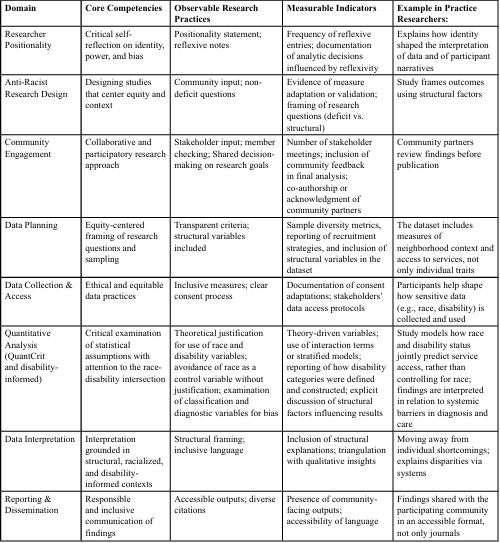
Table 1: Equity-Centered Research Practices
Implications and Area for Future Research
The conceptual model of anti-racist research practices can serve as a framework for counselor researchers to begin adopting anti- racist methodologies into their overall practice. Anti-racist research discussions centering on reflections on social justice and advocacy can lead students to build their confidence and practical skills in research critique and practice. Via anti- racist research scales, counselor educators can measure the effectiveness of anti-racist research pedagogy in developing counseling students’ competencies in relevant domains, which can provide valuable insight into the adjustment of pedagogical practices. For example, pre-test and post- tests carried out at the beginning and end of their graduate program can allow counselor educators to assess counseling students' growth in anti-racist research competence and encourage the development of anti-racist research competencies among counseling students. The ratings can encourage counseling students to focus on improving their weaknesses through the research curriculum and engagement in research studies with faculty members. Counselor students and educators can collaborate with community members to design inclusive research studies. The involvement of the research process can, in return, build not only counseling students’ confidence but also their practical abilities in anti-racist research practices.
Limitation
Our anti-racist research model pioneers the exploration of measuring counseling researchers’ actions in promoting social justice and community advocacy through research. The four domains, researcher positionality, anti-racist research design, anti-research research skills, and anti-research research practices, cover important competencies that an anti-racist researcher should develop. However, this model is not exempt from limitations. The conceptual model lacks imperative evidence in its validity and relation to measuring one’s anti-racist research practices. The authors anticipate that the development of an anti-racist research practice scale will lead to further model refinement. In addition, the current model focuses on anti-racist quantitative research. The authors caution against a general interpretation of our model for research methods other than quantitative. Researchers, especially those passionate about social justice and advocacy, can adapt the model to fit the needs of their professions.
Conclusion
Anti-racist research practices aim to interrogate systems and policies by critically examining the production and reproduction of power hierarchies, social inequities, and the taken-for-granted assumptions of ideological hegemonies [5,7]. Although counseling research has increasingly emphasized multiculturalism and social justice, inequities may still be reproduced when structural context and researcher positionality remain unexamined. Previous research studies in the field of counseling, including those claiming to be committed to promoting equality, have failed to address injustice by perpetuating racism and oppression due to flawed designs and biased findings. This framework offers counseling and rehabilitation researchers a structured approach for integrating anti-racist and equity-centered practices across the research process. Continued refinement, empirical evaluation, and application of these practices may strengthen counseling research that meaningfully responds to the needs and experiences of historically marginalized communities.
Data Availability Statement:
N/A
Funding Statement:
N/A
Conflict Of Interest Disclosure:
The authors have no conflicts of interest relevant to this article.
Ethics Approval Statement:
N/A
Client/Participant Consent Statement:
N/A
Permission To Reproduce Material From Other Sources:
N/A
Clinical Trial Registration:
N/A
References
American Counseling Association. (2014). ACA code of ethics. View
Ratts, M. J., Singh, A. A., Nassar McMillan, S., Butler, S. K., & McCullough, J. R. (2015). Multicultural and social justice counseling competencies: Guidelines for the counseling profession. Journal of Multicultural Counseling and Development, 44(1), 28–48. View
Gillborn, D., Warmington, P., & Demack, S. (2017). QuantCrit: Education, policy, “big data” and principles for a critical race theory of statistics. Race Ethnicity and Education, 21(2), 158- 179. View
Goings, T.C., Belgrave, F., Mosavel, M., & Evans, C. (2023). An anti-racist research framework: Principles, challenges, and recommendations for dismantling racism through research. Journal for the Society for Social Work and Research, 14(1), 101–128. View
Center for Antiracist Research. (2021). Center for Antiracist Research. Boston University. View
Johnson, K. F., Sparkman-Key, N. M., Meca, A., & Tarver, S. Z. (Eds.). (2022). Developing anti-racist practices in the helping professions: Inclusive theory, pedagogy, and application. Springer. View
Doucet, F. (2019). Centering the Margins:(Re)defining useful research evidence through critical perspectives. William T. Grant Foundation. View
Cokley, K., & Awad, G. H. (2013). In defense of quantitative methods: Using the “master’s tools” to promote social justice. Journal for Social Action in Counseling & Psychology, 5(2), 26–41. View
Diakopoulos, N., Friedler, S., Arenas, M., Barocas, S., Hay, M., Howe, B., Jagadish, H. V., Unsworth, K., Sahuguet, A., Venkatasubramanian, S., Wilson, C., Yu, C., & Zevenbergen, B. (2017). Principles for accountable algorithms and a social impact statement for algorithms: FAT ML. www.fatml.org. View
Benjamin, R. (2022). Viral justice: How we grow the world we want. Princeton University Press. View
D’Ignazio, C., & Klein, L. F. (2020). Data feminism. MIT Press. View
Crenshaw, K. (1991). Mapping the margins: Intersectionality, identity politics, and violence against women of color. Stanford Law Review, 43(6), 1241–1299. View
Crenshaw, K. W. (2011). Race, reform, and retrenchment: Transformation and legitimation in antidiscrimination law. German Law Journal, 12(1), 247–284. View
Barocas, S., & Selbst, A. D. (2016). Big data’s disparate impact. SSRN Electronic Journal, 104(3). View
Cooc, N. (2022). Disparities in general education inclusion for students of color with disabilities: Understanding when and why. Journal of School Psychology, 90, 43–59. View
Morgan, P. L., Hu, E. H., & Oh, Y. (2025). Racial and ethnic disparities in school-based disability identification. Educational Researcher, 54(7), 437-441. View
Hawn Nelson, A. L., & Zanti, S. (2020). A framework for centering racial equity throughout the administrative data life cycle. International Journal of Population Data Science, 5(3). View
Sadusky, A., Drapeau, M., & de Roten, Y. (2024). A systematic review of clients’ perspectives on the cultural responsiveness of mental health professionals. Transcultural Psychiatry, 61(1), 3–24. View
López, N., Vargas, E., Juarez, M., Cacari-Stone, L., & Bettez, S. (2017). What’s your “street race”? Leveraging multidimensional measures of race and intersectionality for examining physical and mental health status among Latinxs. Sociology of Race and Ethnicity, 4(1), 49–66. View
Peguero, A. A., Varela, K. S., Marchbanks III, M. P. T., Blake, J., & Eason, J. M. (2021). School punishment and education: Racial/ethnic disparities with grade retention and the role of urbanicity. Urban Education, 56(2), 228–260. View
Nguyen, B. M. D., Noguera, P., Adkins, N., & Teranishi, R. T. (2019). Ethnic discipline gap: Unseen dimensions of racial disproportionality in school discipline. American Educational Research Journal, 56(5), 1973-2003. View
Sullivan, A. L., Kulkarni, T., & Chhuon, V. (2020). Making visible the invisible: Multistudy investigation of disproportionate special education identification of US Asian American and Pacific Islander students. Exceptional children, 86(4), 449–467. View
O’Neil, C. (2016). Weapons of math destruction: How big data increases inequality and threatens democracy. Penguin Books. View
Asmal, L., Lamp, G., & Tan, E. (2022). Considerations for improving diversity, equity, and inclusivity in research designs and teams. Psychiatry Research, 307. View
Tate, S. A., & Page, D. (2018). Whiteliness and institutional racism: Hiding behind (un)conscious bias. Ethics and Education, 13(1), 141–155. View
McGee, E. O. (2020). Interrogating structural racism in STEM higher education. Educational Researcher, 49(9), 633–644. View
Auguste, E., Bowdring, M., Kasparek, S. W., McPhee, J., Tabachnick, A. R., Tung, I., Scholars for Elevating Equity and Diversity (SEED), & Galán, C. A. (2023). Psychology's contributions to anti-Blackness in the United States within psychological research, criminal justice, and mental health. Perspectives on Psychological Science: A Journal of the Association for Psychological Science, 18(6), 1282–1305. View
Reverby, S. M. (2000). Tuskegee’s truths: Rethinking the Tuskegee syphilis study. Chapel Hill, NC: University of North Carolina Press. View
Hardeman, R. R., Medina, E. M., & Boyd, R. W. (2020). Stolen breaths. New England Journal of Medicine, 383(3), 197–199. View
Morgan, P. L., Woods, A. D., Wang, Y., Farkas, G., Hillemeier, M. M., & Mitchell, C. (2023). Which students with disabilities are placed primarily outside of U.S. elementary school general education classrooms?. Journal of learning disabilities, 56(3), 180–192. View
Mays, V. M., Jones, A. L., Cochran, S. D., Taylor, R. J., Rafferty, J., & Jackson, J. S. (2018). Chronicity and mental health service utilization for anxiety, mood, and substance use disorders among Black men in the United States: Ethnicity and nativity differences. Healthcare (Basel), 6(2), 53. View
Cogburn, C. D., Roberts, S. K., Ransome, Y., Addy, N., Hansen, H., & Jordan, A. (2024). The impact of racism on Black American mental health. The Lancet Psychiatry, 11(1), 56–64. View
Matsuzaka, S., & Knapp, M. (2019). Anti-racism and substance use treatment: addiction does not discriminate, but do we? Journal of Ethnicity in Substance Abuse, 19(4), 567–593. View
Stern, J. A., Barbarin, O., & Cassidy, J. (2021). Working toward anti-racist perspectives in attachment theory, research, and practice. Attachment & Human Development, 24(3), 1–31. View
Haslam, N., & Loughnan, S. (2014). Dehumanization and infrahumanization. Annual Review of Psychology, 65, 399–423. View
Lewis, M. E., Hartwell, E. E., & Myhra, L. L. (2018). Decolonizing mental health services for indigenous clients: A training program for mental health professionals. American Journal of Community Psychology, 62(3-4), 330–339. View
Akerele, O., McCall, M., & Aragam, G. (2021). Healing ethno- racial trauma in black communities: Cultural humility as a driver of innovation. JAMA psychiatry, 78(7), 703–704. View
Muvuka, B., Combs, R. M., Ayangeakaa, S. D., Ali, N. M., Wendel, M. L., & Jackson, T. (2020). Health literacy in African- American communities: Barriers and strategies. HLRP: Health Literacy Research and Practice, 4(3), e138–e143. View
Verhaeghe, P. (2025). Five traditions of quantitative research on racism: Their research objects, methods, assumptions and relationships. Sociology Compass, 19(12). View
Garcia, N. M., López, N., & Vélez, V. N. (2017). QuantCrit: Rectifying quantitative methods through critical race theory. Race Ethnicity, and Education, 21(2), 149–157. View
Bryan, J., Kim, H., & Kim, J. (2025). A step-by-step guide to evidence-based research with national datasets: A QuantCrit perspective. Professional School Counseling, 29(1a). View
Castillo, W., & Strunk, K. K. (2024). How to quantcrit: Applying critical race theory to quantitative data in education. Routledge. View
Fish, R. E., Shores, K., & Souto Maior, J. M. (2025). A critical appraisal of the evidence on racial disproportionality in special education. Exceptional Children, 92(2), 144–163. View
Brown, K. S., Kijakazi, K., Runes, C., & Turner, M. A. (2019). Confronting structural racism in research and policy analysis. Urban Institute. View
Hetey, R. C., & Eberhardt, J. L. (2018). The numbers don’t speak for themselves: Racial disparities and the persistence of inequality in the criminal justice system. Current Directions in Psychological Science, 27(3), 183–187. View
Hyams, K., Prater, N., Rohovit, J., & Meyer-Kalos, P. S. (2018). Person-Centered Language. Center for Practice Transformation. View