
- About the Journal
- Editorial Board
- Review Process
- Author Guidelines
- Article Processing Charges
- Special Issues
- Current Issue
- Past Issue
 Journal of Rehabilitation Practices and Research
 Volume 7 (2026), Article ID: JRPR-216
https://doi.org/10.33790/jrpr1100216Research Article
An Integrative Individualized Student Model Approach of Teaching Advanced Human Anatomy: Anatomist, Physical Therapist, and Student Perspectives
Veronica Jackson1*, PT, DPT, PhD, ACCE/DCE, and Allan B. Dunlap2, MD, RMA, AHI
1Professor, Department of Physical Therapy, Alabama State University, Montgomery, AL, United States.
2Assistant Professor, College of Health Sciences, Alabama State University, United States.
Corresponding Author Details: Veronica Jackson, PT, DPT, PhD, ACCE/DCE, Professor, Department of Physical Therapy, Alabama State University, Montgomery, AL, United States.
Received date: 30th June, 2026
Accepted date: 01st September, 2026
Published date: 03rd September, 2026
Citation: Jackson, V., & Dunlap, A. B., (2026). An Integrative Individualized Student Model Approach of Teaching Advanced Human Anatomy: Anatomist, Physical Therapist, and Student Perspectives. J Rehab Pract Res, 7(2):216.
Copyright: ©2026, This is an open-access article distributed under the terms of the Creative Commons Attribution License 4.0, which permits unrestricted use, distribution, and reproduction in any medium, provided the original author and source are credited.
Abstract
Background and Purpose: Advanced Human Anatomy is the foundation of knowledge of any allied health profession. Students entering into allied health professions struggle with Anatomy due to the amount of information that is presented within a short period of time, physical demands of being in a classroom and laboratory setting, visualization requirements, learning new terminology, and making anatomy relevant to clinical application. This course can be a difficult subject for students, but developing a study strategy is key especially when dealing with students at risk. The purpose of this case report is to share outcomes of using specific strategies that lead to the success of students taking Advanced Human Anatomy.
Method and Procedures: Students having difficulty in Advanced Human Anatomy identified by a grade of C or below at midterm were mentored using the Integrative Individualized Student Model Approach. The strategies used were: meeting with the Anatomist faculty member, setting up tutorial sessions with senior student mentors, scheduling tutorial time with another professor in the discipline, incorporating study questions from an online source, the use of muscle memory lab sessions, the use of Human Anatomy lab practical practice sessions, the use of 3D models, providing test taking strategies, and devising a strict study schedule and time management schedule. Students often times have very specific routines when studying. Anatomy may require one to use different study strategies to retain the information. Research has shown that some students may be kinesthetic learners and others may be auditory or visual learners. "The dominant study style of the student, is the top choice for students using diverse methods to master Gross Anatomy." Due to the fact that information in lecture is enhanced by physical dissection, it is imperative that students develop the skill set of hearing and application of material to learn.
Results: At the conclusion of incorporating all strategies described, students passed the Advanced Human Anatomy course successfully with the understanding of clinical application. These interventions were used on a weekly basis for those students at risk. Quiz and test scores showed an improvement as well as practical exam scores, which resulted in a passing grade.
Discussion: The results support the effectiveness of using the Integrative Individualized Student Model Approach Strategies employed in Advance Human Anatomy course. Using this integrative model aimed at improving student learning may have contributed to positive student outcomes.
Conclusion: The Integrative Individualized Student Model Approach proved effective for teaching Advanced Human Anatomy. Educators can use these custom strategies to help future students who struggle in this course.
The Model also included how students could better manage their time, and how to have confidence in their knowledge, through selfreflection. The experience encouraged students to recognize when they needed help and to reach out for assistance in attempting to pass this advanced course of study. The results may not apply to all students as some students may have other learning disabilities, test taking anxiety, and other diagnoses that need medical attention.
Key Words: Advanced Human Anatomy, Integrative Model Approach, Clinical Application
Background and Purpose
According to Estai and Bunt [1], Advanced Human Anatomy is considered one of the cornerstones of medical curricula and this course allows clinicians to develop their clinical skills. In order to master this course individuals must consider the methods of teaching students in higher education. Marcotte and Gruppen [2] assert that integrated learning is designed to strengthen a learner’s grasp and application of knowledge in diverse settings as well as with diverse problems. Learners’ base of knowledge and skills are expanded by revisiting topics and connecting them to other disciplines and contexts. This method of learning may enhance learners’ abilities to retain and apply information in an array of different settings. One problem identified among students in an allied health course, is how to study and prepare for Advanced Human Anatomy.
According to Pascoe [3], In several regions, physical therapy students have already reported negative attitudes toward their anatomy education because they struggle to link theoretical classroom knowledge to real patient cases. Advanced Human Anatomy is the branch of anatomy that deals with the structure of organs and tissues that are visible to the naked eye. Students at this level in their education may have dissected a pig, a cat, or a rat, but this does not fully prepare students to for human dissection. Advanced Human Anatomy covers detailed regional study of the structure of the human body with emphasis on the skeletal, muscular, cardiovascular, peripheral nervous, and respiratory systems. An introduction to functional anatomy and selected pathologies provides a basis for the future understanding of the kinetics of motion and of dysfunction. This advanced course uses integration of learning through cadaver dissection, lectures, case studies, and computerbased learning tasks. Barber [4] defines integration of learning as the demonstrated ability to connect, apply, and synthesize information coherently from disparate contexts and perspectives, and make use of these new insights in multiple contexts.
According to Estai and Bunt [1], the best way to teach modern anatomy is by combining multiple pedagogical resources to complement one another. Research has found, students appear to learn more effectively when multimodal and system-based approaches are integrated. Student advisement stressed meeting with academic advisors to discuss barriers to learning early on in the semester. Students reported difficulty in the amount of information covered, ability to balance studying for Advanced Human Anatomy. Students also reported difficulty in logistically knowing how to study for this course. It is also shared with students during student orientation that the same study routines used in undergraduate programs will not work and yield the same results, such as studying the night before and expecting to pass. A more integrative approach of learning material in Advanced Human Anatomy is warranted.
Barber [4] argues that integration of learning has received much attention as of late and is identified as a primary outcome of a college education by AAC&U and Carnegie Foundation's (2004) Statement on Integrative Learning-. "Fostering students' abilities to integrate learning—over time, across courses, and between academic, personal, and community life—is one of the most important goals and challenges of higher education" (p. 1). There are several ways in which students can learn Advanced Human Anatomy. Sometimes students underestimate the power of reading and outlining the textbook which increases comprehension of material presented during classroom lecture sessions. Amin and Iqbal [5] assert that active learning (AL) engages students with higher levels of cognitive activities like relating, applying and theorizing rather than memorizing and notetaking. Rangareddy et al. [6] assert that retention of knowledge is increased when students are actively involved in learning.
Students are encouraged to take advantage of muscle memory labs, characterized as active learning, to better understand the origin and insertion, position of muscles, and recall of structures. Students learn from quizzes and online practice questions specific to each region of the body. According to Gavin et. al [7] muscle memory is defined as the ability to learn something so well that it becomes automatic due to the repetitiveness in performance.
According to Verma et al. [8], the introduction of quiz-based anatomy teaching for undergraduate medical students is well received and improves learning outcomes in the form of increased attention and participation during class and would lead to better retention of the topics taught during interactive lectures. Students who are given the opportunity to spend additional time in the laboratory in order to practice for practical exams.
According to Thomas et al. [9], a blended learning has consequently gained prominence as a model that intentionally integrates digital resources with in-person laboratory experiences. This approach enables educators to retain the flexibility and accessibility offered by online environments while reintroducing the practical, experiential components essential for spatial and functional understanding.
A senior student can also be assigned to students who have done exceptionally well in this course to serve as a tutor and mentor to students. According to Harrison et al. [10], tutors believed their experience tutoring improved their academic and clinical performance. Students also spent time with a clinician to highlight the relationships between anatomical structures and clinical application. According to Marcotte and Gruppen [2], it is an educational method for combining knowledge and skills from multiple academic disciplines.
The purpose of the case report is to share the outcomes of using the Integrative Individualized Student Model Approach in order to be successful in passing Advance Human Anatomy. The use of these strategies is reinforced by evidence-based literature regarding the effectiveness of these teaching methods. Feedback from students indicated that when incorporating all elements of this Integrative Model students felt supported and were more successful in improving their grades in this course. Through these experiences students also learned about themselves and how using different methods of learning taught them how to navigate within a professional environment. According to Dall ’Alba [11], learning to become a professional involves not only what we know and can do, but also who we are (becoming). It involves integration of knowing, acting, and existing within professional behaviors that unfold over time.
Methods and Procedures
Students identified as having a grade of C or below early in the semester or at the midterm were mentored through the Integrative Individualized Student Model Approach in order to improve their grade in Advanced Human Anatomy. Students voluntarily participated in sessions. Students who reported having difficulty with attention deficit during class were advised to seek assistance from the office of Student Counseling Services in order to be tested, if needed. Students were assigned to a senior tutor, and all elements of the Integrative Individualized Student Model Approach used included: devising a strict study plan (reading and studying notes) that gave balance to other courses, defined times to attend muscle memory labs, computer-based learning, meeting with anatomist, academic advisor, taking practice questions, and participating in mock practical exams. Muscle memory labs are used as physical drills which included the palpation of structures, molding structures to a plastic skeleton, tracing origins and insertions, and creating simulated actions of structures. Mock practical exams were used to allow students to identify pinned anatomical structures that had been presented and studied by students in an anatomy lab on human cadavers. Students rotate around to different stations set by the Professor to identify anatomical structures. Sessions with a Clinician included discussion of specific anatomical structures related to its functional capacity and clinical application related to possible deficits. The student was also coached on being responsible for knowing course schedule for quizzes, exams, and practical exams in order to prepare for these comprehensive course requirements. A check off log list was devised for students to follow and use.
On initial meeting with students, the faculty member probe students about their past study habits, barriers to learning and what will need to be different going forward into the course. Some felt overwhelmed with the amount of material they had to digest, but shortly after students begin to follow and adhere to the Integrative Individualized Student Model Approach, improvements were shown in their weekly quiz and test scores. Students met with the course professor at least twice a week during the semester to reemphasize key topics for about 30 minutes as a group. Students also met with a clinician once a week for about an hour to discuss clinical application of anatomy on current material being presented. Students participated in tutorial sessions with senior student mentors once a week for an hour engaging in “teach backs”. Students were given study questions relevant to material covered for the week, from an online source. Students spent one hour 3 times per week in the muscle memory lab sessions & with 3D models. Students also spent an hour engaging in lab practical practice sessions before practical exams. At the conclusion of the course students were asked to do a self-reflection over how study strategies worked and how devising a strict study schedule worked for them.
Results
At the end of the semester students who were struggling in Advanced Human Anatomy were successful in their study approach, learned that multiple approaches helped them understand material, and passed the course successfully. During a debriefing meeting, students reported that they learned how to manage volumes of information, improved visualization requirements with 3D structures, mastered complex terminology, and connected anatomical forms to clinical function.
Students found that using 3D images, drawing diagrams, and using color coding to map relationships did improve their approach in active recall. Studying with a clinician was found to assist students in understanding the purpose and function of anatomical structures and relate it clinically to diagnosis, and functional limitations. Spending time with senior tutors and using teach backs as a method of active learning assisted students in revealing information they had not grasped. Students reported that having a practical practice lab was beneficial in forcing them to focus on the practical tested material at hand, and made them aware of testing time limits. The Project Data Table and the Feedback Debriefing Chart is listed below for the breakdown of scores and feedback.
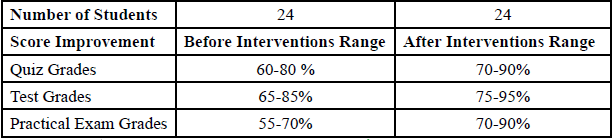
Project Data Table
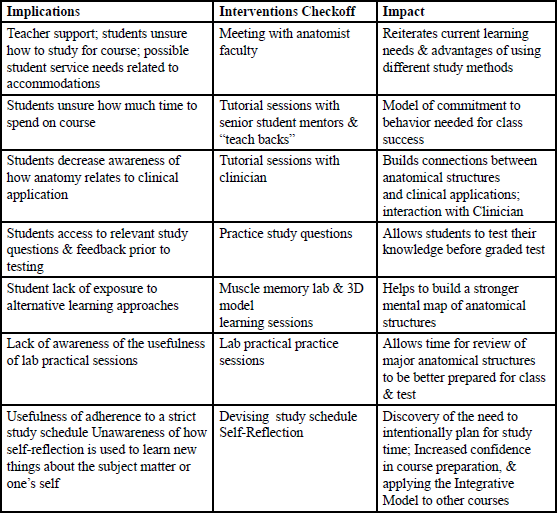
Feedback Debriefing Chart
Discussion
Developing good study habits will lead to classroom success. Applying and utilizing multiple leading approaches like auditory and kinesthetic methods along with visualization builds confidence in the student learner. Classroom teaching has to integrate ways to mold the student to use the different learning methods. The Model uses a creative form of integrating visual, auditory and kinesthetic (application) to orient the student to learn the 1) origins and insertions of muscles; 2) nerve innervations of muscles; 3) actions of the muscles. By successful application of this process, the student is ready to apply the functional aspects of Orthopedics, Neurological, and Differential Diagnosis. The understanding of pathology prepares the student for clinical application and treatment of the physical therapy plan of care.
Limitations
The report does acknowledge limitations to the case study. A small sample size was constrained to 24 participants within an Anatomy course. A self-reported class debriefing was used to determine if the interventions used helped to improve scores and understanding of course material which could include potential bias. And, as in any academic setting time restraints did play a role in meeting consistency with students due to other faculty meetings within the research design.
Conclusion
Prior experience in a laboratory setting could assist students with learning 3D anatomical concepts. Students could benefit from counseling related to anxiety management associated with higher education to assist with retention of information and to deal with cadaver dissection. The Integrative Model Approach allows students to understand that active, evidence-based learning strategies are more helpful than passive re-reading and highlighting material. While these methods have been found to be helpful, they can be integrated into other methods of studying. Students become aware that while learning a massive amount of information, they have to connect new information to previous learned foundational material in order to gain a good understanding of material.
For years, the debate continues on how to teach anatomy in the most effective way. Cadaver dissection has found to be the gold standard but is costly, time-consuming and a potentially hazardous approach that hinders the mental health of some students. It has been feasible and acceptable to transition into the integration of other forms of learning as mentioned in this study.
Anatomist Reflection:
Developing good study habits will lead to classroom success. Applying and utilizing multiple leading approaches like auditory and kinesthetic methods along with visualization builds confidence in the student learner. Classroom teaching has to integrate ways to mold the student to use the different learning methods. We use a creative form of integrating visual, auditory and kinesthetic (application) to orient the student to learn the: 1) Origins and Insertions of muscles; 2) Nerve innervations of the applicable muscles; 3) The actions of the muscles. By successful application of this process, the student is now ready to apply the functional aspects of Orthopedics, Neurological and Differential Diagnosis. The understanding of Pathology prepares the student for clinical application and treatment of the physical therapy student.
Student Reflections:
Taking Gross Anatomy last fall was one of my challenging courses but yet rewarding upon completion. Throughout the semester, I had to develop new study strategies to make sure that I understood and retained the information due to the large amount of detailed information about the human body, muscles, nerves, and functions. One of the most helpful methods for me was using the structured handouts breaking down each section which allowed me to organize and learn the key concepts better. Also, using visuals such as videos and the visible body application helped me extremely due to being a visual learner. It allowed me to interact with 3D models and view structures from different angles. One of the most impactful experiences in this course was working with the live models, specifically the cadavers. This hands-on learning experience helped with having real life application. Being able to physically observe and identify structures made the material more memorable. Along with that, using clay to build structures on mini skeletons was a creative and effective learning tool for me. This activity allowed me to actively engage with the material and reinforce my understanding by physically constructing muscles and their different functions and actions as well as placement. Overall, gross anatomy taught me not only the structure of the human body but also expanded my study methods. By combining visual, hands on, and other strategies I was able to succeed in this course. This experience has prepared me for future coursework as well as career.
Licensed Physical Therapist/Faculty Member Reflection
In order for students to use anatomy in patient clinical scenarios, they must be able to remember the function of each anatomical structure. This can be overwhelming, however, reinforcing and connecting pathology to anatomy prepares the student for clinical application and interventions. For example, lesions or injury to the Circle of Willis, the brachial plexus, the gastro-soleus complex, or spinal levels all tell a story into possible functional limitations and impairments. These concepts must be introduced, reinforced, and a level of mastery should occur in order for students to consistently use anatomy as a guide throughout their clinical practice. When tutoring Student Physical Therapist, repetition between anatomy and a structures function must be reinforced through reading, teach backs, discussion, case studies, and there must be time for this event of revelation to occur and develop in the mind of students.
Conflict of Interest:
The authors declare no conflicts of interest.
References
Estai, M., Bunt, S. (2016). Best teaching practices in anatomy education: A critical review, Annals of Anatomy, Anatomischer Anzeiger, Volume 208, p. 151-157, ISSN 0940-9602. View
Marcotte, K. M., & Gruppen, L. D. (2022). Competency- Based Education as Curriculum and Assessment for Integrative Learning. Education Sciences, 12(4), 267. View
Pascoe, M. A. (2026). Perception Gaps in Anatomical Competence: A Multi-Stakeholder Assessment Physical Therapy Graduate Preparedness and Clinical Capability. medRxiv 2026.03.06.26347754. View
Barber, J. P. (2012). Integration of learning: A grounded theory analysis of college students’ learning. American Educational Research Journal, 49(3), 590-617. View
Amin, A., & Iqbal, J. (2019). EFFECTIVE WAYS TO LEARN AND RETAIN GROSS ANATOMY. Pakistan Armed Forces Medical Journal, 69(3). View
Rangareddy, H., Govinda Swamy, K. S., S, A., & Petimani, M. S. (2025). Enhancing Student Engagement Through Active Teaching-Learning Approaches Among First-Year Medical Undergraduates. Cureus, 17(6), e85921. View
Gavin, C. F., Theibert, A. B. (2020). Learning & memory. In: Amthor FR, Theibert AB, Standaert DG, Roberson ED, eds. Essentials of Modern Neuroscience. McGraw Hill. View
Verma, A., Pasricha, N., Chaudhary, A., Bhatnagar, R., Sthapak, E., & Gaharwar, A. (2024). Interactive Quiz-Based Anatomy Teaching for Medical Undergraduate Students. Cureus, 16(1), e52353. View
Al-Aubaidy, H., Fernandez, R., Jency, T., Marcucci, J., Saini, N. (2019-2023). Adapting anatomy education: A comparative analysis of learning and academic outcomes across in-person, online, and blended instruction in a third-year anatomy subject. Translational Research in Anatomy. Volume 42,2026, 100458, ISSN 2214- 854X. View
Harrison, D., Lentz, J., Schmalz, N. et al. (2017). Peer-Based Anatomy Tutoring for First-Year Medical Students: an Analysis of Peer-Tutoring from the Tutors’ Perspective. Med.Sci.Educ. 27, 57–61. View
Dall’Alba, G. (2013). Learning Professional Ways of Being: Ambiguities of becoming. Educational Philosophy and Theory, 41(1), 34–45. View